
Deutsch-Chinesische Enzyklopädie, 德汉百科
 Nigeria
Algerien
Angola
Ecuador
Nigeria
Algerien
Angola
Ecuador
 Energieressource
 Finanz
 *Deutschland-Konjunkturdaten
Finanz
*Vereinigte Staaten-Konjunkturdaten
Finanz
*Vereinigtes Königreich-Konjunkturdaten
Finanz
*Japan-Konjunkturdaten
Finanz
*Europäische Union-Konjunkturdaten
Finanz
*China-Konjunkturdaten
Finanz
*Frankreich-Konjunkturdaten
Finanz
*Indien-Konjunkturdaten
Finanz
*Russland-Konjunkturdaten
Finanz
*Brasilien-Konjunkturdaten
Finanz
*Italien-Konjunkturdaten
Finanz
*Kanada-Konjunkturdaten
Finanz
*Indonesien-Konjunkturdaten
*Deutschland-Konjunkturdaten
Finanz
*Vereinigte Staaten-Konjunkturdaten
Finanz
*Vereinigtes Königreich-Konjunkturdaten
Finanz
*Japan-Konjunkturdaten
Finanz
*Europäische Union-Konjunkturdaten
Finanz
*China-Konjunkturdaten
Finanz
*Frankreich-Konjunkturdaten
Finanz
*Indien-Konjunkturdaten
Finanz
*Russland-Konjunkturdaten
Finanz
*Brasilien-Konjunkturdaten
Finanz
*Italien-Konjunkturdaten
Finanz
*Kanada-Konjunkturdaten
Finanz
*Indonesien-Konjunkturdaten
 Geographie
*Welt-Übersicht
Geographie
*Welt-Übersicht
 Hand in Hand
Irak
Iran
Kuwait
Libyen
Nigeria
OPEC
Republik Kongo
Saudi-Arabien
Venezuela
Vereinigte Arabische Emirate
Hand in Hand
Irak
Iran
Kuwait
Libyen
Nigeria
OPEC
Republik Kongo
Saudi-Arabien
Venezuela
Vereinigte Arabische Emirate
 Wichtige internationale Organisationen
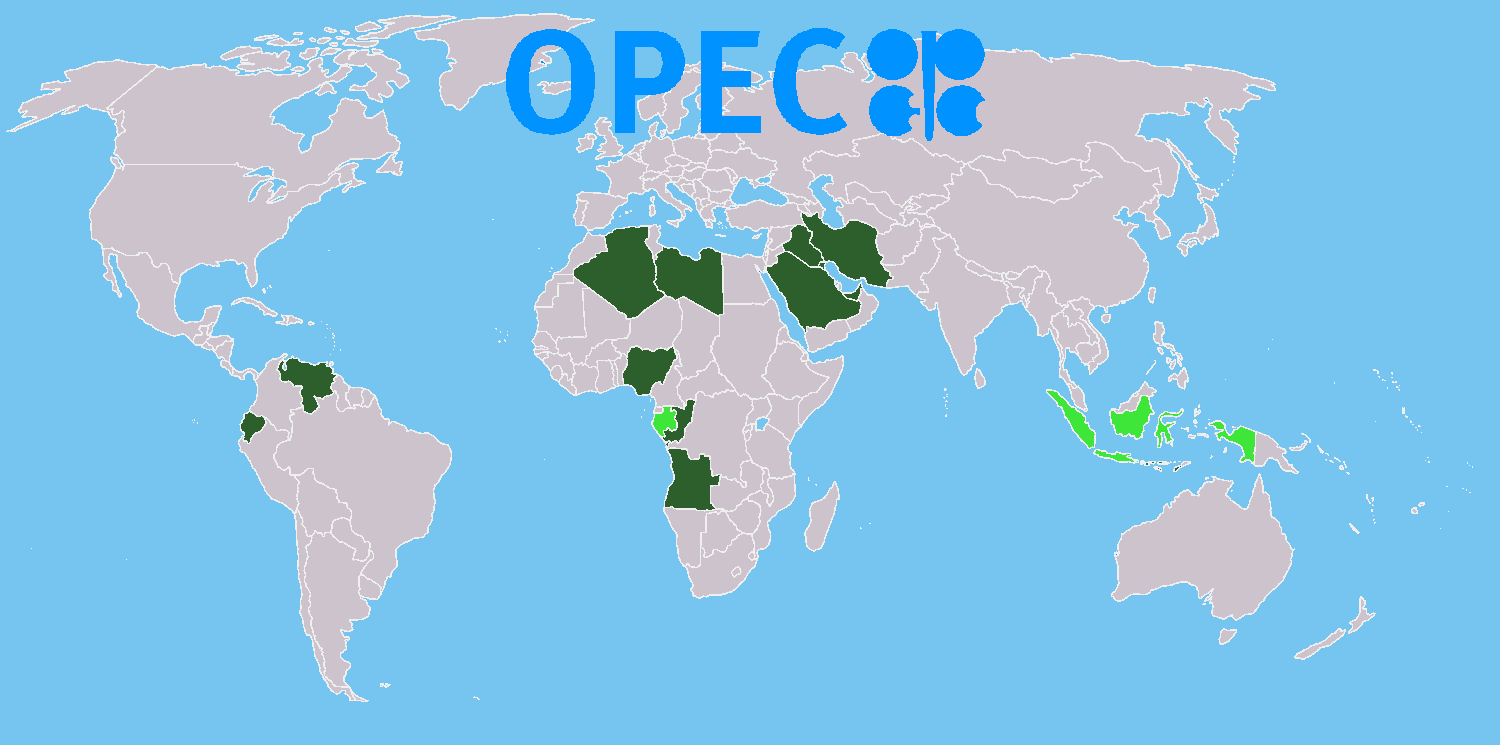
石油输出国组织(英语:Organization of the Petroleum Exporting Countries,OPEC,发音为/ˈoʊpɛk/ OH-pek;简称欧佩克、油盟或油组)是由伊朗、伊拉克、科威特、沙特阿拉伯和委内瑞拉五国为共同应对由英美主导的七姊妹跨国石油公司,并且维护石油这一稳定收入,而于1960年在巴格达成立的一个政府间组织。总部自1965年以来设于奥地利维也纳,截至2018年2月拥有14个成员国。2016年,14个国家估计占全球石油产量的44%,占全球探明石油储量的73%。这使得欧佩克可以对全球原油价格产生重大影响。
石油输出国组织的既定使命是“协调统一成员国的石油政策与价格、确保石油市场的稳定,以确保为石油消费国有效、经济而稳定的石油供应,为产油国提供适度的尊重和稳定的收入,为投资于石油行业的资本提供公平的回报。”[2]该组织也是国际石油市场信息的重要提供者。截至2017年5月,石油输出国组织(欧佩克)的成员除了前加入的五个外还包括阿尔及利亚(1969年加入)、阿拉伯联合酋长国(1967年加入)、安哥拉(2007年加入)、厄瓜多尔(1973年加入,1992年退出,2007年再加入)、赤道几内亚(2017年加入)、加蓬(1975年加入,1995年初退出,2016年再加入)、利比亚(1962年加入)、尼日利亚(1971年加入)、卡塔尔(1961年加入,2019年1月退出)、刚果共和国(2018年加入),而印尼则是其前成员(1962年加入,2008年底退出,2016年1月重新加入,同年12月再度退出)。沙特阿拉伯是该组织事实上的(英语:De facto)领导者。三分之二的石油输出国组织的石油产储量位于围绕富油波斯湾的六个中东国家。
Die Organisation erdölexportierender Länder (kurz OPEC, von englisch Organization of the Petroleum Exporting Countries) ist eine 1960 gegründete internationale Organisation mit Sitz in Wien. Derzeit gehören dem Kartell fünfzehn Staaten an: Algerien, Angola, Ecuador, Äquatorialguinea, Gabun, Iran, Irak, die Republik Kongo, Kuwait, Libyen, Nigeria, Katar, Saudi-Arabien, die Vereinigten Arabischen Emirate und Venezuela.[1] Indonesien ist Ende 2016 ausgetreten.
Fünf OPEC-Mitglieder (Saudi-Arabien, Iran, Kuwait, Venezuela, Vereinigte Arabischen Emirate) gehören zu den zehn größten Erdölförderern der Welt. Insgesamt fördern die OPEC-Mitgliedstaaten ungefähr 40 Prozent der weltweiten Erdölproduktion und verfügen über drei Viertel der weltweiten Erdölreserven. Nachdem einige Nicht-OPEC-Staaten ihr Ölfördermaximum überschritten haben, wird erwartet, dass der Einfluss der OPEC steigt. Andererseits stellen manche Experten (z. B. Matthew Simmons) die Angaben zu den Reserven in Frage, etwa die Saudi-Arabiens.
石油輸出国機構(せきゆゆしゅつこくきこう、英: Organization of the Petroleum Exporting Countries、略称:OPEC(日本語発音:オペックopec 、アメリカ英語発音:[ˈoʊpek] オウペク))は、国際石油資本などから石油産出国の利益を守ることを目的として、1960年9月14日に設立された組織である。設立当初は、イラン、イラク、クウェート、サウジアラビア、ベネズエラの5ヶ国を加盟国としていたものの、後に加盟国は増加し、2018年7月現在では15ヶ国が加盟している。世界最大のカルテルとされ、1970年代には石油の価格決定権を国際石油資本より奪い、2度のオイルショックを引き起こしたが、1986年からは石油価格の決定権は自由市場へと移ったこともあり、現在では価格統制力はそれほど強いものではない。なお、オーストリアは加盟国ではないものの、石油輸出国機構の本部は首都ウィーンに設置されている。
The Organization of the Petroleum Exporting Countries (OPEC, /ˈoʊpɛk/ OH-pek) is an intergovernmental organisation of 14 nations, founded in 1960 in Baghdad by the first five members (Iran, Iraq, Kuwait, Saudi Arabia, and Venezuela), and headquartered since 1965 in Vienna, Austria. As of September 2018, the then 15 member countries accounted for an estimated 44 percent of global oil production and 81.5 percent of the world's "proven" oil reserves, giving OPEC a major influence on global oil prices that were previously determined by the so called "Seven Sisters” grouping of multinational oil companies.
The stated mission of the organisation is to "coordinate and unify the petroleum policies of its member countries and ensure the stabilization of oil markets, in order to secure an efficient, economic and regular supply of petroleum to consumers, a steady income to producers, and a fair return on capital for those investing in the petroleum industry."[4] The organization is also a significant provider of information about the international oil market. The current OPEC members are the following: Algeria, Angola, Ecuador, Equatorial Guinea, Gabon, Iran, Iraq, Kuwait, Libya, Nigeria, the Republic of the Congo, Saudi Arabia (the de facto leader), United Arab Emirates, and Venezuela. Indonesia and Qatar are former members.
The formation of OPEC marked a turning point toward national sovereignty over natural resources, and OPEC decisions have come to play a prominent role in the global oil market and international relations. The effect can be particularly strong when wars or civil disorders lead to extended interruptions in supply. In the 1970s, restrictions in oil production led to a dramatic rise in oil prices and in the revenue and wealth of OPEC, with long-lasting and far-reaching consequences for the global economy. In the 1980s, OPEC began setting production targets for its member nations; generally, when the targets are reduced, oil prices increase. This has occurred most recently from the organization's 2008 and 2016 decisions to trim oversupply.
Economists often cite OPEC as a textbook example of a cartel that cooperates to reduce market competition, but one whose consultations are protected by the doctrine of state immunity under international law. In December 2014, "OPEC and the oil men" ranked as #3 on Lloyd's list of "the top 100 most influential people in the shipping industry".[5] However, the influence of OPEC on international trade is periodically challenged by the expansion of non-OPEC energy sources, and by the recurring temptation for individual OPEC countries to exceed production targets and pursue conflicting self-interests.
L'Organisation des pays exportateurs de pétrole (OPEP) (en anglais Organization of Petroleum Exporting Countries (OPEC)), est une organisation intergouvernementale (un cartel) de pays visant à négocier avec les sociétés pétrolières pour tout ce qui touche à la production de pétrole, son prix et les futurs droits de concession1. Depuis le 1er août 2016, le secrétaire général de l'OPEP est l'ancien patron de la compagnie nationale des hydrocarbures du Nigeria (NNPC) Mohammed Barkindo2.
L'Organizzazione dei Paesi esportatori di petrolio, meglio conosciuta come OPEC (Organization of the Petroleum Exporting Countries), fondata nel 1960, comprende dodici Paesi che si sono associati, formando un cartello economico, per negoziare con le compagnie petrolifere aspetti relativi alla produzione di petrolio, prezzi e concessioni. La sede dell'OPEC, dapprima stabilita a Ginevra, a partire dal 1º settembre 1965 è stata trasferita a Vienna.
Gli stati membri OPEC controllano circa il 78% delle riserve mondiali accertate di petrolio, il 50% di quelle di gas naturale e forniscono circa il 42% della produzione mondiale di petrolio ed il 17% di quella di gas naturale.[1] L'organizzazione parallela dell'OAPEC (Organizzazione dei Paesi Arabi Esportatori di Petrolio), fondata nel 1968 nel Kuwait, si occupa del coordinamento delle politiche energetiche dei paesi Arabi che fanno parte dell'OPEC.
La Organización de Países Exportadores de Petróleo (OPEP) es un organismo internacional fundado en Bagdad, Irak, en 1960. Actualmente lo conforman 15 países, de los cuales 5 son miembros fundadores (Arabia Saudita, Kuwait, Irán, Irak y Venezuela). Desde 1965 tiene sede en Viena, Austria. Constituido a iniciativa del Gobierno de Venezuela, presidido por Rómulo Betancourt, y el entonces presidente de Irak, Muhammad Najib ar-Ruba'i, en respuesta a la concentración de poder político y económico de los Estados Unidos como principal productor y consumidor de petróleo del mundo en el período de posguerra.
La OPEP "puede tener una gran influencia en el mercado de petróleo, especialmente si decide reducir o aumentar su nivel de producción".1 El 43% de la producción mundial de petróleo y el 81% de las reservas mundiales de petróleo se encuentran en países miembros de la OPEP.2 Su dominio en las exportaciones de crudo, para el tercer trimestre del año 2016, se sitúa en alrededor del 34,9%.3 Además, concentra la totalidad de la capacidad necesaria de producción de petróleo del mundo, lo que, de facto, convierte a la Organización de países exportadores de petróleo en el banco central del mercado petrolero.
La cuota de mercado de la organización aumentará en el futuro, ya que la Agencia Internacional de la Energía prevé que la producción de petróleo convencional de los países que no forman parte de la OPEP alcanzará su máximo alrededor de 2015.
La OPEP es una organización reconocida desde el 6 de noviembre de 1962 por la Organización de las Naciones Unidas (ONU), gracias a la resolución número 6.363.[cita requerida] La OPEP tuvo su sede en Ginebra (Suiza) entre 1960 y 1965, y después trasladó su sede a Viena, gracias a las facilidades que otorgó el gobierno austríaco.
Los estatutos de la OPEP establecen que su objetivo es coordinar y unificar las políticas petroleras entre los países miembros, con el fin de garantizar unos precios justos y estables para los productores de petróleo, el abastecimiento eficiente, económico y regular de petróleo a los países consumidores y un rendimiento justo del capital de los inversores.
Los países miembros lograron un significativo aumento del precio del petróleo, sobre todo en los años 1973, 1974 y 1979, y una mayor participación y control sobre la explotación realizada en sus territorios.
La OPEP vivió su primera ampliación en 30 años en enero de 2007 cuando Angola se convirtió de forma oficial en el duodécimo socio del grupo, tras pedir su ingreso en la reunión de la OPEP en Abuya (Nigeria) de diciembre de 2006 y haber sondeado al grupo en la reunión de Caracas (Venezuela) de ese mismo año.
A comienzos del año 2007 el gobierno de Ecuador anunció la posibilidad de regresar a la organización,4 hecho que se materializó finalmente en noviembre de ese mismo año.
Posteriormente, Indonesia suspendió su membresía nuevamente en 2016,5 luego de dos años de haber reingresado a la organización, tras su salida en 2008.
Recientemente, Gabón reingresó a la organización en el año 2016, luego de haber suspendido su membresía en el año 1995; mientras que Guinea Ecuatorial se unió por primera vez a la organización en mayo de 2017.6
Catar, uno de los productores de crudo más pequeños dentro de la Organización, ha anunciado su retiro del organismo para enero de 2019. Así lo dio a conocer su ministro de energía, Saad Sherida al-Kaabi, durante una rueda de prensa el lunes 3 de diciembre de 2018.7
Otros países productores de petróleo, aunque no son integrantes de la OPEP, como Sudán, México, Noruega, Rusia, Kazajistán, Omán y Egipto, participan regularmente como observadores en las reuniones ordinarias del grupo.
Организа́ция стран — экспортёров не́фти (англ. The Organization of the Petroleum Exporting Countries; сокращённо ОПЕ́К, англ. OPEC) — международная межправительственная организация, созданная нефтедобывающими странами в целях контроля квот добычи на нефть. Часто рассматривается как картель. В состав ОПЕК входят 15 стран[4]: Алжир, Ангола, Венесуэла, Габон, Иран, Ирак, Конго, Кувейт, Катар (с января 2019 выходит из альянса), Ливия, Объединённые Арабские Эмираты, Нигерия, Саудовская Аравия, Экваториальная Гвинея и Эквадор. Штаб-квартира расположена в Вене. Генеральный секретарь (с 01 августа 2016 г.) — Мохаммед Баркиндо.[5]
Страны члены ОПЕК контролируют около 2/3 мировых запасов нефти. На их долю приходится ~35 % от всемирной добычи или половина мирового экспорта нефти. Доказанные запасы нефти стран, входящих в ОПЕК, в настоящее время составляют 1199,71 миллиарда баррелей.
 Afghanistan
Ägypten
Albanien
Angola
Antigua und Barbuda
Argentinien
Armenien
Australien
Bahrain
Bangladesh
Barbados
Belgien
Belize
Benin
Bolivien
Botsuana
Brasilien
Brunei Darussalam
Bulgarien
Burkina Faso
Burundi
Chile
China
Columbia
Costa Rica
Côte d´Ivoire
Cuba
Dänemark
Demokratische Republik Kongo
Deutschland
Dominica
Dominikanische Republik
Dschibuti
Ecuador
Estland
Afghanistan
Ägypten
Albanien
Angola
Antigua und Barbuda
Argentinien
Armenien
Australien
Bahrain
Bangladesh
Barbados
Belgien
Belize
Benin
Bolivien
Botsuana
Brasilien
Brunei Darussalam
Bulgarien
Burkina Faso
Burundi
Chile
China
Columbia
Costa Rica
Côte d´Ivoire
Cuba
Dänemark
Demokratische Republik Kongo
Deutschland
Dominica
Dominikanische Republik
Dschibuti
Ecuador
Estland
 Europäische Union
Fidschi
Finanz
Finnland
Frankreich
Gabun
Gambia
Georgien
Ghana
Grenada
Griechenland
Guatemala
Guinea
Guinea-Bissau
Guyana
Honduras
Hongkong Tebiexingzhengqu-HK
Indien
Indonesien
Irland
Island
Israel
Italien
Jamaika
Japan
Jemen
Jordanien
Kambodscha
Kamerun
Kanada
Kap Verde
Kasachstan
Katar
Kenia
Kirgisistan
Kroatien
Kuwait
Laos
Lesotho
Lettland
Liberia
Liechtenstein
Litauen
Luxemburg
Macau Tebiexingzhengqu-MO
Madagaskar
Malawi
Malta
Marokko
Mauretanien
Mauritius
Mexiko
Moldawien
Europäische Union
Fidschi
Finanz
Finnland
Frankreich
Gabun
Gambia
Georgien
Ghana
Grenada
Griechenland
Guatemala
Guinea
Guinea-Bissau
Guyana
Honduras
Hongkong Tebiexingzhengqu-HK
Indien
Indonesien
Irland
Island
Israel
Italien
Jamaika
Japan
Jemen
Jordanien
Kambodscha
Kamerun
Kanada
Kap Verde
Kasachstan
Katar
Kenia
Kirgisistan
Kroatien
Kuwait
Laos
Lesotho
Lettland
Liberia
Liechtenstein
Litauen
Luxemburg
Macau Tebiexingzhengqu-MO
Madagaskar
Malawi
Malta
Marokko
Mauretanien
Mauritius
Mexiko
Moldawien
 Mongolei
Montenegro
Mosambik
Myanmar
Namibia
Nepal
Neuseeland
Nicaragua
Niederlande
Niger
Nigeria
Nordmazedonien
Norwegen
Oman
Österreich
Pakistan
Panama
Papua-Neuguinea
Paraguay
Peru
Philippinen
Polen
Portugal
Republik El Salvador
Republik Haiti
Republik Kongo
Republik Korea
Ruanda
Rumänien
Russland
Salomonen
Sambia
Samoa
Saudi-Arabien
Schweden
Schweden
Schweiz
Genf
Senegal
Seychellen
Sierra Leone
Simbabwe
Singapur
Slowakei
Slowenien
Spanien
Sri Lanka
St. Kitts und Nevis
St. Lucia
St. Vincent und die Grenadinen
Südafrika
Suriname
Swasiland
Tadschikistan
Taiwan Sheng-TW
Tansania
Thailand
Togo
Tonga
Trinidad und Tobago
Tschad
Tschechien
Tunesien
Türkei
Uganda
Ukraine
Ungarn
Uruguay
Vanuatu
Venezuela
Vereinigte Arabische Emirate
Vereinigte Staaten
Vereinigtes Königreich
Vietnam
Wichtige internationale Organisationen
World Trade Organization
Roberto Azevêdo
World Trade Organization
Mike Moore
World Trade Organization
Ngozi Okonjo-Iweala
World Trade Organization
Pascal Lamy
World Trade Organization
Peter Sutherland
World Trade Organization
Renato Ruggiero
World Trade Organization
Supachai Panitchpakdi
Zentralafrikanische Republik
Zypern
Mongolei
Montenegro
Mosambik
Myanmar
Namibia
Nepal
Neuseeland
Nicaragua
Niederlande
Niger
Nigeria
Nordmazedonien
Norwegen
Oman
Österreich
Pakistan
Panama
Papua-Neuguinea
Paraguay
Peru
Philippinen
Polen
Portugal
Republik El Salvador
Republik Haiti
Republik Kongo
Republik Korea
Ruanda
Rumänien
Russland
Salomonen
Sambia
Samoa
Saudi-Arabien
Schweden
Schweden
Schweiz
Genf
Senegal
Seychellen
Sierra Leone
Simbabwe
Singapur
Slowakei
Slowenien
Spanien
Sri Lanka
St. Kitts und Nevis
St. Lucia
St. Vincent und die Grenadinen
Südafrika
Suriname
Swasiland
Tadschikistan
Taiwan Sheng-TW
Tansania
Thailand
Togo
Tonga
Trinidad und Tobago
Tschad
Tschechien
Tunesien
Türkei
Uganda
Ukraine
Ungarn
Uruguay
Vanuatu
Venezuela
Vereinigte Arabische Emirate
Vereinigte Staaten
Vereinigtes Königreich
Vietnam
Wichtige internationale Organisationen
World Trade Organization
Roberto Azevêdo
World Trade Organization
Mike Moore
World Trade Organization
Ngozi Okonjo-Iweala
World Trade Organization
Pascal Lamy
World Trade Organization
Peter Sutherland
World Trade Organization
Renato Ruggiero
World Trade Organization
Supachai Panitchpakdi
Zentralafrikanische Republik
Zypern

世界贸易组织(简称世贸组织或世贸;英语:World Trade Organization,缩写为 WTO;法语:Organisation Mondiale du Commerce,缩写为 OMC;西班牙语:Organización Mundial del Comercio,缩写为 OMC)是负责监督成员经济体之间各种贸易协议得到执行的一个国际组织,前身是1948年起实施的关税及贸易总协定的秘书处。
世贸总部位于瑞士日内瓦,现任总干事是罗伯托·阿泽维多。截至2016年7月29日,世界贸易组织共有164个成员。[5]世界贸易组织的职能是调解纷争,加入WTO不算签订一种多边贸易协议,但其设置的入会门槛可以做为愿意降低关税、法政上配合、参与国际贸易的门票,它是贸易体制的组织基础和法律基础,是众多贸易协定的管理者,是各成员贸易立法的监督者,是就贸易提供解决争端和进行谈判的场所。该机构是当代最重要的国际经济组织之一,其成员间的贸易额占世界贸易额的绝大多数,被称为“经济联合国”。
Die Welthandelsorganisation (englisch World Trade Organization, WTO; französisch Organisation mondiale du commerce, OMC; spanisch Organización Mundial de Comercio, OMC) ist eine internationale Organisation mit Sitz in Genf, die sich mit der Regelung von Handels- und Wirtschaftsbeziehungen beschäftigt. Sie wurde am 15. April 1994 aus dem General Agreement on Tariffs and Trade (GATT) in der Uruguay-Runde nach siebenjähriger Verhandlungszeit gegründet. Am 1. Januar 1995 nahm sie ihre Arbeit in Genf auf. Die WTO ist neben dem IWF und der Weltbank eine der zentralen internationalen Organisationen, die Handels- und Wirtschaftspolitik mit globaler Reichweite verhandelt.
世界貿易機関(せかいぼうえききかん、英: World Trade Organization、略称:WTO)は、自由貿易促進を主たる目的として創設された国際機関である。常設事務局がスイスのジュネーブに置かれている。
GATT(ガット)ウルグアイ・ラウンドにおける合意によって、世界貿易機関を設立するマラケシュ協定(WTO設立協定)に基づいて1995年1月1日にGATTを発展解消させて成立した。
本来GATTは、第二次世界大戦後の安定を見据え、国際通貨基金および国際復興開発銀行とともに設立が予定されていた国際貿易機関(ITO)の設立準備の際に、暫定協定として結ばれたものであった。国際貿易機関の設立が廃案となり、GATTがその代替として発展強化されていくうちに、再びこの分野の常設機関が求められ、WTOが設立されることとなった。発展解消であるため、GATTの事務局及び事務局長もWTOへと引き継がれることとなった[4]。
WTOはGATTを継承したものであるが、GATTが協定(Agreement)に留まったのに対し、WTOは機関(Organization)であるのが根本的な違いである。
を基本原則としている。また、物品貿易だけでなく金融、情報通信、知的財産権やサービス貿易も含めた包括的な国際通商ルールを協議する場である。
対抗処置の発動では、紛争処理機関(パネル)の提訴に対し全加盟国による反対がなければ採択されるというネガティブ・コンセンサス方式(逆コンセンサス方式)を採用した強力な紛争処理能力を持つ。これは国際組織としては稀な例であり、コンセンサス方式を採っていたGATTとの大きな違いで、WTOの特徴の一つといえる。
新多角的貿易交渉(新ラウンド)は、2001年11月にカタールのドーハで行われた第4回WTO閣僚会議で開始を決定し、ドーハ・ラウンドと呼ばれていた。2002年2月1日の貿易交渉委員会で新ラウンドがスタートした。しかし9年に及ぶ交渉は先進国と、急速に台頭してきたBRICsなど新興国との対立によって中断と再開を繰り返した末、ジュネーブで行われた第4回WTO閣僚会議(2011年12月17日)で「交渉を継続していくことを確認するものの、近い将来の妥結を断念する」(議長総括)となり事実上停止状態になった。
その後、2013年のバリ島における閣僚会議で、貿易円滑化協定を含む合意が成立し、2014年7月まで貿易円滑化協定をWTO協定に加える(附属書1Aに追加)するための文書を一般理事会で採択すべきとされた[5]。しかしインドが合意を蒸し返す状態で反対したため期限までに採択できなかった[6]。その後食糧備蓄への補助金の問題で先進国側が譲歩することでようやくインドが合意し、2014年11月27日の一般理事会で貿易円滑化協定が採択された[6]。WTO加盟国の3分の2が改正を受諾した日に発効することになっており、2017年2月22日にこの要件を満たし、協定が発効した。
The World Trade Organization (WTO) is an intergovernmental organization that regulates international trade. The WTO officially commenced on 1 January 1995 under the Marrakesh Agreement, signed by 124 nations on 15 April 1994, replacing the General Agreement on Tariffs and Trade (GATT), which commenced in 1948. It is the largest international economic organization in the world.[5][6]
The WTO deals with regulation of trade in goods, services and intellectual property between participating countries by providing a framework for negotiating trade agreements and a dispute resolution process aimed at enforcing participants' adherence to WTO agreements, which are signed by representatives of member governments[7]:fol.9–10 and ratified by their parliaments.[8] The WTO prohibits discrimination between trading partners, but provides exceptions for environmental protection, national security, and other important goals.[9] Trade-related disputes are resolved by independent judges at the WTO through a dispute resolution process.[9]
The WTO's current Director-General is Roberto Azevêdo,[10][11] who leads a staff of over 600 people in Geneva, Switzerland.[12] A trade facilitation agreement, part of the Bali Package of decisions, was agreed by all members on 7 December 2013, the first comprehensive agreement in the organization's history.[13][14] On 23 January 2017, the amendment to the WTO Trade Related Aspects of Intellectual Property Rights (TRIPS) Agreement marks the first time since the organization opened in 1995 that WTO accords have been amended, and this change should secure for developing countries a legal pathway to access affordable remedies under WTO rules.[15]
Studies show that the WTO boosted trade,[16][17][9] and that barriers to trade would be higher in the absence of the WTO.[18] The WTO has highly influenced the text of trade agreements, as "nearly all recent [preferential trade agreements (PTAs)] reference the WTO explicitly, often dozens of times across multiple chapters... in many of these same PTAs we find that substantial portions of treaty language—sometime the majority of a chapter—is copied verbatim from a WTO agreement."[19]
L'Organisation mondiale du commerce (OMC ; en anglais : World Trade Organization, WTO, en espagnol : Organización Mundial del Comercio, OMC) est une organisation internationale qui s'occupe des règles régissant le commerce international entre les pays. Au cœur de l'organisation se trouvent les accords de l'OMC, négociés et signés en avril 1994 à Marrakech1 par la majeure partie des puissances commerciales du monde2 et ratifiés par leurs assemblées parlementaires. L'OMC a pour but principal de favoriser l'ouverture commerciale. Pour cela, elle tâche de réduire les obstacles au libre-échange, d'aider les gouvernements à régler leurs différends commerciaux et d'assister les exportateurs, les importateurs et les producteurs de marchandises et de services dans leurs activités.
Depuis 2001, le cycle de négociation mené par l'OMC est le Cycle de Doha3. Bien que l'OMC ne soit pas une agence spécialisée de l'ONU, elle entretient des liens avec cette dernière4. Le siège de l'OMC est au Centre William-Rappard, à Genève. Depuis le 1er septembre 2013, l'organisation est présidée par le Brésilien Roberto Azevêdo qui a été élu directeur général.
L'Organizzazione mondiale del commercio, abbreviato in OMC (in inglese: World Trade Organization, WTO), è un'organizzazione internazionale creata allo scopo di supervisionare numerosi accordi commerciali tra gli stati membri. Vi aderiscono[3] 164 Paesi, a cui se ne aggiungono altri 22 con ruolo di osservatori,[4] comprendendo così oltre il 95% del commercio mondiale di beni e servizi.[5]
La sede dell'OMC si trova, dal 1995, presso il Centro William Rappard a Ginevra, Svizzera.[6]
La Organización Mundial del Comercio (OMC) fue establecida en 1995. Tiene su sede en Ginebra, Suiza, y sus idiomas oficiales son el inglés, el francés y el español. La OMC no forma parte del sistema de las Naciones Unidas, y tampoco de los organismos de Bretton Woods como el Banco Mundial o el FMI.Nota 1
Всеми́рная торго́вая организа́ция (ВТО; англ. World Trade Organization (WTO), фр. Organisation mondiale du commerce (OMC), исп. Organización Mundial del Comercio) — международная организация, созданная 1 января 1995 года с целью либерализации международной торговли и регулирования торгово-политических отношений государств-членов. ВТО образована на основе Генерального соглашения по тарифам и торговле (ГАТТ), заключенного в 1947 году и на протяжении почти 50 лет фактически выполнявшего функции международной организации, но не являвшегося тем не менее международной организацией в юридическом смысле.
ВТО отвечает за разработку и внедрение новых торговых соглашений, а также следит за соблюдением членами организации всех соглашений, подписанных большинством стран мира и ратифицированных их парламентами. ВТО строит свою деятельность, исходя из решений, принятых в 1986—1994 годах в рамках Уругвайского раунда и более ранних договоренностей ГАТТ. Обсуждения проблем и принятие решений по глобальным проблемам либерализации и перспективам дальнейшего развития мировой торговли проходят в рамках многосторонних торговых переговоров (раунды). К настоящему времени проведено 8 раундов таких переговоров, включая Уругвайский, а в 2001 году стартовал девятый в Дохе, Катар. Организация пытается завершить переговоры по Дохийскому раунду переговоров, который был начат с явным акцентом на удовлетворение потребностей развивающихся стран. По состоянию на декабрь 2012 года будущее раунда переговоров в Дохе остаётся неопределённым: программа работы состоит из 21 части, а первоначально установленный окончательный срок 1 января 2005 года был давно пропущен[3]. В ходе переговоров возник конфликт между стремлением к свободной торговле и стремлением множества стран к протекционизму, особенно в плане сельскохозяйственных субсидий. До сих пор эти препятствия остаются главными и мешают любому прогрессу для запуска новых переговоров в рамках Дохийского раунда. По состоянию на июль 2012 года, существуют различные группы переговоров в системе ВТО для решения текущих вопросов в плане сельского хозяйства, что приводит к застою в самих переговорах[4].
Штаб-квартира ВТО расположена в Женеве, Швейцария. Глава ВТО (генеральный директор) — Роберту Карвалью ди Азеведу, в штате самой организации около 600 человек[5].
На 26 апреля 2015 года в ВТО состояли 162 страны[6].
Правила ВТО предусматривают ряд льгот для развивающихся стран. В настоящее время развивающиеся страны — члены ВТО имеют (в среднем) более высокий относительный уровень таможенно-тарифной защиты своих рынков по сравнению с развитыми. Тем не менее, в абсолютном выражении общий размер таможенно-тарифных санкций в развитых странах гораздо выше, вследствие чего доступ на рынки высокопередельной продукции из развивающихся стран серьёзно ограничен[7].
Правила ВТО регулируют только торгово-экономические вопросы. Попытки США и ряда европейских стран начать дискуссию об условиях труда (что позволило бы считать недостаточную законодательную защиту работников конкурентным преимуществом) были отвергнуты из-за протестов развивающихся стран, которые утверждали, что такие меры только ухудшат благосостояние работников в связи с сокращением числа рабочих мест, снижением доходов и уровня конкурентоспособности[7].
Mitglieder der WTO
| Staat | Beitrittsdatum |
|---|---|
 Ägypten Ägypten |
30. Juni 1995 |
 Afghanistan Afghanistan |
29. Juli 2016 |
 Albanien Albanien |
8. September 2000 |
 Angola Angola |
23. November 1996 |
 Antigua und Barbuda Antigua und Barbuda |
1. Januar 1995 |
 Argentinien Argentinien |
1. Januar 1995 |
 Armenien Armenien |
5. Februar 2003 |
 Australien Australien |
1. Januar 1995 |
 Bahrain Bahrain |
1. Januar 1995 |
 Bangladesch Bangladesch |
1. Januar 1995 |
 Barbados Barbados |
1. Januar 1995 |
 Belgien Belgien |
1. Januar 1995 |
 Belize Belize |
1. Januar 1995 |
 Benin Benin |
22. Februar 1996 |
 Bolivien Bolivien |
12. September 1995 |
 Botswana Botswana |
31. Mai 1995 |
 Brasilien Brasilien |
1. Januar 1995 |
 Brunei Brunei |
1. Januar 1995 |
 Bulgarien Bulgarien |
1. Dezember 1996 |
 Burkina Faso Burkina Faso |
3. Juni 1995 |
 Burundi Burundi |
23. Juli 1995 |
 Chile Chile |
1. Januar 1995 |
 Volksrepublik China Volksrepublik China |
11. Dezember 2001 |
 Costa Rica Costa Rica |
1. Januar 1995 |
 Dänemark Dänemark |
1. Januar 1995 |
 Deutschland Deutschland |
1. Januar 1995 |
 Dominica Dominica |
1. Januar 1995 |
 Dominikanische Republik Dominikanische Republik |
9. März 1995 |
 Dschibuti Dschibuti |
31. Mai 1995 |
 Ecuador Ecuador |
21. Januar 1996 |
 El Salvador El Salvador |
7. Mai 1995 |
 Elfenbeinküste Elfenbeinküste |
1. Januar 1995 |
 Estland Estland |
13. November 1999 |
 Eswatini Eswatini |
1. Januar 1995 |
 Europäische Union Europäische Union |
1. Januar 1995 |
 Fidschi Fidschi |
14. Januar 1996 |
 Finnland Finnland |
1. Januar 1995 |
 Frankreich Frankreich |
1. Januar 1995 |
 Gabun Gabun |
1. Januar 1995 |
 Gambia Gambia |
23. Oktober 1996 |
 Georgien Georgien |
14. Juni 2000 |
 Ghana Ghana |
1. Januar 1995 |
 Grenada Grenada |
22. Februar 1996 |
 Griechenland Griechenland |
1. Januar 1995 |
 Guatemala Guatemala |
21. Juli 1995 |
 Guinea Guinea |
25. Oktober 1995 |
 Guinea-Bissau Guinea-Bissau |
31. Mai 1995 |
 Guyana Guyana |
1. Januar 1995 |
 Haiti Haiti |
30. Januar 1996 |
 Honduras Honduras |
1. Januar 1995 |
 Hongkong Hongkong |
1. Januar 1995 |
 Indien Indien |
1. Januar 1995 |
 Indonesien Indonesien |
1. Januar 1995 |
 Irland Irland |
1. Januar 1995 |
 Island Island |
1. Januar 1995 |
 Israel Israel |
21. April 1995 |
 Italien Italien |
1. Januar 1995 |
 Jamaika Jamaika |
9. März 1995 |
 Jemen Jemen |
26. Juni 2014 |
 Japan Japan |
1. Januar 1995 |
 Jordanien Jordanien |
11. April 2000 |
 Kambodscha Kambodscha |
13. Oktober 2004 |
 Kamerun Kamerun |
13. Dezember 1995 |
 Kanada Kanada |
1. Januar 1995 |
 Kap Verde Kap Verde |
23. Juli 2008 |
 Kasachstan Kasachstan |
30. November 2015 |
 Katar Katar |
13. Januar 1996 |
 Kenia Kenia |
1. Januar 1995 |
 Kirgisistan Kirgisistan |
20. Dezember 1998 |
 Kolumbien Kolumbien |
30. April 1995 |
 Demokratische Republik Kongo Demokratische Republik Kongo |
1. Januar 1997 |
 Republik Kongo Republik Kongo |
27. März 1997 |
 Kroatien Kroatien |
30. November 2000 |
 Kuba Kuba |
20. April 1995 |
 Kuwait Kuwait |
1. Januar 1995 |
 Laos Laos |
2. Februar 2013 |
 Lesotho Lesotho |
31. Mai 1995 |
 Lettland Lettland |
10. Februar 1999 |
 Liberia Liberia |
14. Juli 2016 |
 Liechtenstein Liechtenstein |
1. September 1995 |
 Litauen Litauen |
31. Mai 2001 |
 Luxemburg Luxemburg |
1. Januar 1995 |
 Macau Macau |
1. Januar 1995 |
 Madagaskar Madagaskar |
17. November 1995 |
 Montenegro Montenegro |
29. April 2012 |
 Malawi Malawi |
31. Mai 1995 |
 Malaysia Malaysia |
1. Januar 1995 |
 Malediven Malediven |
31. Mai 1995 |
 Mali Mali |
31. Mai 1995 |
 Malta Malta |
1. Januar 1995 |
 Marokko Marokko |
1. Januar 1995 |
 Mauretanien Mauretanien |
31. Mai 1995 |
 Mauritius Mauritius |
1. Januar 1995 |
 Nordmazedonien Nordmazedonien |
4. April 2003 |
 Mexiko Mexiko |
1. Januar 1995 |
 Moldau Moldau |
26. Juli 2001 |
 Mongolei Mongolei |
29. Januar 1997 |
 Mosambik Mosambik |
26. August 1995 |
 Myanmar Myanmar |
1. Januar 1995 |
 Namibia Namibia |
1. Januar 1995 |
 Nepal Nepal |
23. April 2004 |
 Neuseeland Neuseeland |
1. Januar 1995 |
 Nicaragua Nicaragua |
3. September 1995 |
 Niederlande Niederlande |
1. Januar 1995 |
 Niger Niger |
13. Dezember 1996 |
 Nigeria Nigeria |
1. Januar 1995 |
 Norwegen Norwegen |
1. Januar 1995 |
 Oman Oman |
9. November 2000 |
 Österreich Österreich |
1. Januar 1995 |
 Pakistan Pakistan |
1. Januar 1995 |
 Panama Panama |
6. September 1997 |
 Papua-Neuguinea Papua-Neuguinea |
9. Juni 1996 |
 Paraguay Paraguay |
1. Januar 1995 |
 Peru Peru |
1. Januar 1995 |
 Philippinen Philippinen |
1. Januar 1995 |
 Polen Polen |
1. Juli 1995 |
 Portugal Portugal |
1. Januar 1995 |
 Ruanda Ruanda |
22. Mai 1996 |
 Rumänien Rumänien |
1. Januar 1995 |
 Russland Russland |
22. August 2012 |
 Salomonen Salomonen |
26. Juli 1996 |
 Sambia Sambia |
1. Januar 1995 |
 Saudi-Arabien Saudi-Arabien |
11. Dezember 2005 |
 Samoa Samoa |
10. Mai 2012 |
 Schweden Schweden |
1. Januar 1995 |
 Schweiz Schweiz |
1. Januar 1995 |
 Senegal Senegal |
1. Januar 1995 |
 Seychellen Seychellen |
26. April 2015 |
 Sierra Leone Sierra Leone |
23. Juli 1995 |
 Simbabwe Simbabwe |
5. März 1995 |
 Singapur Singapur |
1. Januar 1995 |
 Slowakei Slowakei |
1. Januar 1995 |
 Slowenien Slowenien |
30. Juli 1995 |
 Spanien Spanien |
1. Januar 1995 |
 Sri Lanka Sri Lanka |
1. Januar 1995 |
 St. Kitts und Nevis St. Kitts und Nevis |
21. Februar 1996 |
 St. Lucia St. Lucia |
1. Januar 1995 |
 St. Vincent und die Grenadinen St. Vincent und die Grenadinen |
1. Januar 1995 |
 Südafrika Südafrika |
1. Januar 1995 |
 Südkorea Südkorea |
1. Januar 1995 |
 Suriname Suriname |
1. Januar 1995 |
 Tadschikistan Tadschikistan |
2. März 2013 |
 Taiwan[1] Taiwan[1] |
1. Januar 2002 |
 Tansania Tansania |
1. Januar 1995 |
 Thailand Thailand |
1. Januar 1995 |
 Togo Togo |
31. Mai 1995 |
 Tonga Tonga |
27. Juli 2007 |
 Trinidad und Tobago Trinidad und Tobago |
1. März 1995 |
 Tschad Tschad |
19. Oktober 1996 |
 Tschechien Tschechien |
1. Januar 1995 |
 Tunesien Tunesien |
29. März 1995 |
 Türkei Türkei |
26. März 1995[2] |
 Uganda Uganda |
1. Januar 1995 |
 Ukraine Ukraine |
16. Mai 2008 |
 Ungarn Ungarn |
1. Januar 1995 |
 Uruguay Uruguay |
1. Januar 1995 |
 Venezuela Venezuela |
1. Januar 1995 |
 Vereinigte Arabische Emirate Vereinigte Arabische Emirate |
10. April 1996 |
 Vereinigtes Königreich Vereinigtes Königreich |
1. Januar 1995 |
 Vereinigte Staaten Vereinigte Staaten |
1. Januar 1995 |
 Vanuatu Vanuatu |
24. August 2012 |
 Vietnam Vietnam |
11. Januar 2007 |
 Zentralafrikanische Republik Zentralafrikanische Republik |
31. Mai 1995 |
 Zypern Zypern |
30. Juli 1995 |


 FIFA Fussball-Weltmeisterschaft 2014
 FIFA Fussball-Weltmeisterschaft 2018
Gruppe-D
FIFA-Konföderationen-Pokal 2013
Nigeria
FIFA Fussball-Weltmeisterschaft 2018
Gruppe-D
FIFA-Konföderationen-Pokal 2013
Nigeria
 Sport
(F)FIFA-Konföderationen-Pokal
Sport
(F)Fußball-Afrikameisterschaft
Sport
(F)Fußball bei den Olympischen Spielen
Sport
(F)FIFA-Konföderationen-Pokal
Sport
(F)Fußball-Afrikameisterschaft
Sport
(F)Fußball bei den Olympischen Spielen

 Internationale Städte
 Architektur
 Religion


阿布贾国家清真寺,亦称尼日利亚国家清真寺,是尼日利亚的国家清真寺。尼日利亚大量人口信奉伊斯兰教。该清真寺建于1984年,[2]除集会活动时间外,也对非伊斯兰教徒开放。
Die Nigerianische Nationalmoschee ist eine Moschee in der nigerianischen Hauptstadt Abuja.
Die Moschee wurde 1984 im Zuge der Errichtung der Planhauptstadt Abuja erbaut. Sie sollte sich nach den Vorstellungen der Stadtplaner im „kulturellen Sektor“ der Stadt befinden und im annähernd symmetrisch konzipierten Stadtzentrum an der Independence Avenue der ökumenischen Kathedrale gegenüberstehen, die allerdings erst 16 Jahre nach Baubeginn im Oktober 2005 eingeweiht wurde.
Die Nationalmoschee prägt mit ihrer goldenen Kuppel und den vier hohen Minaretten das Stadtbild von Abuja. Zur Moschee gehören eine Gebetshalle, eine Bibliothek, ein Konferenzsaal und eine religiöse Schule.
*Politisches System des Vereinigten Königreichs
Antigua und Barbuda
Australien
Bahamas
Bangladesh
Barbados
Belize
Botsuana
Brunei Darussalam
Commonwealth of Nations
Dominica
 Geschichte
M 1500 - 2000 nach Christus
Geschichte des Vereinigten Königreichs
Ghana
Grenada
Guyana
Indien
Jamaika
Kamerun
Kanada
Kenia
Kiribati
Lesotho
Malawi
Malaysia
Malediven
Malta
Mosambik
Namibia
Nauru
Neuseeland
Nigeria
Pakistan
Papua-Neuguinea
Salomonen
Sambia
Samoa
Seychellen
Sierra Leone
Singapur
Sri Lanka
St. Kitts und Nevis
St. Vincent und die Grenadinen
Südafrika
Swasiland
Tansania
Tonga
Trinidad und Tobago
Tuvalu
Uganda
Vanuatu
Vereinigtes Königreich
Wichtige internationale Organisationen
Zypern
Geschichte
Geschichte
M 1500 - 2000 nach Christus
Geschichte des Vereinigten Königreichs
Ghana
Grenada
Guyana
Indien
Jamaika
Kamerun
Kanada
Kenia
Kiribati
Lesotho
Malawi
Malaysia
Malediven
Malta
Mosambik
Namibia
Nauru
Neuseeland
Nigeria
Pakistan
Papua-Neuguinea
Salomonen
Sambia
Samoa
Seychellen
Sierra Leone
Singapur
Sri Lanka
St. Kitts und Nevis
St. Vincent und die Grenadinen
Südafrika
Swasiland
Tansania
Tonga
Trinidad und Tobago
Tuvalu
Uganda
Vanuatu
Vereinigtes Königreich
Wichtige internationale Organisationen
Zypern
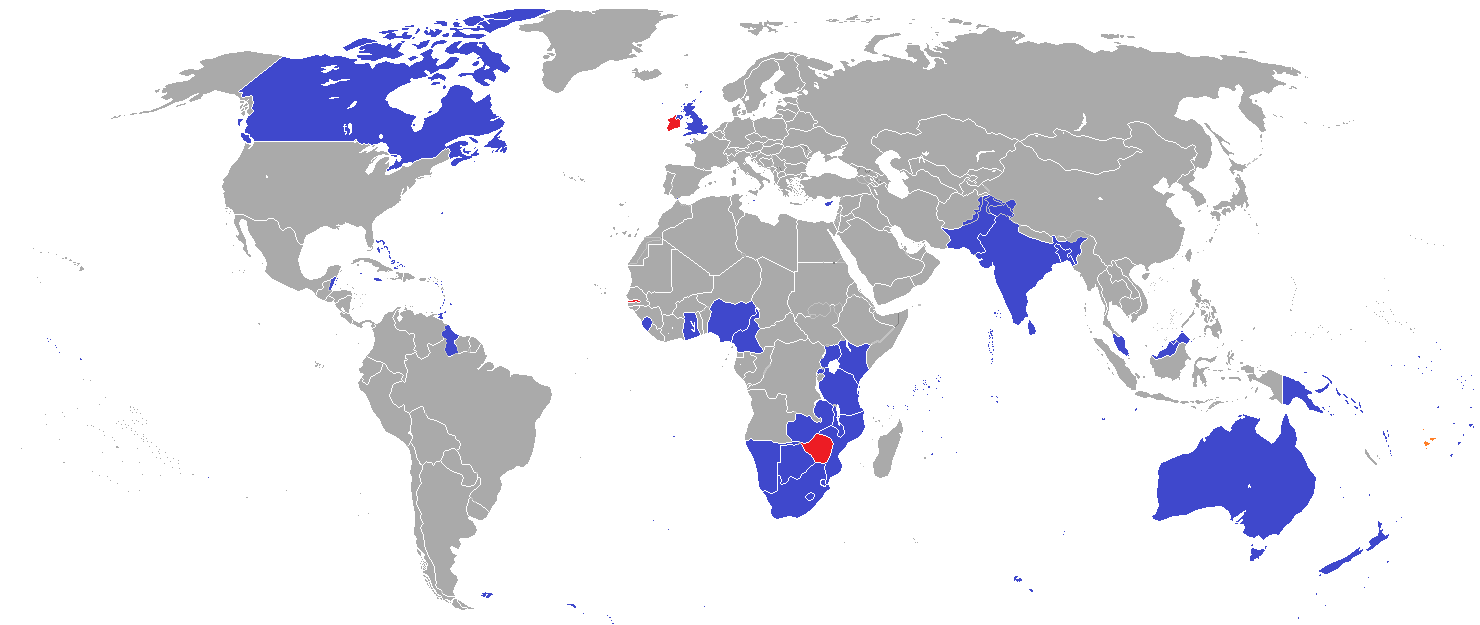
英联邦(英语:Commonwealth of Nations,新马作共和联邦,台湾作大英国协),是一个现代的国际组织,由56个英语系的主权国家联合而成。
英联邦不是一个统一的联邦国家,而是一个国际组织,英联邦也无权约束旗下任何成员国内政。英联邦元首通常由英国君主兼任,其首任元首是乔治六世,现任是查尔斯三世,但元首并无实权,秘书长才是英联邦实际上的掌权者[4][5]。该组织的成员国基本由英国及其旧殖民地组成,也以英式英语为共通语言,但英国的地位并没有凌驾于他国之上,所有成员国一律平等。目前英联邦有56个成员国,其中15个属于英联邦王国,英联邦王国的国家元首、英联邦元首均和英国的一致,即现在的查尔斯三世;另外5个属于独立君主国,它们不以英国君主为自己的元首,而是自立君主,这五国是文莱、斯威士兰、莱索托、马来西亚、汤加;其余的36个均属于共和国,没有君主。
The Commonwealth of Nations, generally known simply as the Commonwealth,[3] is a political association of 53 member states, nearly all of them former territories of the British Empire.[4] The chief institutions of the organisation are the Commonwealth Secretariat, which focuses on intergovernmental aspects, and the Commonwealth Foundation, which focuses on non-governmental relations between member states.[5]
The Commonwealth dates back to the first half of the 20th century with the decolonisation of the British Empire through increased self-governance of its territories. It was originally created as the British Commonwealth of Nations[6] through the Balfour Declaration at the 1926 Imperial Conference, and formalised by the United Kingdom through the Statute of Westminster in 1931. The current Commonwealth of Nations was formally constituted by the London Declaration in 1949, which modernised the community and established the member states as "free and equal".[7]
The human symbol of this free association is the Head of the Commonwealth, currently Queen Elizabeth II, and the 2018 Commonwealth Heads of Government Meeting appointed Charles, Prince of Wales to be her designated successor, although the position is not technically hereditary. The Queen is the head of state of 16 member states, known as the Commonwealth realms, while 32 other members are republics and five others have different monarchs.
Member states have no legal obligations to one another, but are connected through their use of the English language and historical ties. Their stated shared values of democracy, human rights and the rule of law are enshrined in the Commonwealth Charter[8] and promoted by the quadrennial Commonwealth Games.
The countries of the Commonwealth cover more than 29,958,050 km2 (11,566,870 sq mi), equivalent to 20% of the world's land area, and span all six inhabited continents.
Le Commonwealth ou Commonwealth of Nations (littéralement, la « Communauté des Nations ») est une organisation intergouvernementale composée de 53 États membres qui sont presque tous d'anciens territoires de l'Empire britannique.
Le Commonwealth a émergé au milieu du XXe siècle pendant le processus de décolonisation. Il est formellement constitué par la Déclaration de Londres de 1949 qui fait des États membres des partenaires « libres et égaux ». Le symbole de cette libre association est la reine Élisabeth II qui est chef du Commonwealth. La reine est également le chef d'État monarchique des 16 royaumes du Commonwealth. Les autres États membres sont 32 républiques et cinq monarchies dont le monarque est différent.
Les États membres n'ont aucune obligation les uns envers les autres. Ils sont réunis par la langue, l'histoire et la culture et des valeurs décrites dans la Charte du Commonwealth telles que la démocratie, les droits humains et l'état de droit.
Les États du Commonwealth couvrent 29 958 050 km2 de territoire sur les cinq continents habités. Sa population est estimée à 2,328 milliards d'habitants.
Il Commonwealth delle Nazioni o Commonwealth (acronimo CN) è un'organizzazione intergovernativa di 53 Stati membri indipendenti, tutti accomunati, eccetto il Mozambico e il Ruanda, da un passato storico di appartenenza all'Impero britannico, del quale il Commonwealth è una sorta di sviluppo su base volontaria. La popolazione complessiva degli stati che vi aderiscono è di oltre due miliardi di persone. La parola Commonwealth deriva dall'unione di common (comune) e wealth (benessere), cioè benessere comune.
In passato fu noto anche come Commonwealth britannico, benché tale definizione esistette formalmente solo dalla fondazione nel 1926 fino al 1948.
La Mancomunidad de Naciones (en inglés: Commonwealth of Nations)?, antiguamente Mancomunidad Británica de Naciones (British Commonwealth of Nations), es una organización compuesta por 53 países soberanos independientes y semi independientes que, con la excepción de Mozambique y Ruanda,1 comparten lazos históricos con el Reino Unido. Su principal objetivo es la cooperación internacional en el ámbito político y económico, y desde 1950 la pertenencia a ella no implica sumisión alguna a la Corona británica, aunque se respeta la figura de la reina del Reino Unido. Con el ingreso de Mozambique, la organización ha favorecido el término Mancomunidad de Naciones para subrayar su carácter internacionalista. Sin embargo, el adjetivo británico se sigue utilizando con frecuencia para diferenciarla de otras mancomunidades existentes a nivel internacional.
La reina Isabel II del Reino Unido es la cabeza de la organización, según los principios de la Mancomunidad, «símbolo de la libre asociación de sus miembros».
Содру́жество на́ций (англ. Commonwealth of Nations, до 1946 года — Британское Содружество наций — англ. British Commonwealth of Nations), кратко именуемое просто Содружество (англ. The Commonwealth) — добровольное объединение суверенных государств, в которое входят Великобритания и почти все её бывшие доминионы, колонии и протектораты. Членами Содружества также являются Мозамбик, Руанда, Намибия и Камерун[2].
 Vereinte Nationen
Argentinien
Australien
Belgien
Brasilien
China
Dänemark
Deutschland
Finanz
Internationale Bank für Zusammenarbeit
Finanz
***Wichtige Aufsichtsbehörden
Frankreich
Indien
Indonesien
Internationaler Währungsfonds
Christine Lagarde
Internationaler Währungsfonds
Dominique Strauss-Kahn
Internationaler Währungsfonds
Rodrigo Rato
Internationaler Währungsfonds
Horst Köhler
Internationaler Währungsfonds
Michel Camdessus
Internationaler Währungsfonds
Jacques de Larosière
Internationaler Währungsfonds
Johan Witteveen
Internationaler Währungsfonds
Pierre-Paul Schweitzer
Internationaler Währungsfonds
Per Jacobsson
Internationaler Währungsfonds
Ivar Rooth
Internationaler Währungsfonds
Camille Gutt
Internationaler Währungsfonds
Kristalina Georgiewa
Italien
Japan
Kanada
Malaysia
Mexiko
Niederlande
Nigeria
Norwegen
Österreich
Polen
Republik Korea
Russland
Saudi-Arabien
Schweden
Schweiz
Spanien
Südafrika
Venezuela
Vereinigte Staaten
Vereinigtes Königreich
Vereinte Nationen
Argentinien
Australien
Belgien
Brasilien
China
Dänemark
Deutschland
Finanz
Internationale Bank für Zusammenarbeit
Finanz
***Wichtige Aufsichtsbehörden
Frankreich
Indien
Indonesien
Internationaler Währungsfonds
Christine Lagarde
Internationaler Währungsfonds
Dominique Strauss-Kahn
Internationaler Währungsfonds
Rodrigo Rato
Internationaler Währungsfonds
Horst Köhler
Internationaler Währungsfonds
Michel Camdessus
Internationaler Währungsfonds
Jacques de Larosière
Internationaler Währungsfonds
Johan Witteveen
Internationaler Währungsfonds
Pierre-Paul Schweitzer
Internationaler Währungsfonds
Per Jacobsson
Internationaler Währungsfonds
Ivar Rooth
Internationaler Währungsfonds
Camille Gutt
Internationaler Währungsfonds
Kristalina Georgiewa
Italien
Japan
Kanada
Malaysia
Mexiko
Niederlande
Nigeria
Norwegen
Österreich
Polen
Republik Korea
Russland
Saudi-Arabien
Schweden
Schweiz
Spanien
Südafrika
Venezuela
Vereinigte Staaten
Vereinigtes Königreich
 Washington, D.C.
Wichtige internationale Organisationen
Washington, D.C.
Wichtige internationale Organisationen
 Wirtschaft und Handel
Wirtschafts- und Politikforschung
Wirtschaft und Handel
Wirtschafts- und Politikforschung

国际货币基金组织(法语:Fonds Monétaire International,缩写:FMI;英语:International Monetary Fund,缩写:IMF)于1945年12月27日成立,与世界银行同为世界两大金融机构,由189个国家组成,致力于促进全球货币合作,确保金融稳定,促进国际贸易。职责是监察货币汇率和各国贸易情况、提供技术和资金协助[3][4][5],确保全球金融制度运作正常;其总部设置于美国华盛顿特区。
Der Internationale Währungsfonds (IWF; englisch International Monetary Fund, IMF; auch bekannt als Weltwährungsfonds) ist eine rechtlich, organisatorisch und finanziell selbständige Sonderorganisation der Vereinten Nationen mit Sitz in Washington, D.C., USA.
Hauptaufgabe des IWF ist die Vergabe von Krediten an Länder ohne ausreichende Währungsreserven, die in Zahlungsbilanzschwierigkeiten geraten sind. Weitere Tätigkeitsfelder sind die Förderung der internationalen Zusammenarbeit in der Währungspolitik, Ausweitung des Welthandels, Stabilisierung von Wechselkursen, Überwachung der Geldpolitik und technische Hilfe.
Der IWF und seine Schwesterorganisation Weltbank haben ihren Ursprung im 1944 geschaffenen Bretton-Woods-System fester Wechselkurse, das auf der damals mit Gold gedeckten Leitwährung US-Dollar beruhte. Sie waren als internationale Steuerungsinstrumente geplant, mit denen eine Wiederholung der Währungsturbulenzen der Zwischenkriegszeit und der Fehler des Goldstandards aus den 1920er Jahren verhindert werden sollte. Beide Organisationen werden daher als Bretton-Woods-Institution bezeichnet. Die Kreditvergabe des IWF ist an wirtschaftspolitische Auflagen geknüpft, die die Rückzahlung der Kredite sichern sollen. Anders als der IWF vergibt die Weltbank auch Kredite für spezielle Projekte.
Der IWF hat zurzeit (Stand April 2020) 189 Mitgliedstaaten, deren Stimmrecht sich an ihrem Kapitalanteil orientiert. Die Mitgliedstaaten mit den größten Stimmanteilen sind: USA 16,51 %, Japan 6,15 %, China 6,08 %, Deutschland 5,32 %, Frankreich 4,03 %, Vereinigtes Königreich 4,03 % und Italien 3,02 %. Von den deutschsprachigen Ländern haben außerdem Luxemburg 0,29 %, Österreich 0,81 % und die Schweiz 1,18 % Stimmenanteile.[4]
Beschlüsse müssen im IWF mit einer Mehrheit von 85 % getroffen werden. Dadurch verfügen jeweils die USA allein und die EU-Staaten gemeinsam de facto über eine Sperrminorität.[5]
国際通貨基金(こくさいつうかききん、英語: International Monetary Fund, IMF)は、国際金融、並びに、為替相場の安定化を目的として設立された国際連合(国連)の専門機関である。本部は、アメリカ合衆国の首都ワシントンD.C.にある。2018年現在、加盟国は189か国である[2]。
加盟国の経常収支が著しく悪化した場合などに融資などを実施することで、国際貿易の促進、加盟国の高水準の雇用と国民所得の増大、為替の安定、などに寄与する事を目的としている。 また、為替相場の安定のために、経常収支が悪化した国への融資や、為替相場と各国の為替政策の監視などを行っている。各国の中央銀行の取りまとめ役のような役割を負う。世界銀行と共に、国際金融秩序の根幹を成す。
The International Monetary Fund (IMF) is an international organization headquartered in Washington, D.C., consisting of 189 countries working to foster global monetary cooperation, secure financial stability, facilitate international trade, promote high employment and sustainable economic growth, and reduce poverty around the world while periodically depending on the World Bank for its resources.[1] Formed in 1944 at the Bretton Woods Conference primarily by the ideas of Harry Dexter White and John Maynard Keynes,[6] it came into formal existence in 1945 with 29 member countries and the goal of reconstructing the international payment system. It now plays a central role in the management of balance of payments difficulties and international financial crises.[7] Countries contribute funds to a pool through a quota system from which countries experiencing balance of payments problems can borrow money. As of 2016, the fund had XDR 477 billion (about US$ 667 billion).[8]
Through the fund and other activities such as the gathering of statistics and analysis, surveillance of its members' economies, and the demand for particular policies,[9] the IMF works to improve the economies of its member countries.[10] The organization's objectives stated in the Articles of Agreement are:[11] to promote international monetary co-operation, international trade, high employment, exchange-rate stability, sustainable economic growth, and making resources available to member countries in financial difficulty.[12] IMF funds come from two major sources: quotas and loans. Quotas, which are pooled funds of member nations, generate most IMF funds. The size of a member's quota depends on its economic and financial importance in the world. Nations with larger economic importance have larger quotas. The quotas are increased periodically as a means of boosting the IMF's resources in the form of special drawing rights.[13]
The current Managing Director (MD) and Chairwoman of the IMF is Bulgarian Economist Kristalina Georgieva, who has held the post since October 1, 2019.[14]
Gita Gopinath was appointed as Chief Economist of IMF from 1 October 2018. She received her PhD in economics from Princeton University. Prior to her IMF appointment she was economic adviser to the Chief Minister of Kerala, India.[15]
Le Fonds monétaire international (FMI) est une institution internationale regroupant 189 pays, dont le but est de promouvoir la coopération monétaire internationale, garantir la stabilité financière, faciliter les échanges internationaux, contribuer à un niveau élevé d’emploi, à la stabilité économique et faire reculer la pauvreté2.
Le FMI a ainsi pour fonction d'assurer la stabilité du système monétaire international (SMI) et la gestion des crises monétaires et financières. Pour cela, il fournit des crédits aux pays qui connaissent des difficultés financières mettant en péril l'organisation gouvernementale du pays, la stabilité de son système financier (banques, marchés financiers) ou les flux d'échanges de commerce international avec les autres pays.
Lors d'une crise financière, pour éviter qu’un pays ne fasse « défaut » (c’est-à-dire que ce pays ne puisse plus rembourser ses créanciers, voire ne plus payer ses dépenses courantes), le FMI lui prête de l’argent le temps que la confiance des agents économiques revienne. Le FMI conditionne l’obtention de prêts à la mise en place de certaines réformes économiques visant en principe à réguler la gestion des finances publiques (ingérence financière) et à établir une croissance économique équilibrée à long terme.
L'institution a été créée le 27 décembre 1945 et devait à l'origine garantir la stabilité du système monétaire international, dont l'écroulement après le krach de 1929 avait eu des effets catastrophiques sur l'économie mondiale. Après 1976 et la disparition d’un système de change fixe, le FMI perd l'essentiel de sa raison d'être et hérite d'un nouveau rôle face aux problèmes d'endettement des pays en développement et à certaines crises financières.
Il Fondo Monetario Internazionale (in sigla FMI; in inglese International Monetary Fund, IMF) è un'organizzazione internazionale pubblica[1] a carattere universale composta dai governi nazionali di 189 Paesi e insieme al gruppo della Banca Mondiale fa parte delle organizzazioni internazionali dette di Bretton Woods, dal nome della località in cui si tenne la famosa conferenza che ne sancì la creazione. L'FMI è stato formalmente istituito il 27 dicembre 1945, quando i primi 44 stati firmarono l'accordo istitutivo e l'organizzazione nacque nel maggio del 1946. Attualmente gli Stati membri sono 189.
El Fondo Monetario Internacional o FMI (en inglés: International Monetary Fund, IMF) es una organización financiera internacional con sede en Washington D. C., Estados Unidos. Nace como idea el 22 de julio de 1944 en los acuerdos de Bretton Woods, una reunión de 730 delegados de 44 países aliados de la Segunda Guerra Mundial, entrando en vigor oficialmente el 27 de diciembre de 1945. Después de 1976 y de la desaparición del sistema de cambio fijo, el FMI toma un papel preponderante ante países en desarrollo y crisis financieras internacionales. En 2010, durante la 14ª revisión general de cuotas los fondos financieros disponibles del FMI se situaban en 755 700 millones de U.S.dólares.1
A través del fondo y otras actividades como la recolección de estadísticas y datos, monitoreo de las actividades económicas de los países miembros, y la demanda de políticas concretas,2 el FMI trabaja para mejorar la economía de sus países miembros.3 Los objetivos proclamados por la organización son:4 promover la cooperación monetaria internacional, comercio internacional, reducir la desocupación, conseguir tasas de cambio sustentables, lograr crecimiento económico, y otorgar razonablemente recursos a países miembros en dificultades económicas.5 El FMI se financia con dos grandes herramientas: cuotas y préstamo. Las cuotas son aportes realizados por los países miembros al fondo común de la organización. Las mayores economías hacen aportes proporcionales mayores que las economías más pequeñas. Además, las obligaciones de cuotas aumentan periódicamente como forma de aumentar los recursos de los que puede disponer el FMI en forma de derechos especiales de giro.6
Esta organización ha sido fuertemente criticada en las últimas décadas. Las principales críticas se centran en el papel dominante que tienen los países desarrollados dentro del organismo, lo que causa que el FMI oriente sus políticas globales al fomento de un capitalismo que suele denominarse neoliberal,7 a causa de haber impuesto a los países en vías de desarrollo —y más recientemente a algunos países europeos— sus programas económicos basados en el Consenso de Washington que consisten en la reducción del déficit y del gasto público y consecuentemente de servicios y prestaciones sociales, con fundamento en las políticas y teorías monetaristas y en el principio de libre mercado,8 que deben llevarse a cabo como condiciones de los préstamos realizados y que según sus críticos ha provocado un aumento de la brecha entre ricos y pobres y un empeoramiento de los servicios públicos, como la sanidad.9 También está acusada por haber apoyado y financiado a las dictaduras militares en Latinoamérica y Africa,10 y se le han criticado puntualmente sus políticas sobre medio ambiente11 y alimentación.12
Международный валютный фонд, (МВФ) (англ. International Monetary Fund, IMF) — специализированное учреждение (валютный фонд) Организации объединённых наций (ООН) с главным офисом в городе Вашингтон, США.
189 стран являются членами МВФ, в его структурах работают 2500 человек из 133 государств мира. МВФ предоставляет кратко- и среднесрочные кредиты при дефиците платёжного баланса государства. Предоставление кредитов обычно сопровождается набором определённых условий и рекомендаций. Политика и рекомендации МВФ в отношении развивающихся стран неоднократно подвергались критике, суть которой состоит в том, что выполнение рекомендаций и условий, в итоге, направлено не на повышение самостоятельности, стабильности и развитие национальной экономики государства, а лишь на привязывание её к международным финансовым потокам.
В отличие от Всемирного банка, деятельность МВФ сосредоточена на относительно кратковременных макроэкономических кризисах. Всемирный банк предоставляет кредиты только бедным странам, МВФ может давать кредиты любой из своих стран-членов, которая испытывает нехватку иностранной валюты для покрытия краткосрочных финансовых обязательств.

Der Niger ist mit 4184 Kilometern nach dem Nil und dem Kongo der drittlängste Strom Afrikas. Von seinen Quellen in den Bergen Guineas bis zu seiner rund 2000 km weiter östlich liegenden Mündung am Golf von Guinea strömt er in einem weiten Halbkreis durch Mali, den Süden des Staates Niger, entlang der Grenze von Benin und schließlich durch das bevölkerungsreiche Nigeria, wo er im über 200 km breiten Nigerdelta in den Atlantik mündet.
Der Fluss versorgt annähernd 110 Millionen Menschen, die direkt an seinen Ufern leben, mit Wasser. Sein Einzugsgebiet umfasst etwa 2,261 Millionen Quadratkilometer, darunter Wüstengebiete unsicherer Zuordnung in weiteren vier oder fünf Staaten.
尼日尔河(英语:Niger River)是西非最大的河流,发源于几内亚南部边境的富塔贾隆高原,曲折流向东北,在马里东部折向东南,再流经尼日尔和尼日利亚注入几内亚湾。
长4,184公里(全球第十三,非洲第三),流域面积2,090,000平方公里(非洲第三),重要支流有贝努埃河(Benue R)、巴尼河(Bani R)等;在中游及下游各冲积出一个三角洲,河口三角洲面积约为3.6万平方公里;水量季节变化大,夏秋雨季时廷巴克图以上的沼泽和支流等可汇聚成大湖;上中游多急湍浅滩。
下游河段因为盛产油棕榈,而称为油河。
African Union
Bingu wa Mutharika
African Union
Alpha Condé
African Union
Idriss Déby
African Union
Robert Mugabe
African Union
Mohamed Ould Abdel Aziz
African Union
Hailemariam Desalegn
African Union
Thomas Boni Yayi
African Union
Teodoro Obiang Nguema Mbasogo
African Union
Muammar al-Gaddafi
African Union
Jakaya Kikwete
African Union
John Agyekum Kufuor
African Union
Denis Sassou Nguesso
African Union
Olusegun Obasanjo
African Union
Joaquim Chissano
African Union
Thabo Mbeki
African Union
Paul Kagame
African Union
Macky Sall
African Union
Abd al-Fattah as-Sisi
African Union
Moussa Faki
African Union
Nkosazana Dlamini-Zuma
African Union
Jean Ping
African Union
Alpha Oumar Konaré
African Union
Amara Essy
African Union
Mohamed Ould Ghazouani
African Union
Azali Assoumani
African Union
Félix Tshisekedi
Ägypten
Algerien
Angola
Äquatorialguinea
Äthiopien
Benin
Botsuana
Burkina Faso
Burundi
Côte d´Ivoire
Demokratische Arabische Republik Sahara
Demokratische Republik Kongo
Dschibuti
Eritrea
Gabun
Gambia
Geographie
Ghana
Guinea
Guinea-Bissau
Kamerun
Kap Verde
Kenia
Komoren
Lesotho
Liberia
Libyen
Madagaskar
Malawi
Mali
Marokko
Mauretanien
Mauritius
Mosambik
Namibia
Niger
Nigeria
 Parteien und Regierung
Gruppe der zwanzig wichtigsten Industrie- und Schwellenländer
Republik Kongo
Republik Sudan
Republik Südsudan
Ruanda
Sambia
Sao Tome und Principe
Senegal
Seychellen
Sierra Leone
Simbabwe
Südafrika
Swasiland
Tansania
Togo
Tschad
Tunesien
Uganda
Wichtige internationale Organisationen
Wirtschaft und Handel
Zentralafrikanische Republik
Parteien und Regierung
Parteien und Regierung
Gruppe der zwanzig wichtigsten Industrie- und Schwellenländer
Republik Kongo
Republik Sudan
Republik Südsudan
Ruanda
Sambia
Sao Tome und Principe
Senegal
Seychellen
Sierra Leone
Simbabwe
Südafrika
Swasiland
Tansania
Togo
Tschad
Tunesien
Uganda
Wichtige internationale Organisationen
Wirtschaft und Handel
Zentralafrikanische Republik

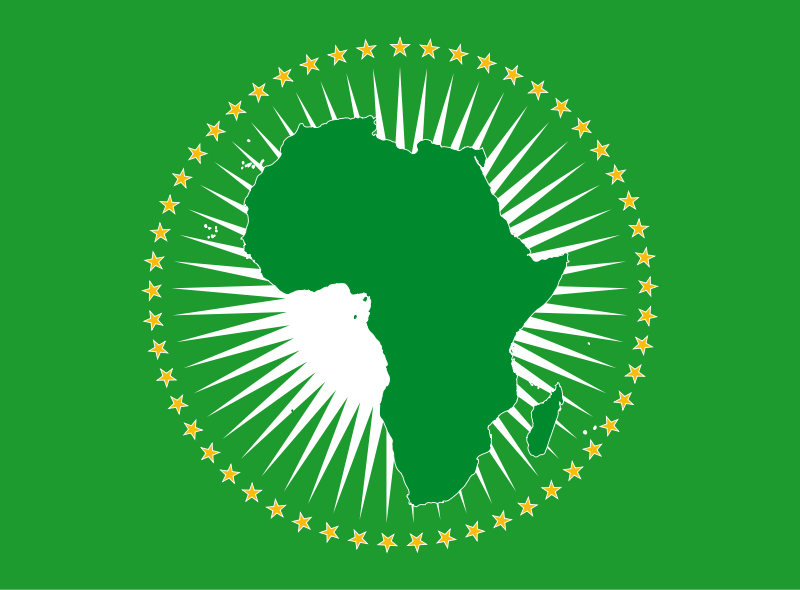
非洲联盟(法语:Union Africaine; 英语:African Union),简称非盟(UA或AU),是一个包涵了55个非洲国家的联盟,是属于集政治、经济和军事于一体的全非洲性政治实体。非洲联盟于未来有计划统一使用货币、联合防御力量、以及成立跨国家的机关,这包括一个管理非洲联盟的内阁政府。此联盟的主要目的是帮助发展及稳固非洲的民主、人权、以及能永续发展的经济,除此之外亦希望减少非洲内部的武装战乱及创造一个有效的共同市场,最终目标是建立“非洲合众国”。
前身是1963年在埃塞俄比亚首都亚的斯亚贝巴成立的“非洲统一组织”。2002年7月在南非改组。[6]2017年在第28届非盟首脑会议上,摩洛哥获得了54个成员国中的42国同意,时隔33年重新成为该组织成员国,至此非洲联盟已涵盖所有非洲主权国家。[7]
Die Afrikanische Union (arabisch الاتحاد الأفريقي, DMG al-Ittiḥād al-Ifrīqī, englisch African Union, französisch Union africaine, portugiesisch União Africana)[2] ist eine Internationale Organisation, die 2002 die Nachfolge der Organisation für Afrikanische Einheit (OAU) angetreten hat und sich für Kooperation auf allen Gebieten einsetzen soll. Sie ist ein Zusammenschluss von anfangs 53 afrikanischen Staaten (Westsahara ist Mitglied der Afrikanischen Union, sein völkerrechtlicher Status allerdings umstritten).
Der Hauptsitz der Organisation befindet sich im äthiopischen Addis Abeba, das Panafrikanische Parlament im südafrikanischen Midrand. Mitgliedstaaten der AU sind alle international allgemein anerkannten afrikanischen Staaten, einschließlich Westsaharas. Geplant ist in der AU unter anderem ein Afrikanischer Gerichtshof. Marokko wurde am 30. Januar 2017 nach 33 Jahren Abwesenheit wieder in die Afrikanische Staatengemeinschaft aufgenommen.[3]
アフリカ連合(アフリカれんごう)は、アフリカの国家統合体。アフリカ統一機構 (OAU) が、2002年に発展改組して発足した[3]。エチオピアのアディスアベバに本部を置いている。
1963年に創設されたアフリカ統一機構は、モロッコを除くアフリカ大陸の53か国(当時)全てが加入する世界最大の地域統合であったが、「統一機構」という名とは裏腹に各国間の内政不干渉を原則としており、各国で頻発する内戦やクーデターといった危機に対して有効な手段をとることができておらず、機能不全に陥っていた[4]。また、各国間の経済統合なども遅々として進んでいなかった。こうした状況に一石を投じたのが、1991年に締結されたアブジャ条約である。この条約では、アフリカ各国は2028年までに大陸統一通貨「アフロ」を導入し、アフリカ経済共同体(AEC)を創設することが謳われた。これによりアフリカ大陸が経済統合の方向に向かう中、より一層のアフリカ大陸の統合を進めるために新しい機構の創設が求められるようになった。
こうしたなか、アフリカ統一機構により強い権限を持たせ、政治・経済的統合を進めて最終的に欧州連合的な形態にアフリカ大陸を持っていくことを目的として、旧統一機構をアフリカ連合へと改組することを提案したのが、リビアの元首だったムアンマル・アル=カッザーフィーであった。カッザーフィーは1997年以降急速にアラブからアフリカへと外交重心を転換させていたが、1999年9月のスルトにおけるOAU首脳会談においてAUへの移行がリビアによって正式提案された[5]。この提案は各国に受け入れられ、アフリカ統一機構からアフリカ連合への移行のため、2000年7月のロメOAU首脳会議でアフリカ連合制定法(アフリカ連合を創設するための条約)が採択され、各国の批准を待って、2001年に発効した[6]。2002年7月のダーバン首脳会議を経て、アフリカ連合は正式に発足した。
アフリカ連合は、アフリカの一層高度な政治的経済的統合の実現及び紛争の予防解決への取組強化のため発足した地域統合体である。アフリカ諸国と諸国民間の一層の統一性及び連帯性の強化、アフリカの政治的経済的社会的統合の加速化、アフリカの平和と域内紛争や独裁政治の根絶、安全保障及び安定の促進、民主主義原則と国民参加統治の促進、持続可能な開発の促進、教育及び科学等での協力、グローバリゼーション時代におけるアフリカ諸国の国際的な地位向上、等を目指している。また、欧州連合(EU)をモデルとした地域統合を目標に掲げており、将来的には統一した国家へ発展させ、アフリカ合衆国を創ることも視野に入れている。
2001年にはアフリカ開発のための新パートナーシップ(NEPAD)を採択し、アフリカ大陸の開発のための指針を表明した。また、これに基づいて、各国が加盟国のガバナンスなどの状況を審査するアフリカン・ピア・レビュー・メカニズム(アフリカにおける相互審査システム、APRM)が創設され、2005年にはガーナの、2006年にはルワンダの報告書が作成された[7]。
The African Union (AU) is a continental union consisting of 55 member states located on the continent of Africa, with exception of various territories of European possessions located in Africa. The bloc was founded on 26 May 2001 in Addis Ababa, Ethiopia and launched on 9 July 2002 in South Africa.[6] The intention of the AU is to replace the Organisation of African Unity (OAU), established on 25 May 1963 in Addis Ababa by 32 signatory governments. The most important decisions of the AU are made by the Assembly of the African Union, a semi-annual meeting of the heads of state and government of its member states. The AU's secretariat, the African Union Commission, is based in Addis Ababa.
In result of its geographical location, the African Union has an area of around 29 million km2 (11 million sq mi) and includes popular world landmarks, including the Sahara and the Nile.[7] They have adopted a gold, green and red based emblem and flag to represent the continental union, where they held a competition for citizens to design a flag in which they chose a submission to replace the old flag. Their main celebration occurs on Africa Day on 25 May. The primary languages spoken include Arabic, English, French and Portuguese and the languages of Africa. Within the African Union, there are official bodies such as the Peace and Security Council and the Pan-African Parliament.
L'Union africaine (UA) est une organisation d'États africains créée en 2002, à Durban en Afrique du Sud, en application de la déclaration de Syrte du 9 septembre 1999. Elle a remplacé l'Organisation de l'unité africaine2 (OUA). La mise en place de ses institutions (Commission, Parlement panafricain et Conseil de paix et de sécurité) a eu lieu en juillet 2003 au sommet de Maputo au Mozambique.
Son premier président a été le Sud-Africain Thabo Mbeki, précédemment président de l'OUA.
Ses buts sont d'œuvrer à la promotion de la démocratie, des droits de l'Homme et du développement à travers l'Afrique, surtout par l'augmentation des investissements extérieurs par l'intermédiaire du programme du Nouveau partenariat pour le développement de l'Afrique (NEPAD). Ce programme considère que la paix et la démocratie sont des préalables indispensables au développement durable.
L'Unione africana (UA) è un'organizzazione internazionale comprendente tutti gli Stati africani, con sede ad Addis Abeba, in Etiopia. Les objectifs de l'UA comportent la création d'une banque centrale de développement.
Si tratta di un'organizzazione internazionale molto giovane, nata ufficialmente con il primo vertice dei capi di Stato e di governo del 9 luglio 2002 a Durban, in Sudafrica, durante il quale ne assunse la presidenza Thabo Mbeki, presidente sudafricano. Nel corso del vertice, al quale presenziava tra gli altri il segretario generale delle Nazioni Unite Kofi Annan, furono sottoscritti i primi atti riguardanti gli organi dell'Unione, ovvero il protocollo relativo allo stabilimento del Consiglio di pace e sicurezza e lo statuto della commissione, e furono stabilite regole e procedure per l'Assemblea, il consiglio esecutivo e il comitato dei rappresentanti permanenti.
Le fasi del processo di sviluppo precedenti al vertice di Durban avvennero all'interno dell'Organizzazione dell'unità africana. Nella sessione straordinaria del 1999 a Sirte, in Libia, (luogo di nascita del Leader libico Mu'ammar Gheddafi promotore dell'organizzazione, anche con cospicui capitali) l'Organizzazione decise la nascita della nuova Unione.
Il Sahara Occidentale è ammesso come Repubblica democratica araba Sahrawi, pur non essendo a tutti gli effetti indipendente trattandosi di un territorio conteso con il Marocco.
Nel 2000 fu adottato l'atto costitutivo, che entrò in vigore il 26 maggio 2001, un mese esatto dopo la sottoscrizione della Nigeria, il trentaseiesimo Stato ad averlo ratificato. Come previsto dall'atto per un anno vi fu coesistenza tra le due organizzazioni.
Il 15 agosto 2002 le è stato riconosciuto lo status di osservatore dell'Assemblea generale delle Nazioni Unite.
La Unión Africana (por su acrónimo UA, o AU en inglés u otras de sus lenguas oficiales) es una unión política formada por 55 Estados africanos. La UA se creó el 26 de mayo de 2001 en Adís Abeba y comenzó a funcionar el 9 de julio de 2002 en Durban (Sudáfrica),2 reemplazando a la Organización para la Unidad Africana (OUA). Las decisiones más importantes de la UA son tomadas por la Asamblea de la Unión Africana, una reunión semestral de jefes de Estado y de gobierno de sus Estados miembros. El secretariado de la UA, la Comisión de la Unión Africana, tiene su sede en Adís Abeba, capital de Etiopía.
Африка́нский сою́з (сокращённо АС, АфроСоюз) — международная межправительственная организация, объединяющая 55 государств Африки, правопреемник Организации африканского единства (ОАЕ). Основана 9 июля 2002 года[4]. Важнейшие решения в рамках организации принимаются на Ассамблее Африканского союза — собрании глав государств и правительств государств — членов организации, которое проводится раз в полгода. Секретариат Африканского союза и Комиссия Африканского союза расположены в Аддис-Абебе, столице Эфиопии. В феврале 2009 года было принято решение о преобразовании Комиссии Африканского союза в Полномочный орган Африканского союза (англ. African Union Authority)[5].
Afghanistan
Ägypten
Albanien
Algerien
Aserbaidschan
Bahrain
Bangladesh
Benin
Brunei Darussalam
Burkina Faso
Côte d´Ivoire
Dschibuti
Gabun
Gambia
Guinea
Guinea-Bissau
Guyana
Indonesien
Irak
Iran
Jemen
Jordanien
Kamerun
Kasachstan
Katar
Kirgisistan
Komoren
Kuwait
Libanon
Libyen
Malaysia
Malediven
Mali
Marokko
Mauretanien
Mosambik
Niger
Nigeria
Oman
Organisation für islamische Zusammenarbeit
Pakistan
Palästina
Republik Sudan
Saudi-Arabien
Senegal
Sierra Leone
Somalia
Suriname
Syrien
Tadschikistan
Togo
Tschad
Tunesien
Türkei
Turkmenistan
Uganda
Usbekistan
Vereinigte Arabische Emirate
Wichtige internationale Organisationen

伊斯兰合作组织(阿拉伯语:منظمة التعاون الإسلامي;英语:Organisation of Islamic Cooperation;法语:Organisation de la coopération islamique)原名伊斯兰会议组织,是一个伊斯兰世界的政府间国际组织,为联合国大会观察员;该组织由遍及西亚(中东)、中亚、西非、北非、印度次大陆和东南亚的57个国家组成,覆盖的人口约为16亿。秘书处设在沙特阿拉伯王国的吉达市;现任秘书长是原沙特社会事务大臣Yousef Al-Othaimeen(从2016年开始)。
组织的宗旨是促进各成员国之间在经济、社会、文化和科学等方面的合作;努力消除种族隔离和种族歧视,反对一切形式的殖民主义;支持巴勒斯坦人民恢复民族权利和重返家园的斗争;支持穆斯林保障其尊严、独立和民族权利的斗争。
但要注意的是并非每个成员国是伊斯兰国家,如圭亚那、苏里南、莫桑比克、喀麦隆、乌干达和加蓬等国,伊斯兰反而是极少数人的信仰,阿尔巴尼亚则是唯一加入该组织的欧洲大陆的主权国家和联合国会员国,2011年脱离苏丹独立的南苏丹也在独立后脱离该组织的势力范围。
Die Organisation für Islamische Zusammenarbeit (arabisch منظمة التعاون الإسلامي, DMG Munaẓẓamat at-Taʿāwun al-islāmī; englisch Organization of Islamic Cooperation, OIC; französisch L’Organisation de Coopération Islamique, OCI; früher Organisation der Islamischen Konferenz) ist eine zwischenstaatliche internationale Organisation von derzeit 56 Staaten,[2] in denen der Islam Staatsreligion, Religion der Bevölkerungsmehrheit oder Religion einer nennenswerten Minderheit ist. Die Organisation nimmt für sich in Anspruch, den Islam zu repräsentieren. Mehrere größere Mitgliedsstaaten (Saudi-Arabien, Ägypten, die Türkei und der Iran) erheben hinter den Kulissen Führungsansprüche; die jeweils anderen Staaten bestreiten deren Recht dazu. Infolge dieser Rivalitäten ist die OIC seit 2017 kaum handlungsfähig.[3]
イスラム協力機構(イスラムきょうりょくきこう、アラビア語: منظمة التعاون الاسلامي、略称OIC; 英語: Organisation of Islamic Cooperation、略称OCI; フランス語: Organisation de la coopération Islamique)は、イスラム諸国をメンバーとして構成され、国際連合に対する常任代表を有する国際機構。公用語はアラビア語、英語、フランス語。かつてはイスラム諸国会議機構(منظمة المؤتمر الإسلامي、英語: Organisation of the Islamic Conference、フランス語: Organisation de la Conférence Islamique)という名称であったが、2011年6月にカザフスタンのアスタナでの会議で「イスラム協力機構」への変更と紋章が決定された[1]。
イスラム諸国の政治的協力、連帯を強化すること、イスラム諸国に対する抑圧に反対し、解放運動を支援することを目的とする。
加盟国はムスリム(イスラム教徒)が国民の多数を占める西アジア、北アフリカ、西アフリカ、東アフリカ、中央アジア、南アジア、東南アジアなどの57か国、オブザーバーが5ヵ国・8組織(国連など)からなり、世界13億人のムスリムの大部分を代表する。
加盟条件としては、国内でムスリムが大多数を占めることを必ずしも条件としているわけではなく、南アメリカのいくつかの国のようにマイノリティとしてある程度のムスリム人口を抱えているだけであっても、外相会議における審査で承認されればイスラム諸国のひとつとして機構に加盟することができる。イスラム教徒が多数派を占める国はほとんど参加しているが、イスラム教徒比率の高い国のうちエチオピア(30~50%)とタンザニア(約30%)が加盟していない。イスラム教徒人口の多い国で言えばインド(約1億5000万人)や中国(約2000万人)も加盟していない。逆にイスラム教徒比率の低い国ではガボン、ウガンダ、スリナム、ガイアナなどが加盟している(それぞれ10%未満)。
The Organisation of Islamic Cooperation (OIC; Arabic: منظمة التعاون الإسلامي; French: Organisation de la coopération islamique), formerly the Organisation of the Islamic Conference, is an international organization founded in 1969, consisting of 57 member states, with a collective population of over 1.8 billion as of 2015 with 53 countries being Muslim-majority countries. The organisation states that it is "the collective voice of the Muslim world" and works to "safeguard and protect the interests of the Muslim world in the spirit of promoting international peace and harmony".[1]
The OIC has permanent delegations to the United Nations and the European Union. The official languages of the OIC are Arabic, English, and French.
L’Organisation de la coopération islamique (OCI), en arabe : منظمة التعاون الإسلامي (Munaẓẓamat at-Taʿāwun al-islāmī), en anglais : Organisation of Islamic Cooperation (OIC), appelée jusqu'en 2011 Organisation de la conférence islamique (en arabe : منظمة المؤتمر الإسلامي, en anglais : Organisation of the Islamic Conference), est une organisation intergouvernementale créée le 25 septembre 1969. Son siège se situe à Djeddah en Arabie saoudite et elle possède une délégation permanente aux Nations unies.
Regroupant 57 États membres, sa vocation est de promouvoir la coopération dans les domaines économiques, sociaux, culturels et scientifiques (grâce notamment à la Banque islamique de développement), mais aussi la sauvegarde des lieux saints de l'islam ou encore le soutien au peuple palestinien. À l'échelle mondiale, il n'existe pas d'autre organisation confessionnelle dont les membres signataires soient des États.
Ses trois langues officielles sont l'arabe, l'anglais et le français2.
L'Organizzazione della cooperazione islamica (in arabo: منظمة التعاون الإسلامي, Munaẓẓamat al-taʿāwun al-islāmī; in inglese: Organization of the Islamic Cooperation, OIC; in francese: Organisation de la coopération islamique, OCI) è un'organizzazione internazionale con una delegazione permanente presso le Nazioni Unite. Rappresenta 56 Stati dell'Europa, Vicino Oriente, Medio Oriente, America meridionale, Africa, Asia centrale e del Subcontinente indiano.[1]
L'organizzazione, fondata a Rabat, in Marocco, il 25 settembre 1969 con il nome Organisation of the Islamic Conference, in arabo: منظمة المؤتمر الإسلامي, Munaẓẓamat al-muʾtamar al-islāmī; (FR) Organisation de la conférence islamique, mutato nell'attuale nel 2011.[2]
Ha come finalità la salvaguardia degli interessi e lo sviluppo delle popolazioni musulmane nel mondo.
Il 10 ottobre 1975 le è stato riconosciuto lo status di osservatore dell'Assemblea generale delle Nazioni Unite.
La Organización para la Cooperación Islámica (Árabe:منظمة التعاون الاسلامي); (Francés: Organisation de la Coopération Islamique); (Inglés: Organisation of Islamic Cooperation) es un organismo internacional que agrupa a los estados de confesión musulmana, creado en 1969 durante la Conferencia de Rabat y formalizada dos años después.
Su sede está en Yidda, ciudad costera de Arabia Saudí a orillas del Mar Rojo. Sus miembros son países con mayoría de población musulmana o con una comunidad significativa en ellos, con Estados miembros y observadores de África, Asia, Europa y América del Sur. El 28 de junio de 2011 se oficializó el cambio de nombre,1 anteriormente se llamó: Organización de la Conferencia Islámica (Árabe:منظمة المؤتمر الإسلامي); (Francés: Organisation de la Conférence Islamique); (Inglés:Organization of the Islamic Conference).
Sus acciones se circunscriben a la actividad colaborativa entre sus miembros, sobre todo en la lucha contra el imperialismo, el neocolonialismo y por la emancipación de Palestina. Históricamente se celebraron diversos congresos que contribuyeron con su desarrollo: Lahore (1974), La Meca (1981), Casablanca (1984), Kuwait (1987), Dakar (1991). Sus repercusiones son menores que las de la Liga Árabe.
Организация исламского сотрудничества (англ. Organisation of Islamic Cooperation (OIC), араб. منظمة التعاون الاسلامي) — международная организация исламских стран (до 2011 года называлась Организация Исламская конференция (ОИК).
Brasilien
Côte d´Ivoire
Dominikanische Republik
Ecuador
 Essen und Trinken
Ghana
Indonesien
Kamerun
Mexiko
Nigeria
Peru
Essen und Trinken
Ghana
Indonesien
Kamerun
Mexiko
Nigeria
Peru
