
漢德百科全書 | 汉德百科全书
 Architecture


 Vacation and Travel
 Exhibition

 Sport
Sport


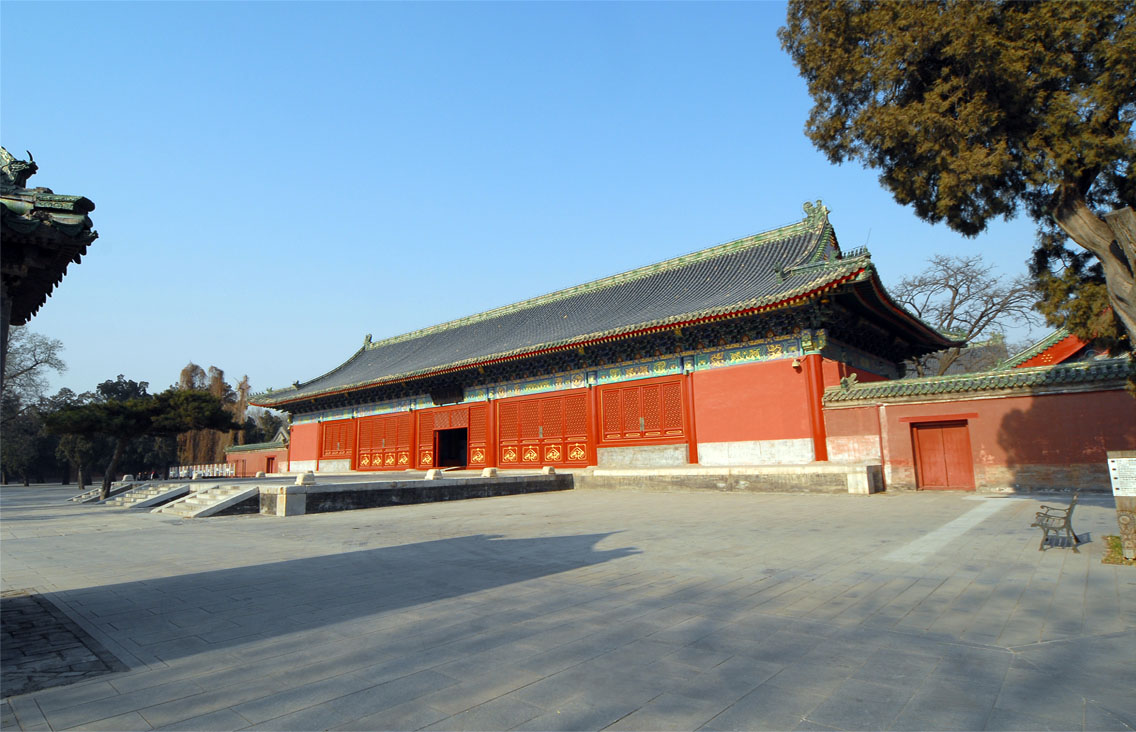
Der Ackerbaualtar oder Altar des Ackerbaus[1] (Xiannongtan 先农坛) ist eine historische Stätte im Pekinger Stadtbezirk Xuanwu und befindet sich nahe dem Himmelstempel. Er wurde im 15. Jahrhundert erbaut und wurde während der Ming-Dynastie und Qing-Dynastie vom Kaiser zu Opfern an den Ackergott verwendet, der den Menschen das Pflügen beigebracht haben soll.
先农坛建筑群是明清两代皇帝祭祀先农诸神和太岁诸神和举行亲耕的地方,位于北京市西城区[註 1]南中轴线西侧,与天坛东西相对,遥相呼应。是全国重点文物保护单位。根据最新版北京市城市总体规划,北京市计划全面恢复先农坛历史布局,重现古都农耕文化。先农坛建筑群可以可分为三组,即先农坛(先农神坛、神厨库院、神仓院、俱服殿、观耕台、庆成宫),太岁殿(太岁殿院和焚帛炉)和天神地祇坛。
先农坛
- 先农神坛--先农神坛是皇帝祭祀先农神的祭坛。先农神坛呈方形见方约15米,高一层约1.5米,由石包砖砌,四面有台阶各8级。
- 宰牲亭--宰牲亭是祭祀宰杀牺牲的亭子。
- 神厨神库院--神厨库院是存放先农诸神神位和准备牺牲祭品的院落,位于先农神坛的正北。 由正殿,东、西配殿和两座六角井亭组成,正殿称为神版库用供奉先农神的牌位,东配殿为神库,存放祭祀和亲耕用品的地方,西配殿为神厨。
- 具服殿--具服殿为皇帝亲耕前更换亲耕礼服的地方,位于观礼台的北方。
- 观耕台--观耕台为皇帝亲耕完毕, 观看王公大臣们耕作的高台。 观耕台呈方形见方18米,高一层1.9米,四面各有台阶9级,台阶踏步由汉白玉条石砌成,侧面雕有莲花图案。
- 一亩三分地--一亩三分地是皇帝亲耕的田地,位于观礼台的南方。俗语所说的一亩三分地就是由此而来。
- 神仓院--神仓院是存放耕田收获的谷物的地方,亲耕收获的谷物供北京各坛、寺庙祭祀使用。 院子分为前后两个院,前院有收谷亭、圆廪神仓和库房,后院是祭器的库房。神仓院建于清乾隆十七年(1752年)。
- 庆成宫--庆成宫是皇帝祭祀和亲耕后犒劳百官的地方。庆成宫始建于明天顺二年(1458年),原称斋宫,乾隆二十年(1755年)改今名。庆成宫设宫门两座,院内东侧原有一座钟楼。主要建筑是前殿、后殿及东西配殿,前殿设有月台。
太岁坛
太岁坛,又称太岁殿,位于先农神坛东北,是祭祀太岁神及十二月将神的院落。 建筑有太岁殿,拜殿及东西配殿, 太岁殿正殿祭祀太岁神,东西配殿祭祀十二月将神
在太岁殿院外东南侧还有用于焚烧祭祀太岁诸神的祝帛祭品的焚帛炉,为砖仿木结构无梁建筑。
祭祀和亲耕仪式
祭祀先农和亲耕的传统,可以追溯到周朝,但不是每年举行。明清两代,成为国家重要的祭祀典礼。每年仲春亥日皇帝率百官到先农坛祭祀先农神并亲耕(称为藉田礼)。在先农神坛祭拜过先农神后,在俱服殿更换亲耕礼服,随后到亲耕田举行亲耕礼。亲耕礼毕后,在观耕台观看王公大臣耕作。
秋天,亲耕田收获后,将谷物存放在神仓院,供北京九坛八庙祭祀使用。
先农,远古称帝社、王社,至汉时始称先农。春时东耕于藉田,引诗 先农坛 先农,则神农也”引;“坛于田,以祀先农”引。魏时,先农为国六神之一(“风伯、雨师、灵星、先农、社、稷为国六神”引)。藉天祭先农,唐前为帝社,祭坛曰藉田坛,垂拱年(公元685~688年)后改为先农坛。至此祭祀先农正式定为封建社会的一种礼制,每年开春,皇帝亲领文武百官行藉田礼于先农坛。
 New York-NY

 Religion

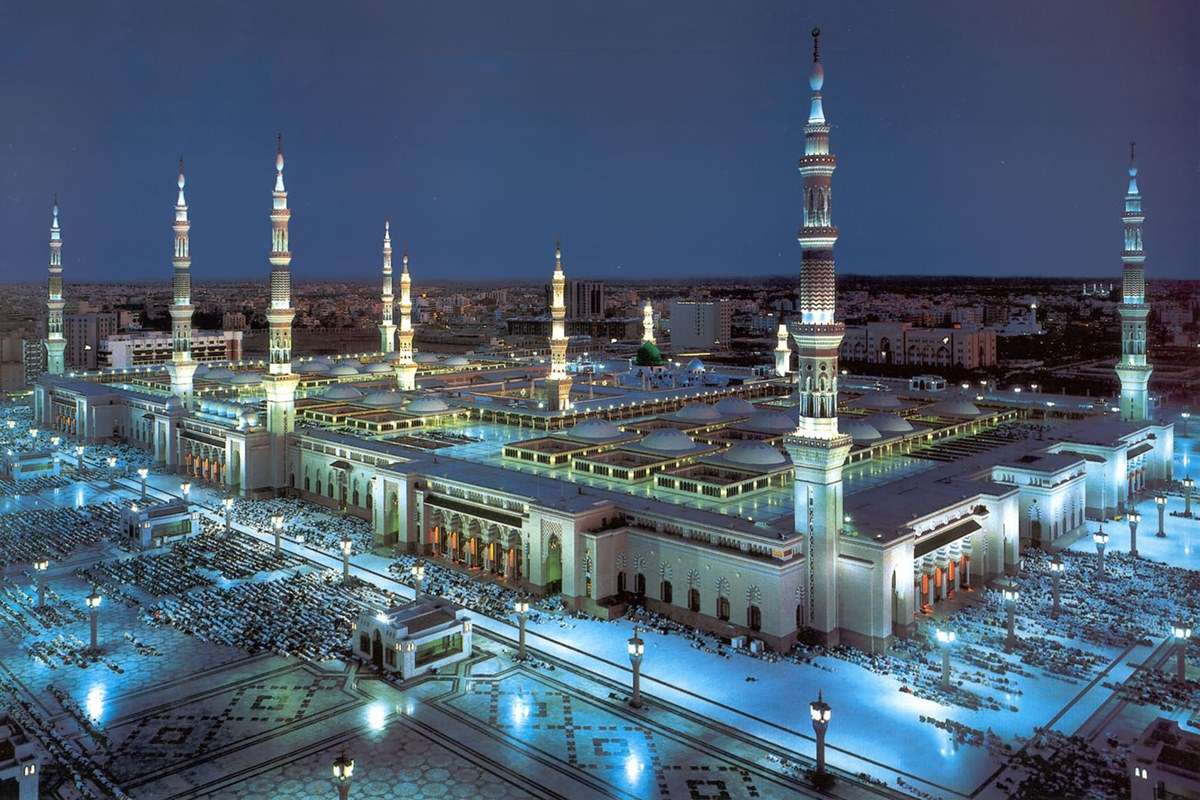
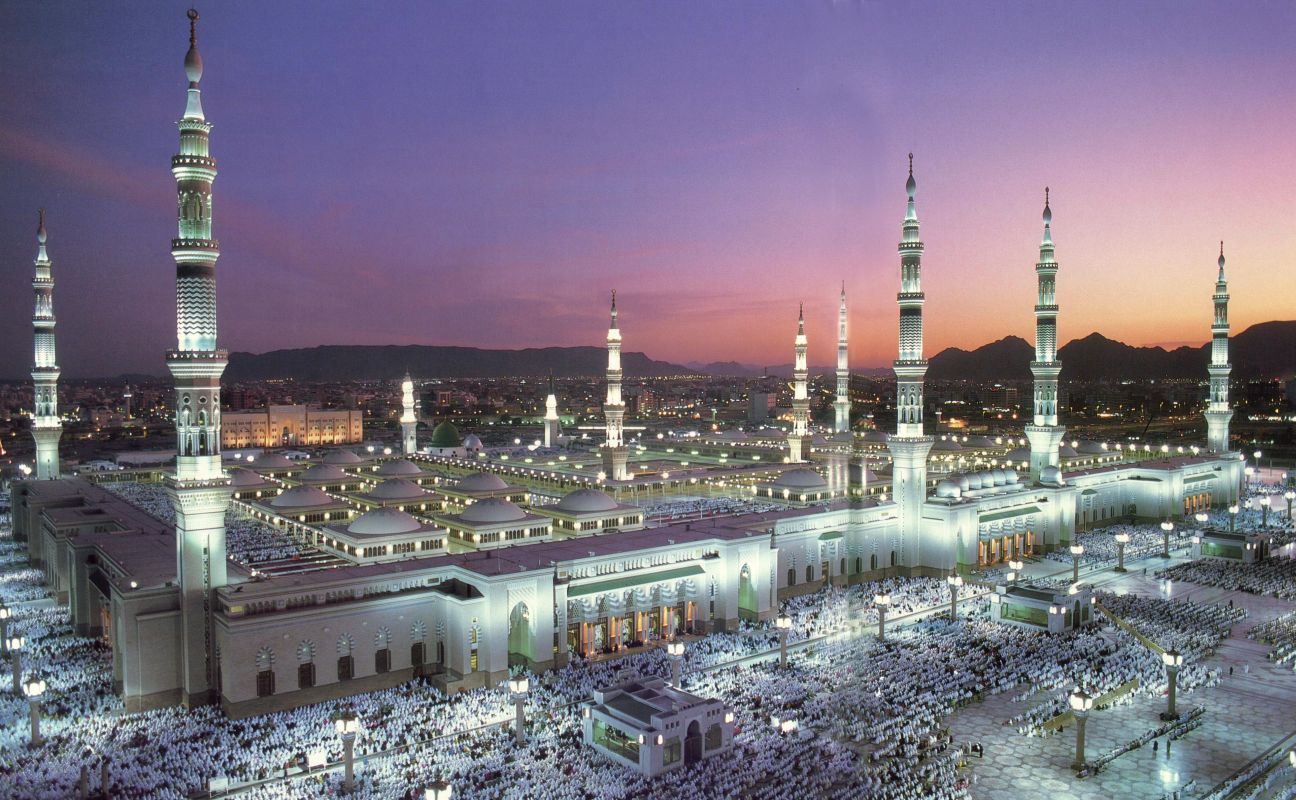
Die Prophetenmoschee (arabisch المسجد النبوي al-Masdschid an-Nabawi, DMG al-masǧid an-nabawī) in Medina ist nach der al-Haram-Moschee in Mekka die zweitheiligste Moschee im Islam. Hier befindet sich die Grabstätte Mohammeds. Zunächst stand hier das Haus des Propheten Mohammed, das er nach der Hidschra 622 erbauen ließ, sowie eine zu seiner Zeit errichtete Moschee. Die Prophetenmoschee wurde ab 1517 vom Osmanischen Reich kontrolliert. 1806 besetzte der Anführer des Wahhabitenreichs, Saud I. ibn Abd al-Aziz, bei seinem Versuch der Einigung Arabiens Medina und dessen heilige Stätten. Mit der Demolierung des al-Baqi'-Friedhofs neben der Prophetenmoschee im Jahre 1806, im Zuge des Einmarsches der Wahhabiten in Mekka und Medina, begann die bis heute andauernde Zerstörung des islamischen Kulturerbes in Saudi-Arabien,[1] die mit dem Kampf gegen die Heiligenverehrung begründet wurde. 1812 eroberten ägyptische Truppen im Auftrag des osmanischen Sultans Mahmud II. Medina zurück.
Die Moschee wurde in späterer Zeit beträchtlich erweitert und heute liegt der bedeutendste Teil, das Grab Mohammeds, unter der grünen Kuppel. Dort sind auch die ersten beiden „rechtgeleiteten“ Kalifen Abu Bakr und Umar ibn al-Chattab begraben.
先知清真寺一般简称先知寺(阿拉伯语:المسجد النبوي),又名麦地那清真寺(مسجد المدينة),是一座位于伊斯兰教第二大圣地麦地那的清真寺,是仅次于麦加禁寺的伊斯兰教第二大圣寺,也是伊斯兰教史上继库巴清真寺之后第二座清真寺。先知寺始建于公元622年,是伊斯兰教复兴者、伊斯兰教先知穆罕默德亲自参与建造,故名。倭马亚王朝哈里发瓦利德一世时期重建,将穆罕默德与伊斯兰教前两任哈里发阿布·伯克尔和欧麦尔的陵墓合并于先知寺,大体形成了今天的建筑格局[1]。后经多次扩建,目前先知寺已成为一座庞大的建筑群,占地面积为1.6326万平方米,可容纳100万人做礼拜,成为全世界最大的清真寺之一。先知寺处于传统的麦地那市中心,周围有许多饭店和旧集市。每年都有许多穆斯林在朝觐期间到此祈祷、礼拜和瞻仰先圣遗迹。
穆罕默德从麦加迁往麦地那[註 1]后,在自己居所的旁边建造了先知寺,以便随时可以进入寺内处理教俗事务。最早的先知寺是露天建筑,是全世界清真寺建筑的雏形。
先知寺也起到交流中心、宗教法庭和宗教学校的作用。1909年,这里成为阿拉伯半岛第一个通电的地方[2]。先知寺历代的管理权都归两圣地监护人(现为沙特阿拉伯国王沙爾曼·賓·阿卜杜勒-阿齊兹·阿紹德)所有。
先知寺中最神圣的地方之一是绿色穹顶,或先知穹顶,它所在的地点原是穆罕默德之妻阿伊莎的房间,穆罕默德即在此归真并安葬。后来,哈里发阿布·伯克尔和欧麦尔先后安葬在穆罕默德陵墓的两旁,而穹顶是后世加建的。
預言者のモスク(アラビア語: المسجد النبوي al-Masjid an-Nabawī, مسجد النبي Masjid al-Nabī)は、サウジアラビアのマディーナにあるイスラム教の礼拝堂・モスクで、イスラム教の第2の聖地。預言者ムハンマドの霊廟でもある。
そもそも預言者のモスクは622年のムハンマドらイスラム共同体のヒジュラにより建てられた最初のモスクであり、ムハンマドの住居であり、イスラム共同体の本部たる所であった。その後、イスラム共同体の首長であるカリフのアリーがイラクのクーファに移るまではイスラム共同体の首都、その後はイスラム教の第2聖地として機能した。
現在の10本のミナレット(尖塔)のある白亜の巨大な建物は1995年にできた。マッカにあるマスジド・ハラーム同様、100万人の収容が可能。ハッジ(巡礼)でついでに訪れるムスリムも多い。
Al-Masjid an-Nabawī (Arabic: ٱلْـمَـسْـجِـدُ ٱلـنَّـبَـوِيّ, "The Prophet's Mosque") is a mosque established and originally built by the Islamic prophet Muhammad, situated in the city of Medina in the Hejaz region of Saudi Arabia. It was the third mosque built in the history of Islam,[a] and is now one of the largest mosques in the world. It is the second-holiest site in Islam, after the Great Mosque in Mecca.[8] It is always open, regardless of date or time.
The site was originally adjacent to Muhammad's house; he settled there after his migration from Mecca to Medina in 622. He shared in the heavy work of construction. The original mosque was an open-air building. The mosque served as a community center, a court, and a religious school. There was a raised platform for the people who taught the Quran. Subsequent Islamic rulers greatly expanded and decorated it. In 1909, it became the first place in the Arabian Peninsula to be provided with electrical lights.[9] The mosque is under the control of the Custodian of the Two Holy Mosques. The mosque is located in what was traditionally the center of Medina, with many hotels and old markets nearby. It is a major pilgrimage site. Many pilgrims who perform the Hajj go on to Medina to visit the mosque, due to its connection to Muhammad.
After an expansion during the reign of the Umayyad caliph al-Walid I, it now incorporates the final resting place of Muhammad and the first two Rashidun caliphs Abu Bakr and Umar.[10] One of the most notable features of the site is the Green Dome in the south-east corner of the mosque,[11] originally Aisha's house,[10] where the tomb of Muhammad is located. In 1279, a wooden cupola was built over the tomb which was later rebuilt and renovated multiple times in late 15th century and once in 1817. The current dome was added in 1818 by the Ottoman sultan Mahmud II,[11] and it was first painted green in 1837, hence becoming known as the "Green Dome".[10]
La mosquée du Prophète (arabe : المسجد النبوي Al-Masjid Al-Nabawi) à Médine en Arabie saoudite, est la deuxième mosquée la plus sainte de l'islam après Masjid al-Haram à La Mecque et avant la mosquée d'Al-Aqsa (à côté du Dôme du Rocher), à Jérusalem.
La mosquée originale a été construite par Mahomet. Les califes suivants l'ont agrandie et amélioré sa décoration. Le premier édifice n'était pas grand et ne représentait qu'une petite partie de superficie du bâtiment actuel. La taille de la mosquée a été considérablement augmenté depuis la formation du royaume saoudien. La dernière rénovation a eu lieu sous le roi Fahd.
La moschea del Profeta (in arabo: المسجد النبوي al-Masjid al-Nabawi [1]) è la seconda moschea più sacra per l'Islam [2] (a Medina, Arabia Saudita). Questa sorge sul luogo in cui, fin dal 622 [3], Maometto fece edificare un locale destinato alla preghiera, attiguo alla stessa abitazione costruitagli non appena giunto a Medina (allora Yathrib).
Come oggi si mostra, la moschea del Profeta ha una pianta rettangolare su due piani, con la muṣalla ottomana che si allunga verso sud. La sala principale di preghiera occupa l'intero primo piano. Il perimetro della moschea è 100 volte maggiore della prima moschea fatta costruire da Maometto e può accogliere oltre mezzo milione di devoti.
La moschea del Profeta ha un piano sovrastato da 24 cupolette dalla base quadrata. Aperture sono praticate alla base di ogni cupola, illuminata al suo interno. Il piano è usato per la preghiera durante i periodi di maggiore affluenza (il mese di Dhu l-Hijja), allorché le 24 cupolette scivolano sui loro binari per ombreggiare le sottostanti aree, fornendo fonti di luce per la sala per la preghiera. In queste occasioni, il cortile della moschea ottomana è anche ombreggiato con appositi tendaggi che sono collegati alle colonne, lasciando del tutto sgombero il sottostante pavimento. Al piano si accede tramite scale e ascensori. L'area pavimentata attorno alla moschea è parimenti usata per la preghiera ed è equipaggiata anch'essa da tendaggi che forniscono all'occorrenza l'ombra.
La facciata settentrionale ha tre ampi portici di dimensioni identiche, mentre la facciata orientale, occidentale e meridionale ne hanno due. I muri ospitano una serie di finestrature sovrastate da archi a sesto acuto, con conci rastremati bianchi e neri. Vi sono sei minareti perimetrali annessi alla nuova estensione della moschea, e quattro altri che fanno parte della struttura di età ottomana. Tutti hanno un'altezza superiore ai 100 metri, con un massimo di 105 metri. La moschea è decorata generosamente con marmi e pietre policromi. Le colonne sono di marmo bianco con capitelli d'ottone che sostengono sottili archi a sesto acuto, per i quali sono stati utilizzati marmi e pietre di color nero e bianco. La base delle colonne ha una griglia di ventilazione che consente di regolare la temperatura all'interno della sala di preghiera.
Questa rilucente moschea del Profeta ingloba l'antica al suo interno. Le due sezioni possono essere agevolmente distinte: la più antica ha molte decorazioni colorate e numerosi piccoli pilastri; la nuova sezione è invece in marmo bianco scintillante ed è completamente climatizzata.
La Mezquita del Profeta (en árabe, المسجد النبوي Al-Masjid an-Nabawī) es una mezquita establecida y construida originalmente por el profeta islámico Muhammad, ubicada en Medina, en la región de Hejaz en Arabia Saudita. Fue la tercera mezquita construida en la historia del Islam y ahora es una de las más grandes del mundo. Es la segunda mezquita más sagrada del islam —entre la Gran Mezquita en La Meca y la mezquita de Al-Aqsa (al lado de la Cúpula de la Roca, en Jerusalén)—. La mezquita original fue construida por el profeta Mahoma.2345 Los siguientes califas aumentaron el tamaño y la decoración de la mezquita. La mezquita original no era muy grande y solo representaba una pequeña parte de la actual mezquita. El tamaño de la mezquita se aumentó de modo considerable tras la formación de Arabia Saudita. La última renovación tuvo lugar bajo el rey Fahd. Siempre está abierta, independientemente de la fecha o la hora.
Se construyó en 622 con ocasión de la Hégira de Mahoma y sus compañeros de La Meca a Medina.6 Algunos días después de haber empezado la construcción de la mezquita de Quba, Mahoma empezó la construcción de una segunda mezquita en Medina, hoy conocida por el nombre de Masjid al-Nabawi, o mezquita del profeta. El emplazamiento de la mezquita se escogió por el lugar en el que se llevó a cabo la primera oración del viernes en Medina.7 En efecto, al retomar su camino hacia Medina, dejó a cargo de su camello, Qoçoua, la tarea de determinar el lugar de llegada para lo que le dejó la brida suelta. Así, tras numerosos desvíos, se detuvo en un amplio terreno vacío y se arrodilló. En ese terreno se edificó la mezquita de Medina.8
La primera ampliación de la mezquita se llevó a cabo bajo el reinado del califa Omar Ibn Al Khattab, quien añadió parte de terreno a la Mezquita por la parte norte y la reconstruyó. A la muerte del califa Omar, se le enterró junto a las tumbas del profeta Mahoma y del califa Abu Bakr Al Siddiq. Bajo el reinado del califa Osman Ibn Affan, la ampliación de la mezquita parecía necesaria y urgente. Procedió en 649-650 a ampliar y reconstruir la mezquita.
Аль-Масджид ан-Набави (араб. المسجد النبوي — Мечеть Пророка) — мечеть в Медине, являющаяся второй святыней в исламе после Заповедной мечети в Мекке (мечеть Аль-Акса в Иерусалиме — третья). Место погребения Мухаммада.
Первая мечеть на этом месте была построена ещё при жизни Мухаммада, последующие исламские правители расширили и украсили святыню. Под Зелёным куполом (Купол Пророка[1]) расположена могила Мухаммада. Точная дата возведения купола неизвестна, но его описание можно найти в манускриптах начала XII века. Первые два мусульманских халифа Абу Бакр и Умар также похоронены в доме Аиши.
После хиджры Мухаммад поселился в Ясрибе (названном позже Мединой) в доме, на месте которого позже начал возведение мечети, сам принимал участие в работах. Принцип планировки этого здания был принят для других мечетей во всем мире[2][3]. В сооружении были заложены основные элементы композиции колонной мечети: открытый прямоугольный двор и прототип будущего колонного зала, ориентированного первоначально к Иерусалиму, а позднее — к Мекке, признанной главным священным городом мусульман. Мечеть также служила помещением для проведения культурных и общественных мероприятий, судом и религиозной школой.
 Life and Style

 History
