Deutsch-Chinesische Enzyklopädie, 德汉百科
 Neuseeland
America´s Cup 2017
Australien
Neuseeland
America´s Cup 2017
Australien
 California-CA
China
California-CA
China
 Comunidad Valenciana
England
Frankreich
Griechenland
Comunidad Valenciana
England
Frankreich
Griechenland
 Illinois-IL
Italien
Japan
Kanada
Kyūshū
Neuseeland
Illinois-IL
Italien
Japan
Kanada
Kyūshū
Neuseeland
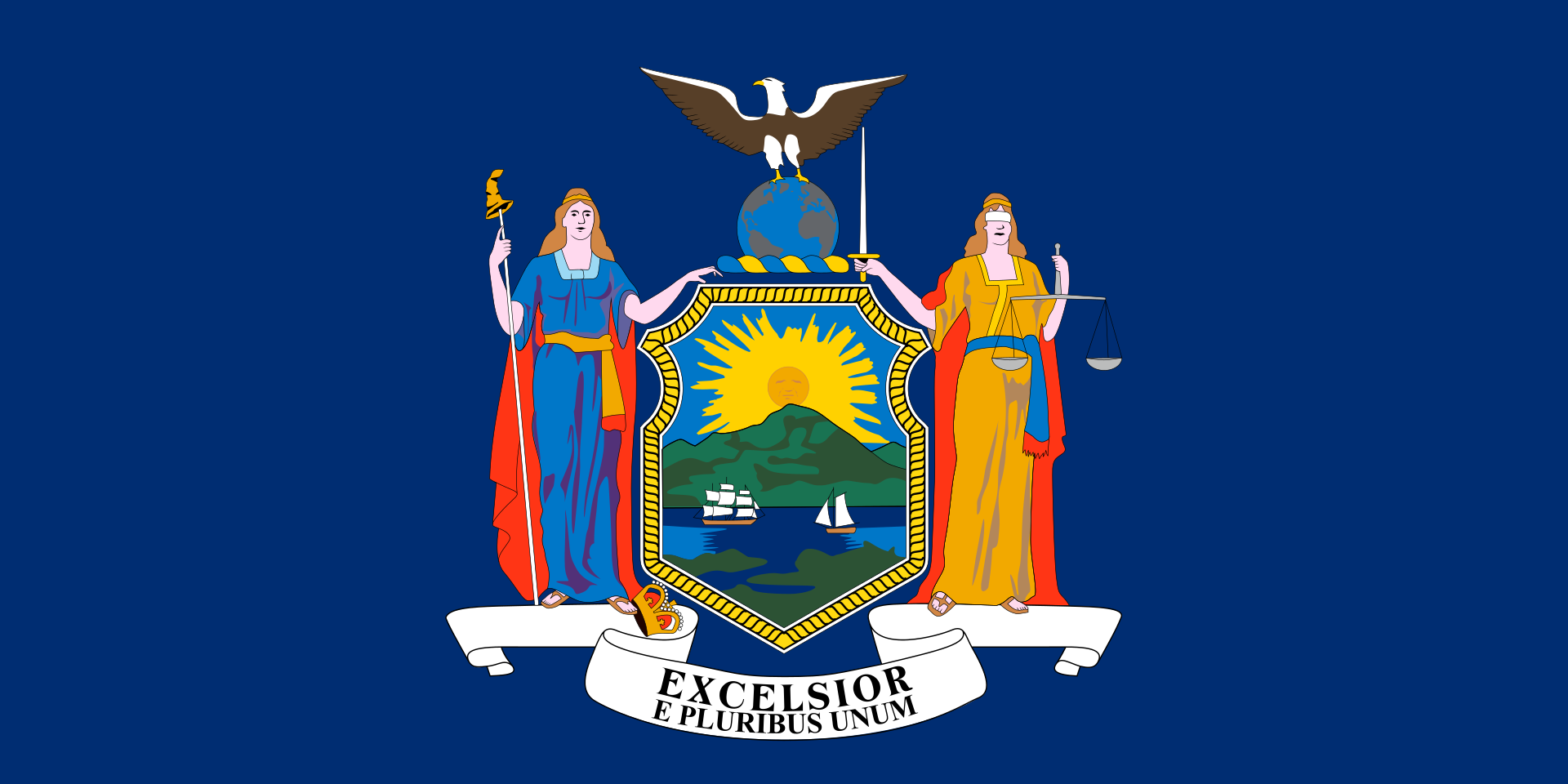 New York-NY
Oman
Österreich
New York-NY
Oman
Österreich
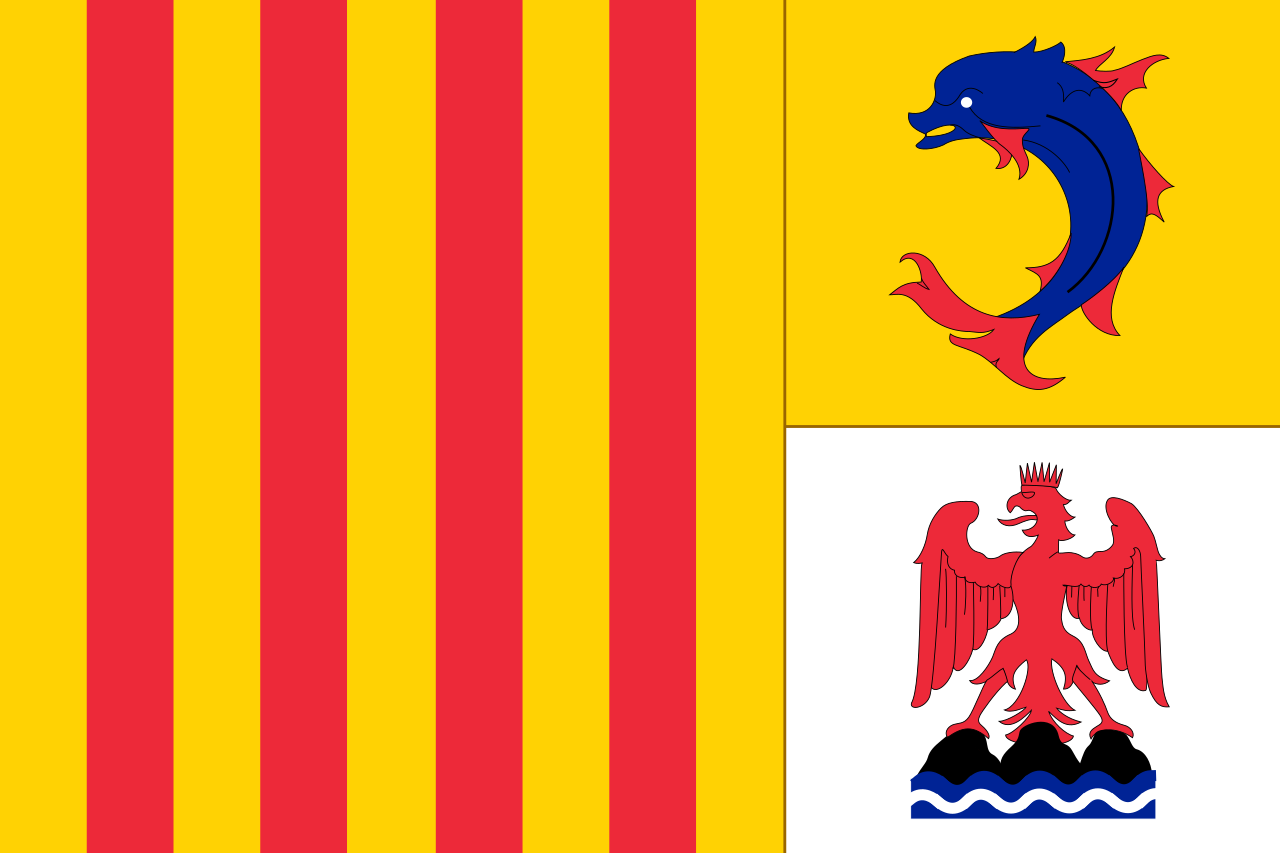 Provence-Alpes-Côte d´Azur
Republik Korea
Provence-Alpes-Côte d´Azur
Republik Korea
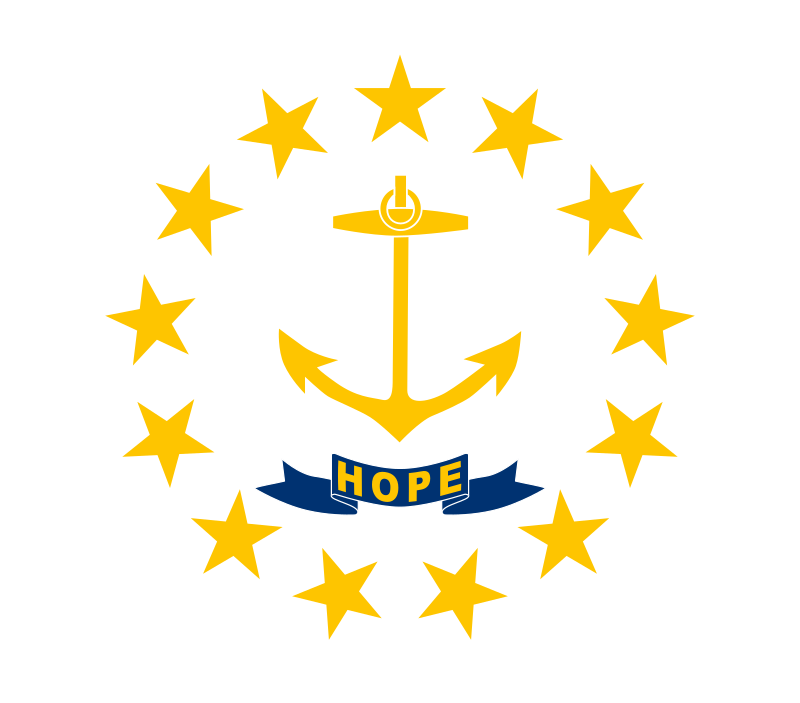 Rhode Island-RI
Russland
Rhode Island-RI
Russland
 Schiffe und Nautik
Schweden
Spanien
Schiffe und Nautik
Schweden
Spanien
 Sport
Sport
 America´s Cup
Vereinigte Staaten
Vereinigtes Königreich
Vereinigtes Königreich
America´s Cup
Vereinigte Staaten
Vereinigtes Königreich
Vereinigtes Königreich
 Western Australia-WA

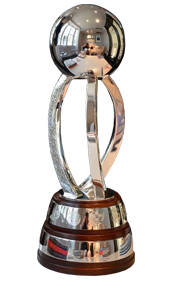
美洲杯帆船赛(英语:America's Cup)是赛艇运动中保存的最著名也是最古老的一项体育比赛。
比赛奖杯是银质大口水罐,奖励给来自不同国家的两艘帆船之间举行的九局五胜制比赛的胜者。两艘帆船中,一艘代表卫冕冠军游艇俱乐部,另一艘则代表俱乐部挑战奖杯。
美洲杯帆船赛源于1851年8月22日,一艘由代表纽约游艇俱乐部(New York Yacht Club,NYYC)的财团拥有的30.86米长纵帆船“美洲号”(America),同15艘代表皇家快艇舰队(Royal Yacht Squadron)的帆船在英国南部的怀特岛附近比赛。“美洲号”最终以领先20分钟胜出。拥有“美洲号”的财团后来将奖杯通过馈赠契约捐献给纽约游艇俱乐部。由此,奖杯被托管成为一项鼓励各国之间友谊竞赛的“挑战”奖品。
在当时公认无敌的英国海上霸权遭受如此打击后,一系列英国财团试图赢回奖杯。但纽约游艇俱乐部在超过132年的25次挑战中保持不败,成为体育运动史上最长的连胜纪录。1930年以前,这项赛事一直在纽约港附近举行,余下的NYYC全盛时期内则改在罗德岛的纽波特(Newport,Rhode Island)举行。
Der America’s Cup ist die älteste noch heute ausgetragene Segelregatta. Der Preis ist ein Wanderpokal und hat seinen Ursprung in einer Regatta rund um die britische Insel Isle of Wight im Jahre 1851.[1] Er ist benannt nach seiner erstmaligen Gewinnerin, der Yacht America des New York Yacht Club (NYYC).
Um den America’s Cup treten die Boote zweier Yachtclubs – Verteidiger und Herausforderer – in mehreren Wettfahrten gegeneinander an. Die Yacht, die eine vorher festgelegte Anzahl von Wettfahrten gewinnt, gewinnt den Cup. Laut der Stiftungsurkunde bestimmt der Verteidiger das Segelrevier. Die Stiftungsurkunde sieht vor, dass Verteidiger und Herausforderer innerhalb gewisser Grenzen Vereinbarungen über die Regeln treffen können, z. B. was die Anzahl der Wettfahrten betrifft.[2]
Von der ersten Verteidigung 1870 bis zur 20. Regatta im Jahr 1967 gab es jeweils nur einen Herausforderer. Im Jahr 1970 gab es erstmals mehrere Herausforderer, so dass der veranstaltende New York Yacht Club sich einverstanden erklärte, den offiziellen Herausforderer durch eine Vorausscheidung zu ermitteln. Zwischen 1983 und 2007 bis zum zeitweiligen Rückzug des Sponsors Louis Vuitton und ab 2013 erneut wurde der Herausforderer durch den Louis Vuitton Cup ermittelt. Schon die Teilnahme am Louis Vuitton Cup setzte großes finanzielles Engagement voraus: die Budgets der High-Tech-Yachten betrugen teilweise über 100 Mio. Dollar. Die Yachten mussten im Land des angemeldeten Teams gebaut werden. Wesentliche Neuerungen ergaben sich bei den letzten beiden ACs. 2010 segelten das erste Mal sowohl Verteidiger wie Herausforderer mit Mehrrumpfbooten. 2013 waren Katamarane vereinbart und die teilnehmenden Teams konstruierten „Tragflügelkatamarane“ die über 40 Knoten (75 km/h) schnell segelten. Für 2017 wurden die Boote „AC50F Katamaran“ von ehemals 72 Fuß (fast 22 m) auf 50 ft (gut 15 m) verkürzt, blieben 24 m hoch und wurden im Training erstmals 50 kn (92 km/h) schnell.[3]
アメリカスカップあるいはアメリカズカップ[1](英: America's Cup)は、1851年より現在まで続く国際ヨットレース。また、その優勝杯の名。その成立は近代オリンピックより45年、サッカーのワールドカップより79年、全英オープンよりも9年早く、継続して使用されている世界最古のスポーツトロフィーとして広く一般に認知されている。[2][3]
名称の由来は最初の優勝艇の『アメリカ号』の名を冠した『アメリカ号のカップ』であり、決して『アメリカ合衆国のカップ』という意味ではない。しかし、その後132年に亘ってアメリカ合衆国のヨットクラブがカップを防衛してきたため、事実上『アメリカ合衆国のカップ』と同じ定義で称される。
競技の本質は、カップの寄贈者が記した贈与証書の規定に基づき、アメリカズカップを掛けてマッチレース(1対1)形式で争われるヨットクラブ間の国際親善レースである。しかし、使用されるヨットは出場国で建造しなければならないため、参加各国の造船工学・建築工学・材料工学・流体力学・航空力学・気象学などの最先端技術や軍事からの応用技術が投入される等、参加国の威信を賭けた国別対抗レースとしての一面も持ち合わせている。またこれら最新ヨットにはオリンピックメダリストら多数のトップセーラーが乗り組むことあり、一般にヨットレース全般、或いはインショア(沿海)レースの最高峰として位置づけられており、別名「海のF1」とも称される。
The America's Cup, affectionately known as the Auld Mug, is a trophy awarded to the winner of the America's Cup match races between two sailing yachts. One yacht, known as the defender, represents the yacht club that currently holds the America's Cup and the second yacht, known as the challenger, represents the yacht club that is challenging for the cup. The timing of each match is determined by an agreement between the defender and the challenger. The America's Cup is the oldest international sporting trophy.[1][2][3] It will next be raced for in the southern summer, in the early part of 2021.[4]
The cup was originally awarded in 1851 by the Royal Yacht Squadron for a race around the Isle of Wight in the United Kingdom, which was won by the schooner America. The trophy, originally named the '£100 Cup', was renamed the America's Cup after the yacht and was donated to the New York Yacht Club (NYYC) under the terms of the Deed of Gift, which made the cup available for perpetual international competition.
Any yacht club that meets the requirements specified in the deed of gift has the right to challenge the yacht club that holds the cup. If the challenging club wins the match, it gains stewardship of the cup.
The history and prestige associated with the America's Cup attracts not only the world's top sailors and yacht designers but also the involvement of wealthy entrepreneurs and sponsors. It is a test not only of sailing skill and boat and sail design, but also of fundraising and management skills.
The trophy was held by the NYYC from 1857 (when the syndicate that won the cup donated the trophy to the club) until 1983. The NYYC successfully defended the trophy twenty-four times in a row before being defeated by the Royal Perth Yacht Club, represented by the yacht Australia II. The NYYC's reign was the longest winning streak (in terms of date) in the history of all sports.[5]
From the first defence of the cup in 1870 through the twentieth defence in 1967, there was always only one challenger. In 1970, for the first time, there were multiple challengers, so the NYYC agreed that the challengers could run a selection series with the winner becoming the official challenger and competing against the defender in the America's Cup match. Since 1983, Louis Vuitton has sponsored the Louis Vuitton Cup as a prize for the winner of the challenger selection series.
Early matches for the cup were raced between yachts 65–90 ft (20–27 m) on the waterline owned by wealthy sportsmen. This culminated with the J-Class regattas of the 1930s. After World War II and almost twenty years without a challenge, the NYYC made changes to the deed of gift to allow smaller, less expensive 12-metre class yachts to compete; this class was used from 1958 until 1987. It was replaced in 1990 by the International America’s Cup Class which was used until 2007.
After a long legal battle, the 2010 America's Cup was raced in 90 ft (27 m) waterline multihull yachts in a best of three "deed of gift" match in Valencia, Spain. The victorious Golden Gate Yacht Club then elected to race the 2013 America's Cup in AC72 foiling, wing-sail catamarans. Golden Gate Yacht Club successfully defended the cup. The 35th America's Cup match was announced to be sailed in 50 ft foiling catamarans.[6]
The history of the America's Cup has included legal battles and disputes over rule changes including most recently over the rule changes for the 2017 America's Cup.[7]
The America's Cup is currently held by the Royal New Zealand Yacht Squadron,[8] who will stage the 36th defence of the Cup in 2021.
La Coupe de l'America (America's Cup) est une compétition nautique internationale à la voile, voulue par ses initiateurs comme un défi amical et perpétuel entre Yacht Clubs de différentes nations et définie sous cette dénomination en 1857 par les membres du New York Yacht Club (NYYC)2, vainqueurs, six ans plus tôt, en 1851, avec la goélette America, de la régate internationale originelle, organisée autour de l'île de Wight, par le Royal Yacht Squadron (RYS), en marge de l'exposition universelle de Londres.
Le trophée est une aiguière en argent, attribuée au Yacht Club vainqueur du défi jusqu'à sa remise en jeu. Fabriquée en 1848 pour le Royal Yacht Squadron par le bijoutier et orfèvre Robert Garrard de Londres comme trophée de la Coupe de Cent Souverains, elle est ramenée aux États-Unis, en septembre 1851 sous le nom de Coupe de Cent Guinées, pour prendre en juillet 1857 son nom actuel de Coupe de l'America, en hommage à la goélette victorieuse.
C'est une des plus anciennes compétitions sportives encore disputée de nos jours et se révèle être l'un des principaux théâtres de l'évolution de l'architecture navale en matière de voiliers de régates.
À la suite de la régate de 1851 et de la création de la course en 1857, la première édition de la coupe de l'America n'est disputée qu'après la guerre de Sécession, en août 1870. Après ces deux compétitions, lors desquelles un voilier challenger affronte une flotte de voiliers défendeurs, les adversaires se mesurent en duel (match-racing). La deuxième édition de 1871 se déroule en deux duels successifs avec deux défendeurs du NYYC contre l'unique challenger du Royal Thames Yacht Club.
C'est à partir de la troisième édition de 1876 que les régates opposent, le défender, tenant du titre, au challenger qui relève le défi. Ce dernier est désigné par des régates de sélection depuis la 21e édition de 1970, régates qui prennent le nom de Coupe Louis-Vuitton en 1983, lors de la 25e édition.
Chaque édition voit l'établissement d'un règlement particulier, appelé acte de donation, définissant entre autres les conditions de régates et le type de bateau utilisé basé sur une jauge de course, rédigé par le defender et le challenger de référence, c'est-à-dire le premier Yacht Club à défier le tenant du titre.
En 2002, une exposition intitulée L'America's Cup, 150 ans d'histoire racontée par Louis Vuitton est organisée au Musée national de la Marine à Paris.
Le trophée est détenu par Emirates Team New Zealand, représentant le Royal New Zealand Yacht Squadron qui s'impose sept à un face au défi Oracle Team USA lors de la 35e édition disputée aux Bermudes. Grant Dalton, patron du défi néo-zélandais, annonce que le nouveau Challenger of Records est Circolo della Vela Sicilia (en) avec Luna Rossa.
L'America's Cup (Coppa America in italiano) è il più famoso trofeo nello sport della vela, nonché il più antico trofeo sportivo del mondo per cui si compete tuttora.
Si tratta di una serie di regate di match race, ovvero tra soli due yacht che gareggiano uno contro l'altro. Le due imbarcazioni appartengono a due Yacht Club differenti, una rappresentante lo yacht club che detiene la coppa e l'altra uno yacht club sfidante.
Nelle edizioni 1995, 2000, 2003 e 2007, la coppa, una brocca d'argento, è stata assegnata al vincitore di un incontro al meglio di nove regate. L'edizione 2010 della competizione è stata vinta dall'imbarcazione statunitense BMW Oracle Racing che ha avuto la meglio sul defender svizzero Alinghi con un risultato di 2-0. Oracle ha mantenuto la Coppa anche durante l'edizione 2013, battendo Emirates Team New Zealand 9-8. Nell'edizione numero 35, svoltasi nel 2017 nelle Isole Bermuda, Emirates Team New Zealand si aggiudica il trofeo sconfiggendo 7-1 il defender Oracle Team USA[1].
La Copa América (America's Cup en inglés y oficialmente) de vela es la competición más importante de ese deporte y algunas fuentes sostienen que es el tercer evento deportivo con mayor impacto económico para el país de acogida después de los Juegos Olímpicos y el Mundial de fútbol.1234
El actual defensor es el Real Escuadrón de Yates de Nueva Zelanda, que venció al Club de Yates Golden Gate en la última edición, celebrada en Hamilton (Bermudas).
El Challenger of Record para la próxima edición es el Círculo de Vela Sicilia.5
Кубок «Америки» (англ. America's Cup) — одна из самых известных и самых престижных регат в мире. Является старейшим в мире международным соревнованием во всех видах спорта, будучи основанным на два десятилетия ранее Кубка Англии по футболу и на 45 лет раньше первых современных Олимпийских игр.
Кубок Америки получил своё название в честь яхты «Америка» , которая выиграла его в престижной английской регате в 1851 году. Трофей остался в Нью-Йоркском яхт-клубе.
Кубок был изготовлен в 1848 году компанией «Гаррард и Ко». Он представляет собой кувшин без дна, на котором выгравированы названия всех яхт — обладателей кубка. По легенде, дно в кубке отсутствует по желанию английской королевы Виктории, не желавшей, чтобы из него пили[1]. Материал кубка — это так называемый британский металл — сплав олова, меди и сурьмы, покрытый серебром. В 1958 и 2003 годах кубок был дополнен основаниями, для размещения названий очередных победителей. В 1997 году вандал, проникший в здание Новозеландского яхт-клуба, изуродовал Кубок кувалдой. Кубок был бесплатно восстановлен английскими мастерами.
Кубок разыгрывается в серии матчевых гонок между представителем страны, победившим в прошлом цикле, и претендентом. Претендентом является победитель предварительных отборочных соревнований. В настоящее время отборочными соревнованиями служит Кубок Луи Виттона. Место поединка выбирает обладатель кубка.
 Afghanistan
Australien
Bangladesh
England
Afghanistan
Australien
Bangladesh
England
 Geographie
Westindische Inseln
Indien
Irland
Neuseeland
Pakistan
Simbabwe
Sri Lanka
Südafrika
Vereinigtes Königreich
Geographie
Geographie
Westindische Inseln
Indien
Irland
Neuseeland
Pakistan
Simbabwe
Sri Lanka
Südafrika
Vereinigtes Königreich

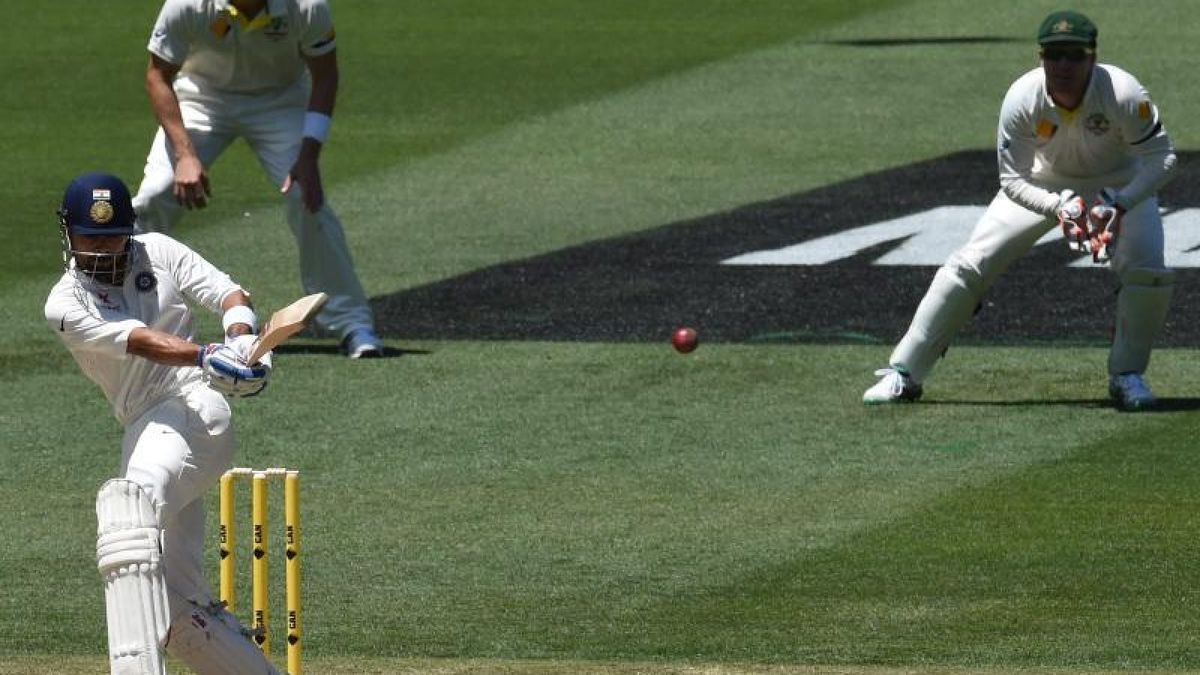
板球(或称木球、桨球、柴球,英语:Cricket)是由两队各十一人进行对抗比赛的一项团队运动。其现代形式起源于英格兰,盛行于英联邦国家,如在英国、澳大利亚、新西兰、印度、南亚、非洲南部、西印度群岛等地。板球的球季主要在春季与夏季,与在秋季与冬季踢的足球互补。
板球比赛时间长度不一,国际板球对抗赛的一场比赛每天进行六小时或以上,并长达五天;还有许多午餐和饮茶的休息时间;以及丰富的板球术语,都使板球门外汉非常困扰。但对于球迷来讲,这项运动以及顶尖板球国家队之间的激烈竞争,都为他们提供了充满激情的娱乐。
Cricket (englisch [ˈkɹɪkɪt]; in Deutschland amtlich auch Kricket,[1][2] in den Anfängen auch Thorball) ist ein Schlagballspiel, bei dem zwei Mannschaften mit jeweils elf Spielern gegeneinander antreten. Kernelement des Spiels ist das Duell zwischen dem Bowler (Werfer) und dem Batter (Schlagmann). Während der Bowler versucht, den Batter zu einem Fehler zu bewegen und damit ausscheiden zu lassen, versucht der Batter seinerseits, durch Wegschlagen des Balls sogenannte Runs (Punkte) zu erzielen. Der Bowler wird in seiner Aufgabe durch die anderen Feldspieler unterstützt, die versuchen, den Ball so schnell wie möglich zurückzubringen.
 Wirtschaft und Handel
Asia-Pacific Economic Cooperation,APEC
Wirtschaft und Handel
Asia-Pacific Economic Cooperation,APEC
 Australian Capital Territory-ACT
Australien
Beijing Shi-BJ
Australian Capital Territory-ACT
Australien
Beijing Shi-BJ
 British Columbia-BC
Brunei Darussalam
Chile
China
British Columbia-BC
Brunei Darussalam
Chile
China
 Hand in Hand
 Hawaii-HI
Hongkong Tebiexingzhengqu-HK
Indonesien
Japan
Kanada
Kantō
Kinki
Malaysia
Mexiko
Neuseeland
Hawaii-HI
Hongkong Tebiexingzhengqu-HK
Indonesien
Japan
Kanada
Kantō
Kinki
Malaysia
Mexiko
Neuseeland
 New South Wales-NSW
Papua-Neuguinea
New South Wales-NSW
Papua-Neuguinea
 Parteien und Regierung
Asia-Pacific Economic Cooperation,APEC
Peru
Philippinen
Republik Korea
Russland
Shanghai Shi-SH
Singapur
Taiwan Sheng-TW
Thailand
Vereinigte Staaten
Vietnam
Parteien und Regierung
Parteien und Regierung
Asia-Pacific Economic Cooperation,APEC
Peru
Philippinen
Republik Korea
Russland
Shanghai Shi-SH
Singapur
Taiwan Sheng-TW
Thailand
Vereinigte Staaten
Vietnam
 Washington-WA
 Wichtige internationale Organisationen
亚太经济合作组织(简称亚太经合组织;英语:Asia-Pacific Economic Cooperation,缩写:APEC),是亚太区内各地区之间促进经济成长、合作、贸易、投资的论坛。此组织的创办在历史上取代了该区域的冷战结构,但由于日本在该区域会因过去历史记忆引发负面评价,所以由澳大利亚主导创始事项[1]。
始设于1989年,现有21个经济体成员。亚太经合组织是经济合作的论坛平台,其运作是通过非约束性的承诺与成员的自愿,强调开放对话及平等尊重各成员意见,不同于其他经由条约确立的政府间组织。“APEC”与“Asia-Pacific Economic Cooperation”均是亚太经济合作组织的注册商标。[2]
Die Asiatisch-Pazifische Wirtschaftsgemeinschaft (für englisch Asia-Pacific Economic Cooperation, kurz APEC, auch übersetzt als Asiatisch-Pazifische Wirtschaftskooperation oder Asien-Pazifik-Forum) ist eine internationale Organisation, die es sich zum Ziel gesetzt hat, im pazifischen Raum eine Freihandelszone einzurichten.
In den 21 APEC-Staaten lebt knapp die Hälfte der Weltbevölkerung. Der Wirtschaftsraum erbringt mehr als die Hälfte der Weltwirtschaftsleistung und ist eine der am schnellsten wachsenden Wirtschaftsregionen der Welt.
アジア太平洋経済協力会議(アジアたいへいようけいざいきょうりょくかいぎ、英: Asia-Pacific Economic Cooperation)は、環太平洋地域における多国間経済協力を進めるための非公式なフォーラム[2]である。略称、APEC(エイペック[3][4])。
「アジア太平洋」という概念が最初に打ち出されたのは、永野重雄が1967年に発足させた太平洋経済委員会(PBEC)という経済団体の設立時であるとされるが[5][6][7]、具体的にこうした地域概念が政府レベルの協力枠組みに発展する萌芽は、1978年、日本の大平正芳首相が就任演説で「環太平洋連帯構想」を呼びかけたことにある。これを具体化した大平政権の政策研究会「環太平洋連帯研究グループ」(議長:大来佐武郎、幹事佐藤誠三郎)の報告を受け、大平がオーストラリアのマルコム・フレイザー首相に提案して強い賛同を得たことが、1980年9月の太平洋経済協力会議(PECC)の設立につながった。PECCは地域における様々な課題を議論し研究するセミナーといった趣のものであったが、これを土台にして、各国政府が正式に参加する会合として設立されたのが、APECである[8][9]。
APECは、1989年にオーストラリアのホーク首相の提唱で、日本・アメリカ合衆国・カナダ・韓国・オーストラリア・ニュージーランド及び当時の東南アジア諸国連合(ASEAN)加盟6か国の計12か国で発足し、同国のキャンベラで閣僚会議(Ministerial Meeting)を開催した。また、1993年には米国のシアトルで初の首脳会議(Economic Leaders' Meeting)がもたれた。現在は、首脳会議、及び、外相、経済担当相による閣僚会議をそれぞれ年1回開いている。シンガポールに常設事務局を置き、開催国から任期1年で事務局長が選任されている[10]。 参加しているメンバーは、21カ国・地域で、2012年現在、人口では世界の41.4%、GDP(国内総生産)では57.8%、貿易額では47%を占めている。
APECは、開かれた地域協力によって経済のブロック化を抑え、域内の貿易・投資の自由化を通じて、世界貿易機関(WTO)のもとでの多角的自由貿易体制を維持・発展することを目的としてきたが、近年のWTOの新ラウンドの停滞や自由貿易協定締結の動きの活発化などによって、その存在意義が問われている。
Asia-Pacific Economic Cooperation (APEC) is an inter-governmental forum for 21 Pacific Rim member economies[2] that promotes free trade throughout the Asia-Pacific region. Inspired from the success of Association of Southeast Asian Nations (ASEAN)’s series of post-ministerial conferences launched in the mid-1980s, the APEC was established in 1989 in response to the growing interdependence of Asia-Pacific economies and the advent of regional trade blocs in other parts of the world; and to establish new markets for agricultural products and raw materials beyond Europe.[3][4][5] Headquartered in Singapore, the APEC is recognised as one of the oldest forums and highest-level multilateral blocs in the Asia-Pacific region, and exerts a significant global influence.[6][7][8][9][10][11]
An annual APEC Economic Leaders' Meeting is attended by the heads of government of all APEC members except Republic of China (Taiwan) (which is represented by a ministerial-level official under the name Republic of China as economic leader).[12] The location of the meeting rotates annually among the member economies, and a famous tradition, followed for most (but not all) summits, involves the attending leaders dressing in a national costume of the host country. APEC has three official observers: the Association of Southeast Asian Nations Secretariat, the Pacific Economic Cooperation Council and the Pacific Islands Forum Secretariat.[13] APEC's Host Economy of the Year is considered to be invited in the first place for geographical representation to attend G20 meetings following G20 guidelines.[14][15][16][17]
La Coopération économique pour l'Asie-Pacifique (en anglais : Asia-Pacific Economic Cooperation, APEC) est un forum économique intergouvernemental visant à faciliter la croissance économique, la coopération, les échanges et l'investissement de la région Asie Pacifique. Elle se réunit chaque année1.
L'Asia-Pacific Economic Cooperation (APEC), ossia Cooperazione Economica Asiatico-Pacifica, è un organismo nato nel 1989 allo scopo di favorire la cooperazione (o, più in generale, la crescita) economica, il libero scambio e gli investimenti nell'area asiatico-pacifica. Tale area (come suggerisce il logo stesso dell'APEC) coincide non solo con l'Asia Pacifica, ma potenzialmente con l'intero Pacific Rim.
L'APEC ha sede a Singapore, Paese considerato una delle tigri dell'Asia.
Dal punto di vista del diritto internazionale l'APEC si definisce organismo e non organizzazione internazionale perché, essendo composto da economie e non da Stati, è privo di una piena personalità giuridica. Ciò spiega, fra l'altro, come mai possano farne parte contemporaneamente la Cina continentale, Hong Kong e Taiwan, ossia tre realtà che, territorialmente (secondo Pechino e secondo tutti i governi che intrattengono relazioni diplomatiche con Pechino), appartengono a un unico Stato: la Repubblica Popolare di Cina.
APEC (Asia-Pacific Economic Cooperation, en español Foro de Cooperación Económica Asia-Pacífico) es un foro multilateral creado en 1989, con el fin de consolidar el crecimiento y la prosperidad de los países del Pacífico, que trata temas relacionados con el intercambio comercial, coordinación económica y cooperación entre sus integrantes.1
Como mecanismo de cooperación y concertación económica, está orientado a la promoción y facilitación del comercio, las inversiones, la cooperación económica y técnica y al desarrollo económico regional de los países y territorios de la cuenca del océano Pacífico. Fomentando un crecimiento económico inclusivo, equitativo, sustentable e innovador.2
La suma del Producto Nacional Bruto de las veintiuna economías que conforman el APEC equivale al 56 % de la producción mundial, en tanto que en su conjunto representan el 46 % del comercio global.
La APEC no tiene un tratado formal. Sus decisiones se toman por consenso y funciona con base en declaraciones no vinculantes. Tiene una Secretaría General, con sede en Singapur, que es la encargada de coordinar el apoyo técnico y de consultoría. Cada año uno de los países miembros es huésped de la reunión anual de la APEC. La vigésimo novena cumbre se realizó en noviembre de 2017 en Da Nang, Vietnam; y la próxima será en Santiago, Chile.
Азиатско-Тихоокеанское экономическое сотрудничество (АТЭС) (англ. Asia-Pacific Economic Cooperation, APEC) — форум 21 экономики Азиатско-Тихоокеанского региона для сотрудничества в области региональной торговли и облегчения и либерализации капиталовложений.
Целью АТЭС является повышение экономического роста, процветания в регионе и укрепление азиатско-тихоокеанского сообщества. В экономиках-участницах проживает около 40 % мирового населения, на них приходится приблизительно 54 % ВВП и 44 % мировой торговли[1].
Afghanistan
Ägypten
Albanien
Angola
Antigua und Barbuda
Argentinien
Armenien
Australien
Bahrain
Bangladesh
Barbados
Belgien
Belize
Benin
Bolivien
Botsuana
Brasilien
Brunei Darussalam
Bulgarien
Burkina Faso
Burundi
Chile
China
Columbia
Costa Rica
Côte d´Ivoire
Cuba
Dänemark
Demokratische Republik Kongo
Deutschland
Dominica
Dominikanische Republik
Dschibuti
Ecuador
Estland
 Europäische Union
Fidschi
Europäische Union
Fidschi
 Finanz
Finnland
Frankreich
Gabun
Gambia
Georgien
Ghana
Grenada
Griechenland
Guatemala
Guinea
Guinea-Bissau
Guyana
Honduras
Hongkong Tebiexingzhengqu-HK
Indien
Indonesien
Irland
Island
Israel
Italien
Jamaika
Japan
Jemen
Jordanien
Kambodscha
Kamerun
Kanada
Kap Verde
Kasachstan
Katar
Kenia
Kirgisistan
Kroatien
Kuwait
Laos
Lesotho
Lettland
Liberia
Liechtenstein
Litauen
Luxemburg
Macau Tebiexingzhengqu-MO
Madagaskar
Malawi
Malta
Marokko
Mauretanien
Mauritius
Mexiko
Moldawien
Finanz
Finnland
Frankreich
Gabun
Gambia
Georgien
Ghana
Grenada
Griechenland
Guatemala
Guinea
Guinea-Bissau
Guyana
Honduras
Hongkong Tebiexingzhengqu-HK
Indien
Indonesien
Irland
Island
Israel
Italien
Jamaika
Japan
Jemen
Jordanien
Kambodscha
Kamerun
Kanada
Kap Verde
Kasachstan
Katar
Kenia
Kirgisistan
Kroatien
Kuwait
Laos
Lesotho
Lettland
Liberia
Liechtenstein
Litauen
Luxemburg
Macau Tebiexingzhengqu-MO
Madagaskar
Malawi
Malta
Marokko
Mauretanien
Mauritius
Mexiko
Moldawien
 Mongolei
Montenegro
Mosambik
Myanmar
Namibia
Nepal
Neuseeland
Nicaragua
Niederlande
Niger
Nigeria
Nordmazedonien
Norwegen
Oman
Österreich
Pakistan
Panama
Papua-Neuguinea
Paraguay
Peru
Philippinen
Polen
Portugal
Republik El Salvador
Republik Haiti
Republik Kongo
Republik Korea
Ruanda
Rumänien
Russland
Salomonen
Sambia
Samoa
Saudi-Arabien
Schweden
Schweden
Schweiz
Genf
Senegal
Seychellen
Sierra Leone
Simbabwe
Singapur
Slowakei
Slowenien
Spanien
Sri Lanka
St. Kitts und Nevis
St. Lucia
St. Vincent und die Grenadinen
Südafrika
Suriname
Swasiland
Tadschikistan
Taiwan Sheng-TW
Tansania
Thailand
Togo
Tonga
Trinidad und Tobago
Tschad
Tschechien
Tunesien
Türkei
Uganda
Ukraine
Ungarn
Uruguay
Vanuatu
Venezuela
Vereinigte Arabische Emirate
Vereinigte Staaten
Vereinigtes Königreich
Vietnam
Wichtige internationale Organisationen
World Trade Organization
Roberto Azevêdo
World Trade Organization
Mike Moore
World Trade Organization
Ngozi Okonjo-Iweala
World Trade Organization
Pascal Lamy
World Trade Organization
Peter Sutherland
World Trade Organization
Renato Ruggiero
World Trade Organization
Supachai Panitchpakdi
Zentralafrikanische Republik
Zypern
Mongolei
Montenegro
Mosambik
Myanmar
Namibia
Nepal
Neuseeland
Nicaragua
Niederlande
Niger
Nigeria
Nordmazedonien
Norwegen
Oman
Österreich
Pakistan
Panama
Papua-Neuguinea
Paraguay
Peru
Philippinen
Polen
Portugal
Republik El Salvador
Republik Haiti
Republik Kongo
Republik Korea
Ruanda
Rumänien
Russland
Salomonen
Sambia
Samoa
Saudi-Arabien
Schweden
Schweden
Schweiz
Genf
Senegal
Seychellen
Sierra Leone
Simbabwe
Singapur
Slowakei
Slowenien
Spanien
Sri Lanka
St. Kitts und Nevis
St. Lucia
St. Vincent und die Grenadinen
Südafrika
Suriname
Swasiland
Tadschikistan
Taiwan Sheng-TW
Tansania
Thailand
Togo
Tonga
Trinidad und Tobago
Tschad
Tschechien
Tunesien
Türkei
Uganda
Ukraine
Ungarn
Uruguay
Vanuatu
Venezuela
Vereinigte Arabische Emirate
Vereinigte Staaten
Vereinigtes Königreich
Vietnam
Wichtige internationale Organisationen
World Trade Organization
Roberto Azevêdo
World Trade Organization
Mike Moore
World Trade Organization
Ngozi Okonjo-Iweala
World Trade Organization
Pascal Lamy
World Trade Organization
Peter Sutherland
World Trade Organization
Renato Ruggiero
World Trade Organization
Supachai Panitchpakdi
Zentralafrikanische Republik
Zypern

世界贸易组织(简称世贸组织或世贸;英语:World Trade Organization,缩写为 WTO;法语:Organisation Mondiale du Commerce,缩写为 OMC;西班牙语:Organización Mundial del Comercio,缩写为 OMC)是负责监督成员经济体之间各种贸易协议得到执行的一个国际组织,前身是1948年起实施的关税及贸易总协定的秘书处。
世贸总部位于瑞士日内瓦,现任总干事是罗伯托·阿泽维多。截至2016年7月29日,世界贸易组织共有164个成员。[5]世界贸易组织的职能是调解纷争,加入WTO不算签订一种多边贸易协议,但其设置的入会门槛可以做为愿意降低关税、法政上配合、参与国际贸易的门票,它是贸易体制的组织基础和法律基础,是众多贸易协定的管理者,是各成员贸易立法的监督者,是就贸易提供解决争端和进行谈判的场所。该机构是当代最重要的国际经济组织之一,其成员间的贸易额占世界贸易额的绝大多数,被称为“经济联合国”。
Die Welthandelsorganisation (englisch World Trade Organization, WTO; französisch Organisation mondiale du commerce, OMC; spanisch Organización Mundial de Comercio, OMC) ist eine internationale Organisation mit Sitz in Genf, die sich mit der Regelung von Handels- und Wirtschaftsbeziehungen beschäftigt. Sie wurde am 15. April 1994 aus dem General Agreement on Tariffs and Trade (GATT) in der Uruguay-Runde nach siebenjähriger Verhandlungszeit gegründet. Am 1. Januar 1995 nahm sie ihre Arbeit in Genf auf. Die WTO ist neben dem IWF und der Weltbank eine der zentralen internationalen Organisationen, die Handels- und Wirtschaftspolitik mit globaler Reichweite verhandelt.
世界貿易機関(せかいぼうえききかん、英: World Trade Organization、略称:WTO)は、自由貿易促進を主たる目的として創設された国際機関である。常設事務局がスイスのジュネーブに置かれている。
GATT(ガット)ウルグアイ・ラウンドにおける合意によって、世界貿易機関を設立するマラケシュ協定(WTO設立協定)に基づいて1995年1月1日にGATTを発展解消させて成立した。
本来GATTは、第二次世界大戦後の安定を見据え、国際通貨基金および国際復興開発銀行とともに設立が予定されていた国際貿易機関(ITO)の設立準備の際に、暫定協定として結ばれたものであった。国際貿易機関の設立が廃案となり、GATTがその代替として発展強化されていくうちに、再びこの分野の常設機関が求められ、WTOが設立されることとなった。発展解消であるため、GATTの事務局及び事務局長もWTOへと引き継がれることとなった[4]。
WTOはGATTを継承したものであるが、GATTが協定(Agreement)に留まったのに対し、WTOは機関(Organization)であるのが根本的な違いである。
を基本原則としている。また、物品貿易だけでなく金融、情報通信、知的財産権やサービス貿易も含めた包括的な国際通商ルールを協議する場である。
対抗処置の発動では、紛争処理機関(パネル)の提訴に対し全加盟国による反対がなければ採択されるというネガティブ・コンセンサス方式(逆コンセンサス方式)を採用した強力な紛争処理能力を持つ。これは国際組織としては稀な例であり、コンセンサス方式を採っていたGATTとの大きな違いで、WTOの特徴の一つといえる。
新多角的貿易交渉(新ラウンド)は、2001年11月にカタールのドーハで行われた第4回WTO閣僚会議で開始を決定し、ドーハ・ラウンドと呼ばれていた。2002年2月1日の貿易交渉委員会で新ラウンドがスタートした。しかし9年に及ぶ交渉は先進国と、急速に台頭してきたBRICsなど新興国との対立によって中断と再開を繰り返した末、ジュネーブで行われた第4回WTO閣僚会議(2011年12月17日)で「交渉を継続していくことを確認するものの、近い将来の妥結を断念する」(議長総括)となり事実上停止状態になった。
その後、2013年のバリ島における閣僚会議で、貿易円滑化協定を含む合意が成立し、2014年7月まで貿易円滑化協定をWTO協定に加える(附属書1Aに追加)するための文書を一般理事会で採択すべきとされた[5]。しかしインドが合意を蒸し返す状態で反対したため期限までに採択できなかった[6]。その後食糧備蓄への補助金の問題で先進国側が譲歩することでようやくインドが合意し、2014年11月27日の一般理事会で貿易円滑化協定が採択された[6]。WTO加盟国の3分の2が改正を受諾した日に発効することになっており、2017年2月22日にこの要件を満たし、協定が発効した。
The World Trade Organization (WTO) is an intergovernmental organization that regulates international trade. The WTO officially commenced on 1 January 1995 under the Marrakesh Agreement, signed by 124 nations on 15 April 1994, replacing the General Agreement on Tariffs and Trade (GATT), which commenced in 1948. It is the largest international economic organization in the world.[5][6]
The WTO deals with regulation of trade in goods, services and intellectual property between participating countries by providing a framework for negotiating trade agreements and a dispute resolution process aimed at enforcing participants' adherence to WTO agreements, which are signed by representatives of member governments[7]:fol.9–10 and ratified by their parliaments.[8] The WTO prohibits discrimination between trading partners, but provides exceptions for environmental protection, national security, and other important goals.[9] Trade-related disputes are resolved by independent judges at the WTO through a dispute resolution process.[9]
The WTO's current Director-General is Roberto Azevêdo,[10][11] who leads a staff of over 600 people in Geneva, Switzerland.[12] A trade facilitation agreement, part of the Bali Package of decisions, was agreed by all members on 7 December 2013, the first comprehensive agreement in the organization's history.[13][14] On 23 January 2017, the amendment to the WTO Trade Related Aspects of Intellectual Property Rights (TRIPS) Agreement marks the first time since the organization opened in 1995 that WTO accords have been amended, and this change should secure for developing countries a legal pathway to access affordable remedies under WTO rules.[15]
Studies show that the WTO boosted trade,[16][17][9] and that barriers to trade would be higher in the absence of the WTO.[18] The WTO has highly influenced the text of trade agreements, as "nearly all recent [preferential trade agreements (PTAs)] reference the WTO explicitly, often dozens of times across multiple chapters... in many of these same PTAs we find that substantial portions of treaty language—sometime the majority of a chapter—is copied verbatim from a WTO agreement."[19]
L'Organisation mondiale du commerce (OMC ; en anglais : World Trade Organization, WTO, en espagnol : Organización Mundial del Comercio, OMC) est une organisation internationale qui s'occupe des règles régissant le commerce international entre les pays. Au cœur de l'organisation se trouvent les accords de l'OMC, négociés et signés en avril 1994 à Marrakech1 par la majeure partie des puissances commerciales du monde2 et ratifiés par leurs assemblées parlementaires. L'OMC a pour but principal de favoriser l'ouverture commerciale. Pour cela, elle tâche de réduire les obstacles au libre-échange, d'aider les gouvernements à régler leurs différends commerciaux et d'assister les exportateurs, les importateurs et les producteurs de marchandises et de services dans leurs activités.
Depuis 2001, le cycle de négociation mené par l'OMC est le Cycle de Doha3. Bien que l'OMC ne soit pas une agence spécialisée de l'ONU, elle entretient des liens avec cette dernière4. Le siège de l'OMC est au Centre William-Rappard, à Genève. Depuis le 1er septembre 2013, l'organisation est présidée par le Brésilien Roberto Azevêdo qui a été élu directeur général.
L'Organizzazione mondiale del commercio, abbreviato in OMC (in inglese: World Trade Organization, WTO), è un'organizzazione internazionale creata allo scopo di supervisionare numerosi accordi commerciali tra gli stati membri. Vi aderiscono[3] 164 Paesi, a cui se ne aggiungono altri 22 con ruolo di osservatori,[4] comprendendo così oltre il 95% del commercio mondiale di beni e servizi.[5]
La sede dell'OMC si trova, dal 1995, presso il Centro William Rappard a Ginevra, Svizzera.[6]
La Organización Mundial del Comercio (OMC) fue establecida en 1995. Tiene su sede en Ginebra, Suiza, y sus idiomas oficiales son el inglés, el francés y el español. La OMC no forma parte del sistema de las Naciones Unidas, y tampoco de los organismos de Bretton Woods como el Banco Mundial o el FMI.Nota 1
Всеми́рная торго́вая организа́ция (ВТО; англ. World Trade Organization (WTO), фр. Organisation mondiale du commerce (OMC), исп. Organización Mundial del Comercio) — международная организация, созданная 1 января 1995 года с целью либерализации международной торговли и регулирования торгово-политических отношений государств-членов. ВТО образована на основе Генерального соглашения по тарифам и торговле (ГАТТ), заключенного в 1947 году и на протяжении почти 50 лет фактически выполнявшего функции международной организации, но не являвшегося тем не менее международной организацией в юридическом смысле.
ВТО отвечает за разработку и внедрение новых торговых соглашений, а также следит за соблюдением членами организации всех соглашений, подписанных большинством стран мира и ратифицированных их парламентами. ВТО строит свою деятельность, исходя из решений, принятых в 1986—1994 годах в рамках Уругвайского раунда и более ранних договоренностей ГАТТ. Обсуждения проблем и принятие решений по глобальным проблемам либерализации и перспективам дальнейшего развития мировой торговли проходят в рамках многосторонних торговых переговоров (раунды). К настоящему времени проведено 8 раундов таких переговоров, включая Уругвайский, а в 2001 году стартовал девятый в Дохе, Катар. Организация пытается завершить переговоры по Дохийскому раунду переговоров, который был начат с явным акцентом на удовлетворение потребностей развивающихся стран. По состоянию на декабрь 2012 года будущее раунда переговоров в Дохе остаётся неопределённым: программа работы состоит из 21 части, а первоначально установленный окончательный срок 1 января 2005 года был давно пропущен[3]. В ходе переговоров возник конфликт между стремлением к свободной торговле и стремлением множества стран к протекционизму, особенно в плане сельскохозяйственных субсидий. До сих пор эти препятствия остаются главными и мешают любому прогрессу для запуска новых переговоров в рамках Дохийского раунда. По состоянию на июль 2012 года, существуют различные группы переговоров в системе ВТО для решения текущих вопросов в плане сельского хозяйства, что приводит к застою в самих переговорах[4].
Штаб-квартира ВТО расположена в Женеве, Швейцария. Глава ВТО (генеральный директор) — Роберту Карвалью ди Азеведу, в штате самой организации около 600 человек[5].
На 26 апреля 2015 года в ВТО состояли 162 страны[6].
Правила ВТО предусматривают ряд льгот для развивающихся стран. В настоящее время развивающиеся страны — члены ВТО имеют (в среднем) более высокий относительный уровень таможенно-тарифной защиты своих рынков по сравнению с развитыми. Тем не менее, в абсолютном выражении общий размер таможенно-тарифных санкций в развитых странах гораздо выше, вследствие чего доступ на рынки высокопередельной продукции из развивающихся стран серьёзно ограничен[7].
Правила ВТО регулируют только торгово-экономические вопросы. Попытки США и ряда европейских стран начать дискуссию об условиях труда (что позволило бы считать недостаточную законодательную защиту работников конкурентным преимуществом) были отвергнуты из-за протестов развивающихся стран, которые утверждали, что такие меры только ухудшат благосостояние работников в связи с сокращением числа рабочих мест, снижением доходов и уровня конкурентоспособности[7].
Mitglieder der WTO
| Staat | Beitrittsdatum |
|---|---|
 Ägypten Ägypten |
30. Juni 1995 |
 Afghanistan Afghanistan |
29. Juli 2016 |
 Albanien Albanien |
8. September 2000 |
 Angola Angola |
23. November 1996 |
 Antigua und Barbuda Antigua und Barbuda |
1. Januar 1995 |
 Argentinien Argentinien |
1. Januar 1995 |
 Armenien Armenien |
5. Februar 2003 |
 Australien Australien |
1. Januar 1995 |
 Bahrain Bahrain |
1. Januar 1995 |
 Bangladesch Bangladesch |
1. Januar 1995 |
 Barbados Barbados |
1. Januar 1995 |
 Belgien Belgien |
1. Januar 1995 |
 Belize Belize |
1. Januar 1995 |
 Benin Benin |
22. Februar 1996 |
 Bolivien Bolivien |
12. September 1995 |
 Botswana Botswana |
31. Mai 1995 |
 Brasilien Brasilien |
1. Januar 1995 |
 Brunei Brunei |
1. Januar 1995 |
 Bulgarien Bulgarien |
1. Dezember 1996 |
 Burkina Faso Burkina Faso |
3. Juni 1995 |
 Burundi Burundi |
23. Juli 1995 |
 Chile Chile |
1. Januar 1995 |
 Volksrepublik China Volksrepublik China |
11. Dezember 2001 |
 Costa Rica Costa Rica |
1. Januar 1995 |
 Dänemark Dänemark |
1. Januar 1995 |
 Deutschland Deutschland |
1. Januar 1995 |
 Dominica Dominica |
1. Januar 1995 |
 Dominikanische Republik Dominikanische Republik |
9. März 1995 |
 Dschibuti Dschibuti |
31. Mai 1995 |
 Ecuador Ecuador |
21. Januar 1996 |
 El Salvador El Salvador |
7. Mai 1995 |
 Elfenbeinküste Elfenbeinküste |
1. Januar 1995 |
 Estland Estland |
13. November 1999 |
 Eswatini Eswatini |
1. Januar 1995 |
 Europäische Union Europäische Union |
1. Januar 1995 |
 Fidschi Fidschi |
14. Januar 1996 |
 Finnland Finnland |
1. Januar 1995 |
 Frankreich Frankreich |
1. Januar 1995 |
 Gabun Gabun |
1. Januar 1995 |
 Gambia Gambia |
23. Oktober 1996 |
 Georgien Georgien |
14. Juni 2000 |
 Ghana Ghana |
1. Januar 1995 |
 Grenada Grenada |
22. Februar 1996 |
 Griechenland Griechenland |
1. Januar 1995 |
 Guatemala Guatemala |
21. Juli 1995 |
 Guinea Guinea |
25. Oktober 1995 |
 Guinea-Bissau Guinea-Bissau |
31. Mai 1995 |
 Guyana Guyana |
1. Januar 1995 |
 Haiti Haiti |
30. Januar 1996 |
 Honduras Honduras |
1. Januar 1995 |
 Hongkong Hongkong |
1. Januar 1995 |
 Indien Indien |
1. Januar 1995 |
 Indonesien Indonesien |
1. Januar 1995 |
 Irland Irland |
1. Januar 1995 |
 Island Island |
1. Januar 1995 |
 Israel Israel |
21. April 1995 |
 Italien Italien |
1. Januar 1995 |
 Jamaika Jamaika |
9. März 1995 |
 Jemen Jemen |
26. Juni 2014 |
 Japan Japan |
1. Januar 1995 |
 Jordanien Jordanien |
11. April 2000 |
 Kambodscha Kambodscha |
13. Oktober 2004 |
 Kamerun Kamerun |
13. Dezember 1995 |
 Kanada Kanada |
1. Januar 1995 |
 Kap Verde Kap Verde |
23. Juli 2008 |
 Kasachstan Kasachstan |
30. November 2015 |
 Katar Katar |
13. Januar 1996 |
 Kenia Kenia |
1. Januar 1995 |
 Kirgisistan Kirgisistan |
20. Dezember 1998 |
 Kolumbien Kolumbien |
30. April 1995 |
 Demokratische Republik Kongo Demokratische Republik Kongo |
1. Januar 1997 |
 Republik Kongo Republik Kongo |
27. März 1997 |
 Kroatien Kroatien |
30. November 2000 |
 Kuba Kuba |
20. April 1995 |
 Kuwait Kuwait |
1. Januar 1995 |
 Laos Laos |
2. Februar 2013 |
 Lesotho Lesotho |
31. Mai 1995 |
 Lettland Lettland |
10. Februar 1999 |
 Liberia Liberia |
14. Juli 2016 |
 Liechtenstein Liechtenstein |
1. September 1995 |
 Litauen Litauen |
31. Mai 2001 |
 Luxemburg Luxemburg |
1. Januar 1995 |
 Macau Macau |
1. Januar 1995 |
 Madagaskar Madagaskar |
17. November 1995 |
 Montenegro Montenegro |
29. April 2012 |
 Malawi Malawi |
31. Mai 1995 |
 Malaysia Malaysia |
1. Januar 1995 |
 Malediven Malediven |
31. Mai 1995 |
 Mali Mali |
31. Mai 1995 |
 Malta Malta |
1. Januar 1995 |
 Marokko Marokko |
1. Januar 1995 |
 Mauretanien Mauretanien |
31. Mai 1995 |
 Mauritius Mauritius |
1. Januar 1995 |
 Nordmazedonien Nordmazedonien |
4. April 2003 |
 Mexiko Mexiko |
1. Januar 1995 |
 Moldau Moldau |
26. Juli 2001 |
 Mongolei Mongolei |
29. Januar 1997 |
 Mosambik Mosambik |
26. August 1995 |
 Myanmar Myanmar |
1. Januar 1995 |
 Namibia Namibia |
1. Januar 1995 |
 Nepal Nepal |
23. April 2004 |
 Neuseeland Neuseeland |
1. Januar 1995 |
 Nicaragua Nicaragua |
3. September 1995 |
 Niederlande Niederlande |
1. Januar 1995 |
 Niger Niger |
13. Dezember 1996 |
 Nigeria Nigeria |
1. Januar 1995 |
 Norwegen Norwegen |
1. Januar 1995 |
 Oman Oman |
9. November 2000 |
 Österreich Österreich |
1. Januar 1995 |
 Pakistan Pakistan |
1. Januar 1995 |
 Panama Panama |
6. September 1997 |
 Papua-Neuguinea Papua-Neuguinea |
9. Juni 1996 |
 Paraguay Paraguay |
1. Januar 1995 |
 Peru Peru |
1. Januar 1995 |
 Philippinen Philippinen |
1. Januar 1995 |
 Polen Polen |
1. Juli 1995 |
 Portugal Portugal |
1. Januar 1995 |
 Ruanda Ruanda |
22. Mai 1996 |
 Rumänien Rumänien |
1. Januar 1995 |
 Russland Russland |
22. August 2012 |
 Salomonen Salomonen |
26. Juli 1996 |
 Sambia Sambia |
1. Januar 1995 |
 Saudi-Arabien Saudi-Arabien |
11. Dezember 2005 |
 Samoa Samoa |
10. Mai 2012 |
 Schweden Schweden |
1. Januar 1995 |
 Schweiz Schweiz |
1. Januar 1995 |
 Senegal Senegal |
1. Januar 1995 |
 Seychellen Seychellen |
26. April 2015 |
 Sierra Leone Sierra Leone |
23. Juli 1995 |
 Simbabwe Simbabwe |
5. März 1995 |
 Singapur Singapur |
1. Januar 1995 |
 Slowakei Slowakei |
1. Januar 1995 |
 Slowenien Slowenien |
30. Juli 1995 |
 Spanien Spanien |
1. Januar 1995 |
 Sri Lanka Sri Lanka |
1. Januar 1995 |
 St. Kitts und Nevis St. Kitts und Nevis |
21. Februar 1996 |
 St. Lucia St. Lucia |
1. Januar 1995 |
 St. Vincent und die Grenadinen St. Vincent und die Grenadinen |
1. Januar 1995 |
 Südafrika Südafrika |
1. Januar 1995 |
 Südkorea Südkorea |
1. Januar 1995 |
 Suriname Suriname |
1. Januar 1995 |
 Tadschikistan Tadschikistan |
2. März 2013 |
 Taiwan[1] Taiwan[1] |
1. Januar 2002 |
 Tansania Tansania |
1. Januar 1995 |
 Thailand Thailand |
1. Januar 1995 |
 Togo Togo |
31. Mai 1995 |
 Tonga Tonga |
27. Juli 2007 |
 Trinidad und Tobago Trinidad und Tobago |
1. März 1995 |
 Tschad Tschad |
19. Oktober 1996 |
 Tschechien Tschechien |
1. Januar 1995 |
 Tunesien Tunesien |
29. März 1995 |
 Türkei Türkei |
26. März 1995[2] |
 Uganda Uganda |
1. Januar 1995 |
 Ukraine Ukraine |
16. Mai 2008 |
 Ungarn Ungarn |
1. Januar 1995 |
 Uruguay Uruguay |
1. Januar 1995 |
 Venezuela Venezuela |
1. Januar 1995 |
 Vereinigte Arabische Emirate Vereinigte Arabische Emirate |
10. April 1996 |
 Vereinigtes Königreich Vereinigtes Königreich |
1. Januar 1995 |
 Vereinigte Staaten Vereinigte Staaten |
1. Januar 1995 |
 Vanuatu Vanuatu |
24. August 2012 |
 Vietnam Vietnam |
11. Januar 2007 |
 Zentralafrikanische Republik Zentralafrikanische Republik |
31. Mai 1995 |
 Zypern Zypern |
30. Juli 1995 |
China
Italien
Japan
Legende
Nepal
Neuseeland
Österreich
Polen
Schweiz
Vereinigte Staaten
Vereinigtes Königreich
Xizang Zizhiqu-XZ
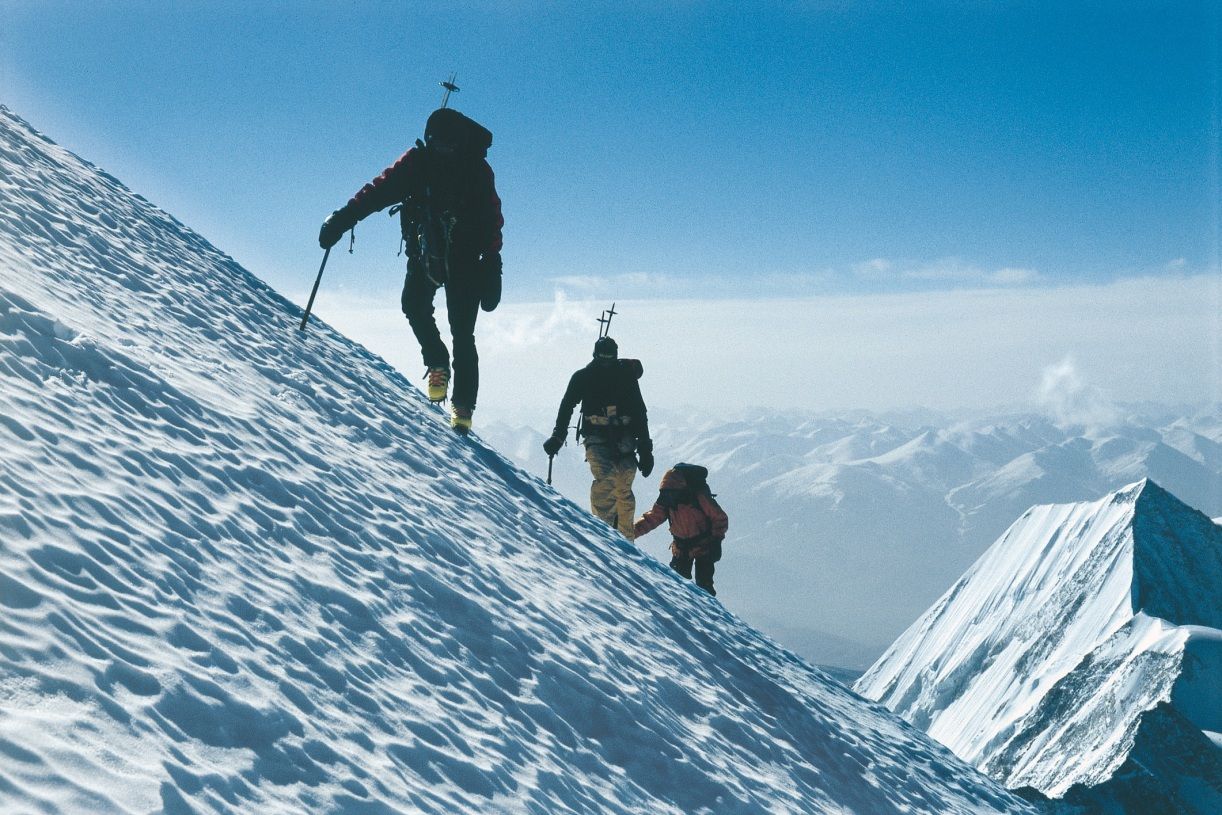
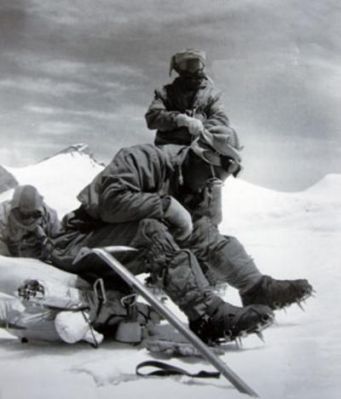
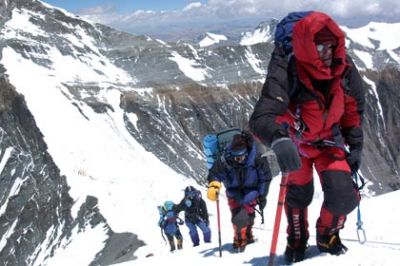
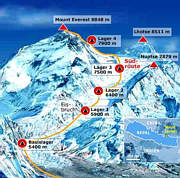
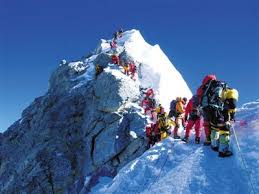
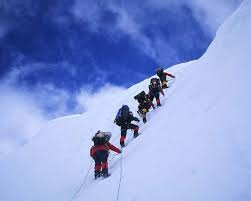
珠穆朗玛峰山体呈巨型金字塔状,威武雄壮昂首天外,地形极端险峻,环境异常复杂。雪线高度:北坡为5800—6200米,南坡为5500—6100米。东北山脊、 东南山脊和西山山脊中间夹着三大陡壁(北壁、东壁和西南壁),在这些山脊 和峭壁之间又分布着548条大陆型冰川,总面积达1457.07平方公里,平均厚度达7260米。冰川的补给主要靠印度洋季风带两大降水带积雪变质形成。冰川上 有千姿百态、瑰丽罕见的冰塔林,又有高达数十米的冰陡崖和步步陷井的明暗 冰裂隙,还有险象环生的冰崩雪崩区。(Quelle:http://news.xinhuanet.com)
珠穆朗玛峰(藏文:ཇོ་མོ་གླང་མ;藏语拼音:qomolangma;威利:jo mo glang ma,香港称珠穆朗玛峰,台湾称圣母峰),中文简称珠峰,尼泊尔名萨加玛塔峰(尼泊尔语:सगरमाथा),英国名埃佛勒斯峰(英语:Mount Everest),为地球第一高峰,属于喜马拉雅山脉,位于中国西藏自治区与尼泊尔萨加玛塔专区边界上。2005年中国国家测绘局测量的岩面高为8,844.43米(29,017.2英尺),尼泊尔则使用传统的雪盖高8,848米(29,029英尺),BBC报道称2010年起两国官方互相承认对方的测量数据[5],中国国家测绘地理信息局则在2018年2月声明否认此说法,仍采用8,844.43米数据至今[6]。它除了是海拔最高的山峰之外,也是距离地心第五远的高峰。[7]它附近的高峰包括8,516米(27,940英尺)的洛子峰、7,855米(25,771英尺)的努子峰和7,580米(24,870英尺)的章子峰。
清朝经过测绘于1719年出版的全国地图上称此峰为“朱姆朗马阿林”,但没有标出高度或用经纬度标出其位置。1856年英属印度测量局首次公布此峰的经纬度及海拔高度,主张此峰8,840米(29,000英尺)是世界第一高峰。1865年英国皇家地理学会接受印度测量局局长安德鲁·史考特·华欧的建议,将此峰命名为“埃佛勒斯峰”,以纪念前任局长乔治·埃佛勒斯。1952年,中国采用“珠穆朗玛峰”为官方名称。
珠穆朗玛峰吸引了许多登山者。主要的攀登路线有两条,一条从尼泊尔东南部出发,经过与洛子峰之间的南坳登顶,称为“标准路线”;另一条则从西藏的北部出发,经过与章子峰之间的北坳登顶。从标准路线登顶对登山技术的挑战不算高,但这条路线的风险包括雪崩、摔落山谷、高山症、冻伤和通过昆布冰瀑的危险。到2016年为止,山上有超过200具尸体,其中一些成为地标。[8][9]
据气象记载,珠穆朗玛峰山顶最低温度为-60°C,最低月平均温度为-35°C,全年平均温度为-29°C,参照北极、南极,因此也被称为“世界第三极”。[10]
Der Mount Everest ist ein Berg im Himalaya und mit einer Höhe von 8848 m der höchste Berg der Erde. Er gehört zu den 14 Achttausendern und zu den Seven Summits. Der Mount Everest ist seit 1856 nach dem britischen Landvermesser George Everest benannt. Auf Nepali heißt der Berg Sagarmatha, auf Tibetisch Qomolangma (deutsche Aussprache „Tschomolangma“; englische Umschrift Chomolungma).
Der Mount Everest befindet sich im Mahalangur Himal in der Region Khumbu in Nepal an der Grenze zu China (Autonomes Gebiet Tibet); der westliche und südöstliche seiner drei Gipfelgrate bilden die Grenze. Auf nepalesischer Seite ist er Teil des Sagarmatha-Nationalparks, der zum UNESCO-Welterbe gehört. Auf der Nordseite gehört er zum Qomolangma National Nature Reserve, das mit dem von der UNESCO ausgewiesenen Qomolangma-Biosphärenreservat korrespondiert.[1]
Edmund Hillary und Tenzing Norgay gelang am 29. Mai 1953 die Erstbesteigung des „dritten Pols“. Am 8. Mai 1978 bestiegen Reinhold Messner und Peter Habeler den Gipfel erstmals ohne zusätzlichen Sauerstoff.
エベレスト、エヴェレスト(英: Everest)、またはチョモランマ(チベット語: ཇོ་མོ་གླང་མ[1] Chomolungma, Qomolangma)、サガルマータ(ネパール語: सगरमाथा Sagarmāthā)は、ヒマラヤ山脈にある世界最高峰である。
エベレストはインド測量局(Survey of India)で長官を務めたジョージ・エベレストにちなんで命名された。
1920年代から長きにわたる挑戦の末、1953年にイギリス探検隊のメンバーでニュージーランド出身の登山家であるエドモンド・ヒラリーとネパール出身のシェルパであるテンジン・ノルゲイによって初登頂がなされた。
エベレストの標高については諸説あり、1954年にインド測量局が周辺12ヶ所で測定しその結果を平均して得られた8,848 mという数値が長年一般に認められてきた。1999年、全米地理学協会はGPSによる測定値が8,850mだったと発表した[2]。厳密には地殻変動などの影響によって標高は年々変動していると考えられている。
エベレストの南麓に位置するネパールのサガルマータ国立公園はユネスコの世界遺産に登録されている。
Mount Everest, known in Nepali as Sagarmatha (सगरमाथा) and in Tibetan as Chomolungma (ཇོ་མོ་གླང་མ), is Earth's highest mountain above sea level, located in the Mahalangur Himal sub-range of the Himalayas. The international border between Nepal (Province No. 1) and China (Tibet Autonomous Region) runs across its summit point.
The current official elevation of 8,848 m (29,029 ft), recognized by China and Nepal, was established by a 1955 Indian survey and subsequently confirmed by a Chinese survey in 1975.[1] In 2005, China remeasured the rock height of the mountain, with a result of 8844.43 m. There followed an argument between China and Nepal as to whether the official height should be the rock height (8,844 m., China) or the snow height (8,848 m., Nepal). In 2010, an agreement was reached by both sides that the height of Everest is 8,848 m, and Nepal recognizes China's claim that the rock height of Everest is 8,844 m.[5]
In 1865, Everest was given its official English name by the Royal Geographical Society, upon a recommendation by Andrew Waugh, the British Surveyor General of India. As there appeared to be several different local names, Waugh chose to name the mountain after his predecessor in the post, Sir George Everest, despite George Everest's objections.[6]
Mount Everest attracts many climbers, some of them highly experienced mountaineers. There are two main climbing routes, one approaching the summit from the southeast in Nepal (known as the "standard route") and the other from the north in Tibet. While not posing substantial technical climbing challenges on the standard route, Everest presents dangers such as altitude sickness, weather, and wind, as well as significant hazards from avalanches and the Khumbu Icefall. As of 2017, nearly 300 people have died on Everest, many of whose bodies remain on the mountain.[7]
The first recorded efforts to reach Everest's summit were made by British mountaineers. As Nepal did not allow foreigners into the country at the time, the British made several attempts on the north ridge route from the Tibetan side. After the first reconnaissance expedition by the British in 1921 reached 7,000 m (22,970 ft) on the North Col, the 1922 expedition pushed the north ridge route up to 8,320 m (27,300 ft), marking the first time a human had climbed above 8,000 m (26,247 ft). Seven porters were killed in an avalanche on the descent from the North Col. The 1924 expedition resulted in one of the greatest mysteries on Everest to this day: George Mallory and Andrew Irvine made a final summit attempt on 8 June but never returned, sparking debate as to whether or not they were the first to reach the top. They had been spotted high on the mountain that day but disappeared in the clouds, never to be seen again, until Mallory's body was found in 1999 at 8,155 m (26,755 ft) on the north face. Tenzing Norgay and Edmund Hillary made the first official ascent of Everest in 1953, using the southeast ridge route. Norgay had reached 8,595 m (28,199 ft) the previous year as a member of the 1952 Swiss expedition. The Chinese mountaineering team of Wang Fuzhou, Gonpo, and Qu Yinhua made the first reported ascent of the peak from the north ridge on 25 May 1960.[8][9]
L’Everest, en tibétain ཇོ་མོ་གླང་མ, Qomolangma ou encore Chomolungma, en népalais सगरमाथा, Sagarmāthā, aussi appelé mont Everest, est une montagne située dans la chaîne de l'Himalaya, à la frontière entre le Népal (province no 1 (en)) et la Chine (Tibet).
Il est aperçu par des Européens pour la première fois en 1847 puis, après quelques années d'observations et de calculs, son altitude est établie à 8 848 mètres et il est identifié comme le plus haut sommet du monde. Cette caractéristique lui vaut d'être baptisé de son nom actuel par les Occidentaux en 1865 et, dès les années 1920, de lui attirer l'intérêt des alpinistes qui se lancent à l'assaut de ses pentes. Plusieurs expéditions, en particulier britanniques, se succèdent depuis le versant nord au Tibet. Toutefois, les conditions climatiques extrêmes font leurs premières victimes, parmi lesquelles George Mallory et Andrew Irvine, en 1924, dont on ne saura probablement jamais avec certitude s'ils ont atteint le sommet. En 1950, le Népal autorise l'accès à la montagne depuis le sud offrant des possibilités d'ascension par l'arête Sud-Est, moins périlleuse. Finalement, trois ans plus tard, Edmund Hillary et Tensing Norgay réussissent à vaincre l'Everest. Dès lors, les exploits en tous genres s'enchaînent, alimentant les fantasmes populaires ; mais, en 1996, une série d'accidents mortels vient rappeler les dangers liés à la montagne, portant de nos jours à plus de 200 le nombre de victimes. Pourtant, le tourisme de masse se popularise, fragilisant le milieu naturel malgré les créations du parc national de Sagarmatha en 1976 et de la réserve naturelle du Qomolangma en 1988. Ainsi, plus de 14 000 alpinistes ont tenté l'ascension depuis 1922 et plus de 4 000 l'ont réussie, bien aidés, pour la majorité d'entre eux, par les porteurs sherpas.
Il monte Everest (pron. /ˈɛverest/[1]) è la vetta più alta del continente asiatico e della Terra con i suoi 8 848 m di altitudine s.l.m., situato nella catena dell'Himalaya assieme ad altri ottomila, al confine fra Cina e Nepal. Rientra dunque nelle cosiddette Sette Vette del Pianeta.
El monte Everest es la montaña más alta del planeta Tierra, con una altitud de 8.848 metros (29 029 pies) sobre el nivel del mar.1 Está localizada en el continente asiático, en la cordillera del Himalaya, concretamente en la subcordillera de Mahalangur Himal; marca la frontera entre China y Nepal, considerada como la frontera más alta del mundo.[cita requerida] El macizo incluye los picos vecinos Lhotse, 8516 m (27 940 pies); Nuptse, 7855 m (25 771 pies) y Changtse, 7580 m (24 870 pies).


 Tierwelt

 Internationale Städte
Fußball-Weltmeisterschaft der Frauen 2023
ITU World Championship Series
Neuseeland
Sport
Triathlon
Internationale Städte
Fußball-Weltmeisterschaft der Frauen 2023
ITU World Championship Series
Neuseeland
Sport
Triathlon
 Wichtiger Hafen
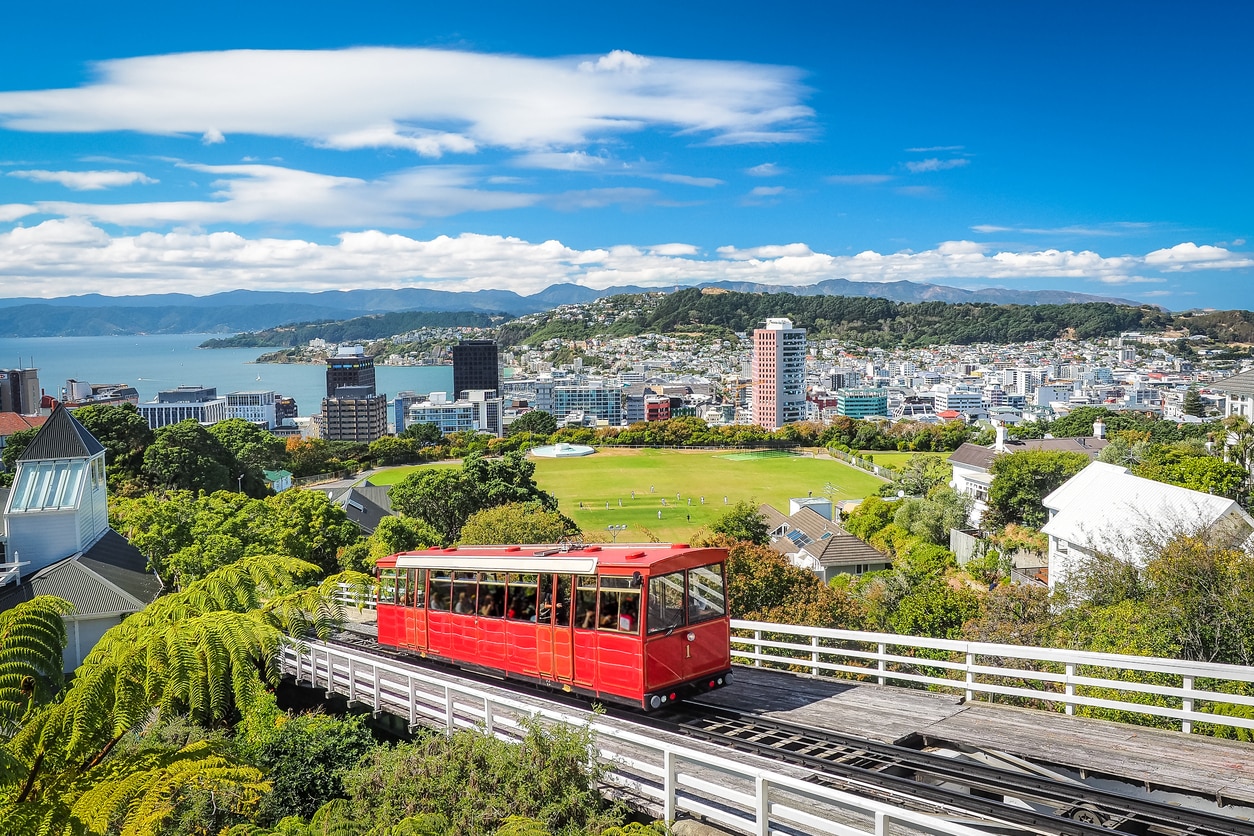
惠灵顿(英语:Wellington、毛利语:Te Whanganui-a-Tara 或 Poneke)是新西兰的首都,位于新西兰北岛南端,人口约四十万。它是新西兰的第二大城市,与悉尼和墨尔本一起成为大洋洲的文化中心。许多艺术家在此定居或活动,它还有许多艺术咖啡馆和生动的夜生活。
惠灵顿位于北岛的南端,与南岛隔库克海峡相望。在晴朗的日子里,人们可以隔海峡看到南岛上凯库拉岭的雪峰。城市北面是卡培提市的金色海岸。城市东面的里姆塔卡山将城市与盛产葡萄酒的怀拉拉帕平原隔开。
惠灵顿是世界最南方的首都,其纬度高达41度。由于港口和周围山脉之间的可用地带有限,它比新西兰其它城市的人口密度要高。由于它位于纬度40度的咆哮西风带,以及库克海峡对风的影响,他在当地有“多风的惠灵顿”之称号。
惠灵顿市中心的商业区是它的最重要部分,约6.2万人在那里工作(比较:奥克兰的居民数是惠灵顿的三倍,而它的中心商业区工作人员的数目仅比惠灵顿多4千)。惠灵顿的艺术和夜生活主要集中在中心商业区的南部,Te Aro区是新西兰最大的娱乐中心。
惠灵顿以其美丽的自然港口和绿色的山坡而著称。山坡上点缀着殖民时期遗留下来的盖瓦洋房。城市的中心商业区位于港口的附近。惠灵顿的尼可森海港的走向沿着一个活跃的地质断层。向西地势骤然高起,因此惠灵顿的许多市区高于市中心。
惠灵顿的南端是密拉马半岛,它与北岛的其它部分通过一条狭窄的地峡相连。惠灵顿国际机场也在这里。
Wellington, offizielle Bezeichnung: Wellington City (Māori Te Whanganui-a-Tara, wobei damit der Wellington Harbour und seine Umgebung gemeint ist), ist die Hauptstadt von Neuseeland und stellt zusammen mit den angrenzenden Städten Lower Hutt, Upper Hutt und Porirua nach Auckland den zweitgrößten Ballungsraum des Landes dar. Die Stadt Wellington selbst hat rund 190.000 Einwohner.
Wellington City liegt am südlichen Ende der Nordinsel. Die Stadt verfügt über eine reine Landfläche von 290 km² und zählte zum Census im Jahr 2013 190.959 Einwohner.[2] Damit ist die Stadt zwar flächenmäßig die zweitkleinste Stadt der vier eigenständigen Städte in der Region Wellington, ist aber mit 658,7 Einwohner pro km² die Stadt mit der dritthöchsten Bevölkerungsdichte des Landes, hinter Hamilton und Tauranga.
Im Norden und Nordosten der Stadt bilden die Stadtgebiete von Porirua City und Hutt City die Grenze, im Westen tut dies die Küstenlinie der Tasmansee, im Süden die Küstenlinie der Cook Strait und im Osten der Wellington Harbour.[3] Der westliche Teil der Stadt ist durch eine Berglandschaft geprägt, die mit dem 537 m hohen Outlook Hill an der Südspitze ihre Höhepunkt findet.
Die Gegenden im Westen des bebauten Gebiets von Wellington steigen relativ steil zu einer hügeligen Mittelgebirgskette an, so dass die dort gelegenen Stadtteile mitunter um einiges höher als das Stadtzentrum liegen. Aufgrund seiner geographischen Beschaffenheit wird Wellington oft mit San Francisco verglichen. Der südlich des Stadtzentrums gelegene Mount Victoria ist ein beliebter Aussichtspunkt und eine der markantesten geographischen Besonderheiten der Stadt. Die Miramar Peninsula (spanisch; Seeblick) bildet den östlichsten Punkt der Stadt. Auf dem zu dieser Halbinsel führenden Isthmus befindet sich der Internationale Flughafen der Stadt und direkt östlich dieser Halbinsel die Hafeneinfahrt in den Wellington Harbour mit dem berüchtigten Barrett-Riff, dem schon zahlreiche Schiffe zum Opfer fielen. Die Wahine, die 1968 an dem Riff gesunken ist und 52 Menschen in den Tod gerissen hat, ist das wohl bekannteste Opfer. Im Naturhafen selbst gibt es die drei Inseln Matiu/Somes Island, Ward (Makaro) und Mokopuna, von denen nur die erste bewohnt ist. Im Norden mündet einer der großen Flüsse der Nordinsel, der Hutt River in die Bucht. In seinem Tal, dem Hutt Valley befinden sich die Städte Upper Hutt im Norden und Lower Hutt südlich davon. Die beiden Städte werden westlich von den Bergen des Akatarawa Forest als Ausläufer der Tararua Range und östlich von der Rimutaka Range eingegrenzt.
Bekannte Sehenswürdigkeiten sind das ältere neuseeländischen Parlamentsgebäude und das 1979 fertiggestellte Regierungsgebäude, Beehive (Bienenstock) genannt, in dem der Prime Minister und die Minister des Kabinetts ihre Büros haben und das Kabinett tagt; das historische Wellington Cable Car und der dadurch an die City angeschlossene Botanische Garten mitsamt Aussichtspunkt oberhalb der Victoria University of Wellington; das Old Government Building als größtes Holzgebäude der Südhalbkugel (heute die juristische Fakultät der Universität) sowie Mount Victoria als einer der besten Aussichtspunkte der Stadt. Old Saint Paul’s, die erste anglikanische Kathedrale, wurde ab 1855 als Holzkirche in neugotischen Formen errichtet. 1964 ging ihre Funktion an die neu erbaute Cathedral of Saint Paul über. Bischofskirche des römisch-katholischen Erzbistums Wellington ist die 1901 vollendete Sacred Heart Cathedral.
Während der Stadtentwicklung sind um den Beginn des 20. Jahrhunderts eine Reihe von Profanbauten entstanden, welche das Bild der Innenstadt mitbestimmen. Dazu zählen die Aida Konditorei und das Barber Building in der Cuba Street, das Thistle Inn als einer der ältesten Pubs Neuseelands, das Albemarle Hotel in der Ghuznee Street, das Antrim House inmitten höherer moderner Gebäude, Alcohol and Drug Dependence Centre Building, das Appraisal House in der Willis Street, das Ashleigh Court Private Hotel sowie der Aqua Vitae Bottle Store, als seltenes Zeugnis der frühen kolonialen Bebauung.
ウェリントン(英語: Wellington、マオリ語: Te Whanga-nui-a-Tara)は、ニュージーランドの首都。同国2番目の都市圏で、オセアニアの首都の中では最も人口が多い。オセアニア有数の世界都市でもある。ウェリントン広域自治体(Wellington Region)に属し、ニュージーランド北島の南端にあり、ちょうど同国の国土の中央に位置する。マオリ語ではテ・ワンガヌイ=ア=タラあるいはポネケ(Poneke)という。
ニュージーランドの主要な金融機関はウェリントンとオークランドに分かれ、幾つかの企業は本社を両都市に置いている。ウェリントンはニュージーランドの政治の中心地であり、ニュージーランド議会とすべての行政機関の本庁舎が置かれている。
またウェリントンは、ニュージーランドの映画・演劇産業の中心地である。テ・パパ(Te Papa ニュージーランド国立博物館)、ニュージーランド交響楽団 (New Zealand Symphony Orchestra)、そしてロイヤル・ニュージーランド・バレエ団 (Royal New Zealand Ballet) が本拠地を置いている。隔年でニュージーランド国際アートフェスティバル (New Zealand International Arts Festival) も開催される。
小さくまとまった都心部では、都市の大きさのわりに大規模なアートシーンやカフェ文化、ナイトライフが展開されている。
ウェリントンの名前は、ワーテルローの戦いでナポレオン1世に勝利した初代ウェリントン公爵アーサー・ウェルズリーに敬意を表してつけられたものである。そしてその「ウェリントン」の爵号は、イングランド・サマセット州のウェリントンという町の名に由来する。
マオリ語ではウェリントンは2つの名前で呼ばれる。「テ・ワンガヌイ=ア=タラ (Te Whanganui-a-Tara)」はウェリントン港を指すもので、「タラ(ポリネシアの神話に登場する女神)の大いなる港」を意味する。もう一つの名称の「ポネケ」の方は、港のかつての名称「ポート・ニコルソン (Port Nicholson)」を縮めた愛称である「ポート・ニック (Port Nick)」の音訳でしかないと信じられているため、必ずしもマオリ語名とは言えないとされることも多い。
ウェリントンの都市圏は単独の地方自治体の境界を大きく越えて広がっている。「大ウェリントン (Greater Wellington)」あるいは「ウェリントン地方 (Wellington Region)」と呼ばれるのは、都市圏全体に加え、それを構成する市の市街地以外の部分、カピティ海岸 (Kapiti Coast)、それにリムタカ山脈 (Rimutaka Range) を挟んでワイララパ (Wairarapa) に至る範囲である。
Wellington (Māori: Te Whanganui-a-Tara [tɛ ˈfaŋanʉi a taɾa]) is the capital city and second most populous urban area of New Zealand, with 418,500 residents.[3] It is located at the south-western tip of the North Island, between Cook Strait and the Remutaka Range. Wellington is the major population centre of the southern North Island, and is the administrative centre of the Wellington Region, which also includes the Kapiti Coast and Wairarapa. Its latitude is 41°17′S, making it the world's southernmost capital of a sovereign state.[4] Wellington features a temperate maritime climate and is the world's windiest city, with an average wind speed of over 26 km/h (16 mph).[5]
The Wellington urban area comprises four local authorities: Wellington City, on the peninsula between Cook Strait and Wellington Harbour, contains the central business district and about half the population; Porirua on Porirua Harbour to the north is notable for its large Māori and Pacific Island communities; Lower Hutt and Upper Hutt are largely suburban areas to the northeast, together known as the Hutt Valley.
Situated near the geographic centre of the country, Wellington was well placed for trade. In 1839 it was chosen as the first major planned settlement for British immigrants coming to New Zealand. The settlement was named in honour of Arthur Wellesley, the first Duke of Wellington and victor of the Battle of Waterloo.
As the nation's capital since 1865, the New Zealand Government and Parliament, Supreme Court and most of the public service are based in the city. Architectural sights include the Government Building—one of the largest wooden buildings in the world—as well as the iconic Beehive. Wellington is also home to several of the largest and oldest cultural institutions in the nation such the National Archives, the National Library, the Museum of New Zealand Te Papa Tongarewa, and numerous theatres. It plays host to many artistic and cultural organisations, including the New Zealand Symphony Orchestra and Royal New Zealand Ballet. One of the world's most liveable cities, the 2014 Mercer Quality of Living Survey ranked Wellington 12th in the world.[6]
Wellington's economy is primarily service-based, with an emphasis on finance, business services, and government. It is the centre of New Zealand's film and special effects industries, and increasingly a hub for information technology and innovation,[7] with two public research universities. Wellington is one of New Zealand's chief seaports and serves both domestic and international shipping. The city is served by Wellington International Airport, the third busiest airport in the country. Wellington's transport network includes train and bus lines which reach as far as the Kapiti Coast and Wairarapa, and ferries connect the city to the South Island.
Wellington est la capitale de la Nouvelle-Zélande depuis 1865 et la deuxième ville la plus peuplée du pays. Elle est située à l'extrémité sud de l'île du Nord, dans la région de Wellington, au centre du pays. Cette situation en fait la capitale de pays la plus australe. Comme beaucoup de villes, l'aire urbaine de Wellington s'étend au-delà des frontières de son administration territoriale. Le Grand Wellington ou la région de Wellington comprend toute l'aire urbaine ainsi que les villes, les régions rurales, le Kapiti Coast, la chaine des monts Rimutaka et la Wairarapa.
Les principales institutions financières néo-zélandaises sont réparties entre Wellington et Auckland, et certaines organisations ont des bureaux dans les deux villes. Wellington est en revanche le centre politique de la Nouvelle-Zélande, le siège du parlement, des ministères et des départements d'État. Son centre-ville dense est le foyer d'une scène artistique, d'une culture des cafés et d'une vie nocturne que pourraient lui envier bon nombre de villes de taille similaire. Elle accueille également une industrie cinématographique d'échelle mondiale, ainsi qu'une scène théâtrale importante, Te Papa Tongarewa (le musée national), l'Orchestre symphonique de Nouvelle-Zélande et le Ballet national de Nouvelle-Zélande.
Wellington è la capitale della Nuova Zelanda, ed è la seconda città del paese, dopo Auckland.
Wellington è situata sulla punta sud-occidentale dell'isola del Nord e si trova tra lo Stretto di Cook e la zona di Rimutaka. È la città capitale più meridionale del mondo, ed è nel contempo anche la più remota capitale poiché lontana da qualsiasi altra.
L'area urbana di Wellington è il centro principale del sud dell'Isola del Nord, ed è il capoluogo della Regione di Wellington, che oltre alla zona urbana copre la costa Kapiti e Wairarapa.
La zona metropolitana della città comprende quattro quartieri: "Wellington City", sulla penisola tra lo stretto di Cook ed il porto, "Porirua City", a nord, "Lower Hutt City" e Upper Hutt City.
Wellington, inoltre, ha tre isole: Matiu, Makaro e Mokopuna. La prima di queste isole è stata usata come luogo di quarantena per le persone e gli animali, e anche come campo di internamento durante i due conflitti mondiali; oggi è un luogo di conservazione, in cui vengono protette specie in pericolo, proprio come Kapiti, che si trova più avanti rispetto alla costa. È possibile raggiungere queste isole tramite il traghetto Dominion Post.
Wellington ha subito gravi danni in una serie di terremoti nel 1848 (8,2 della scala Richter) e nel 1855. Questi terremoti trasformarono l'area intorno al porto in una palude; la zona è stata successivamente recuperata ed oggi vi si trova il Central Business District, il quartiere degli affari.
Una leggenda maori racconta che il grande navigatore polinesiano Kupe scoprì ed esplorò intorno al X secolo la zona dove sorge la città.
Il primo insediamento europeo si stabilì con l'arrivo dei coloni a bordo della nave Tory, il 20 settembre 1839; altre 150 persone arrivarono sulla nave Aurora il 22 gennaio 1840. I coloni costruirono le loro case alla foce della zona pianeggiante del fiume Hutt.
Nel 1865 Wellington divenne la capitale della Nuova Zelanda, in sostituzione di Auckland, dove William Hobson, l'aveva posta nel 1841. Il primo ministro della Nuova Zelanda, Alfred Domett, presentò al Parlamento una proposta di legge, in cui si esprimeva la necessità di trasferire la capitale in una località adatta.
Wellington (en maorí: Te Whanganui-a-Tara o Pōneke) es la capital de Nueva Zelanda, así como de la región de Wellington. Está localizada al sur de la isla Norte (North Island en inglés), en la que Wellington es la ciudad principal. Con 179 463 habitantes en 2006,1 es la tercera ciudad más poblada del país, después de Auckland y Christchurch.
Como muchas otras grandes ciudades y capitales, la ciudad se extiende más allá de los límites de su término municipal, y su área metropolitana o Gran Wellington incluye las poblaciones y áreas rurales cercanas, la costa de Kapiti y los montes Rimutaka hasta la región de Wairarapa. El área urbana incluye cuatro ciudades: Wellington, entre el estrecho de Cook y el puerto de Wellington, abarca la mitad de la población de todas las áreas y por lo tanto es su centro económico; al norte se encuentra Porirua, se caracteriza por su gran afluencia de maoríes y procedentes de las islas del pacífico; Lower Hutt y Upper Hutt al noreste, situadas junto al valle de Hutt.
La ciudad es un importante centro financiero y de negocios en el país. Es también un importante centro cultural, que alberga el museo Te Papa ("nuestro lugar" en lengua maorí), el ballet, la orquesta sinfónica y la producción cinematográfica en Nueva Zelanda. Fue fundada a finales de 1830 y se convirtió en la capital de Nueva Zelanda en 1865, en sustitución de Auckland. La ciudad está situada a 41 grados latitud sur y es la capital nacional más austral en el mundo.
Веллингто́н, Уэ́ллингтон (англ. Wellington) — столица Новой Зеландии, второй по численности населения город страны с учётом агломерации, крупнейшая столица среди стран Океании и самая южная столица в мире[2]. Город расположен в регионе Веллингтон в южной части острова Северный. Маорийское название Веллингтона — Те Фанауи-а-Тара (маори Te Whanganui-a-Tara). В начале XIX века начался процесс захвата европейцами земель коренного населения маори. В 1839 году полковник Уильям Уэйкфилд, служивший в Новозеландской компании, основал город немного северней его современного расположения. Однако в 1840 году сильные разливы реки Хатт заставили переселиться южнее. Первые переселенцы назвали город Веллингтоном в честь фельдмаршала герцога Артура Уэлсли Веллингтона, командующего объединёнными англо-голландскими войсками, в благодарность за ту помощь, которую он оказал первым переселенцам. Сильное землетрясение 1848 года вызвало серьёзные разрушения в городе, а в 1854 году по той же причине погибло много людей. В 1865 году Веллингтон стал столицей Новой Зеландии, которой остается и поныне. Веллингтон — красивый и уютный город, с большим количеством мостов, виадуков, тоннелей, парков и скверов. Многообразен его архитектурный облик: эклектические сооружения, относящееся к XIX — первой половине XX веков, на улицах города сочетаются со зданиями современного стиля и массовой деревянной застройкой. Одной из интереснейших построек столицы является круглое здание парламента, которое горожане называют ульем. Напротив парламента расположен бывший дворец правительства, являющейся второй в мире по величине постройкой из дерева. Также привлекает внимание собор Святого Павла. Впечатляет столичный ботанический сад, который расположился на склоне высокой горы. Особой гордостью города можно также считать зоопарк, в котором животные размещаются чаще всего не в клетках, а в просторных открытых вольерах.
 Transport und Verkehr
Air New Zealand
Airbus A320
A320neo
Airbus A320
A320-100 / -200
Airbus A320
A321neo
Boeing 777
777-200ER
Boeing 777
777-300ER
Boeing 787
Boeing 787-9
Transport und Verkehr
Air New Zealand
Airbus A320
A320neo
Airbus A320
A320-100 / -200
Airbus A320
A321neo
Boeing 777
777-200ER
Boeing 777
777-300ER
Boeing 787
Boeing 787-9
 Luft- und Raumfahrt
Star Alliance
Neuseeland
Luft- und Raumfahrt
Star Alliance
Neuseeland
 Unternehmen
 Commonwealth of Nations
Fußball-Weltmeisterschaft der Frauen 2023
Geographie
Geographie
***IWF Entwickelte Länder
IWF entwickelte Länder
IWF entwickelte Länder
TOP5
Neuseeland
Commonwealth of Nations
Fußball-Weltmeisterschaft der Frauen 2023
Geographie
Geographie
***IWF Entwickelte Länder
IWF entwickelte Länder
IWF entwickelte Länder
TOP5
Neuseeland


 FIFA Fussball-Weltmeisterschaft 2026
Gruppe G
FIFA-Konföderationen-Pokal 2017
Neuseeland
Sport
(F)FIFA-Konföderationen-Pokal
Sport
(F)OFC Nations Cup
FIFA Fussball-Weltmeisterschaft 2026
FIFA Fussball-Weltmeisterschaft 2026
Gruppe G
FIFA-Konföderationen-Pokal 2017
Neuseeland
Sport
(F)FIFA-Konföderationen-Pokal
Sport
(F)OFC Nations Cup