Deutsch-Chinesische Enzyklopädie, 德汉百科
 Lombardia
 Motorsport
Aserbaidschan
Australien
Bahrain
Belgien
Brasilien
China
Deutschland
Motorsport
Aserbaidschan
Australien
Bahrain
Belgien
Brasilien
China
Deutschland
 Emilia-Romagna
England
Emilia-Romagna
England
 Florida-FL
Formel-1-Weltmeisterschaft 2017
Formel-1-Weltmeisterschaft 2018
Florida-FL
Formel-1-Weltmeisterschaft 2017
Formel-1-Weltmeisterschaft 2018
 Formel-1-Weltmeisterschaft 2025
Frankreich
Indien
Italien
Japan
Kanada
Katar
Kinki
Lombardia
Mexiko
Monaco
Formel-1-Weltmeisterschaft 2025
Frankreich
Indien
Italien
Japan
Kanada
Katar
Kinki
Lombardia
Mexiko
Monaco
 Nevada-NV
Österreich
Nevada-NV
Österreich
 Quebec-QC
Russland
São Paulo
Saudi-Arabien
Schweiz
Shanghai Shi-SH
Singapur
Spanien
Quebec-QC
Russland
São Paulo
Saudi-Arabien
Schweiz
Shanghai Shi-SH
Singapur
Spanien
 Sport
Sport
 Steiermark
 Texas-TX
Ungarn
Vereinigte Arabische Emirate
Vereinigte Staaten
Vereinigtes Königreich
Texas-TX
Ungarn
Vereinigte Arabische Emirate
Vereinigte Staaten
Vereinigtes Königreich
 Victoria-VIC

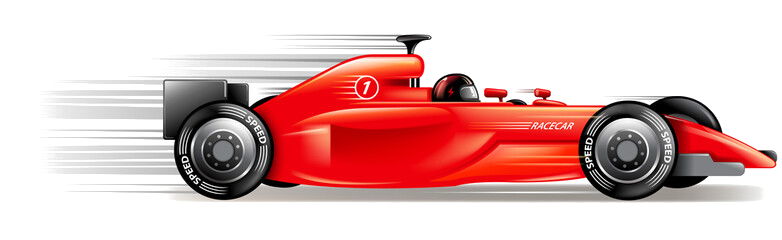
一级方程式赛车(英语:Formula One,也叫Formula 1或者F1)是由国际汽车联盟举办的最高等级的年度系列场地方程式赛车比赛,正式名称为“国际汽车联合会世界一级方程式锦标赛”。名称中“方程式”是指一组所有参赛车辆都必须遵守的规则[1]。F1赛季包括一系列的比赛,而这些所谓的“大奖赛”(Grand Prix,出自法语,本意Great Prizes)的场地是全封闭的专门赛道或者是临时封闭的普通公路。每场比赛的结果算入积分系统并以此确定两个年度世界冠军:一个给车手和另一个给制造商。F1的车手、制造商、组织者以及赛道都必须持有FIA超级驾驶执照,这是国际汽联颁发的最高级别执照。
一级方程式赛车通过产生大量的空气动力学下压力达到非常高的过弯速度,是风靡全球的赛车运动。发动机性能限制在每分钟最多15000转时,其比赛最高速度就可以超过360公里/小时。赛车过弯的横向加速度超过5个标准重力。F1赛车的性能非常依赖电子系统(牵引力控制系统和其他辅助驾驶装置自2008年已被禁止)、空气动力学、悬挂和轮胎。
Die Formel 1 ist eine vom Automobil-Dachverband Fédération Internationale de l’Automobile (FIA) festgelegte Formelserie. Hersteller konstruieren Autos, die den Formel-1-Regeln entsprechen. Diese Autos treten im Rahmen der Formel-1-Weltmeisterschaft zu Rennen in ungefähr 20 Orten pro Jahr an. Am Ende der Saison wird der Fahrer mit den meisten Punkten F1 Fahrerweltmeister und der Hersteller mit den meisten Punkten Konstrukteursweltmeister.
Die Formel 1 ist die höchstrangige von der FIA veranstaltete Rennserie des Formelsports. Sie wird als Königsklasse des Automobilsports bezeichnet, da sie den Anspruch erhebt, die höchsten technischen, fahrerischen, aber auch finanziellen Anforderungen aller Rennserien an Fahrer und Konstrukteure zu stellen. Sie wird auch kurz F1 genannt. Die F1 Weltmeisterschaft heißt offiziell FIA Formula One World Championship, bis 1980 hat sie Automobil-Weltmeisterschaft geheissen.
Formula One (also Formula 1 or F1) is the highest class of single-seater auto racing sanctioned by the Fédération Internationale de l'Automobile (FIA) and owned by the Formula One Group. The FIA Formula One World Championship has been one of the premier forms of racing around the world since its inaugural season in 1950. The "formula" in the name refers to the set of rules to which all participants' cars must conform.[2] A Formula One season consists of a series of races, known as Grands Prix (French for "grand prizes" or "great prizes"), which are held worldwide on purpose-built circuits and public roads.
The results of each race are evaluated using a points system to determine two annual World Championships: one for drivers, the other for constructors. Drivers must hold valid Super Licences, the highest class of racing licence issued by the FIA.[3] The races are required to be held on tracks graded "1" (formerly "A"), the highest grade rating issued by the FIA.[3] Most events are held in rural locations on purpose-built tracks, but there are several events in city centres throughout the world, with the Monaco Grand Prix being the most well-known.
Formula One cars are the fastest regulated road course racing cars in the world, owing to very high cornering speeds achieved through the generation of large amounts of aerodynamic downforce. The cars underwent major changes in 2017,[4] allowing wider front and rear wings, and wider tyres, resulting in cornering forces closing in on 8g and top speeds of up to approximately 375 km/h (230 mph).[5] The hybrid engines are currently limited in performance to a maximum of 15,000 rpm and the cars are very dependent on electronics—although traction control and other driving aids have been banned since 2008—and also on aerodynamics, suspension, and tyres.
While Europe is the sport's traditional base, the championship is truly global, with 11 of the 21 races in the 2018 season taking place outside Europe. With the annual cost of running a mid-tier team—designing, building, and maintaining cars, pay, transport—being US$120 million,[6] Formula One has a significant economic and job-creation effect, and its financial and political battles are widely reported. Its high profile and popularity have created a major merchandising environment, which has resulted in large investments from sponsors and budgets (in the hundreds of millions for the constructors). On 8 September 2016, it was announced that Liberty Media had agreed to buy Delta Topco, the company that controls Formula One, from private equity firm CVC Capital Partners for $4.4 billion in cash, stock, and convertible debt.[7] On 23 January 2017, it was confirmed that the acquisition had been completed, for $8 billion.[8]
La Formule 1, communément abrégée en F1, est une discipline de sport automobile considérée comme la catégorie reine de ce sport. Elle a pris au fil des ans une dimension mondiale et elle est, avec les Jeux olympiques et la Coupe du monde de football, l'un des événements sportifs les plus médiatisés.
Chaque année depuis 1950, un championnat mondial des pilotes est organisé, complété depuis 1958 par un championnat mondial des constructeurs automobiles. La compétition est basée sur des Grands Prix, courses à bord de voitures monoplaces disputées sur circuits routiers fermés permanents mais parfois tracés en ville et temporaires, comme à Monaco, Valence, Singapour, et Bakou.
Cette discipline sportive, régie par la Fédération internationale de l'automobile (FIA), est gérée par la Formula One Administration (FOA) et un ensemble de sociétés satellites contrôlées par Liberty Media. Après l'ère des artisans des années 1960 et 1970, elle a peu à peu attiré les grands constructeurs automobiles mondiaux qui y investissent des sommes élevées, en espérant tirer profit des retombées médiatiques d'éventuels succès. La Formule 1 est considérée comme la vitrine technologique de l'industrie automobile qui y expérimente des nouveautés techniques, parfois issues de la technologie spatiale et susceptibles d'être adaptées ensuite sur les voitures de série.
Outre la compétition, le terme Formule 1 désigne l'ensemble des règles techniques des voitures monoplaces qui sont mises à jour tous les ans par la FIA. Ces règles sont très strictes sur les dimensions des voitures, la cylindrée des moteurs, les technologies mises en œuvre ; elles définissent également les mesures de sécurité des voitures pour assurer la protection du pilote. Les monoplaces de course répondant aux caractéristiques de la réglementation de la Formule 1 sont généralement désignées sous le terme générique de Formules 1.
La Formula 1 o Formula Uno,[1] in sigla F1, è la massima categoria (in termini prestazionali) di vetture monoposto a ruote scoperte da corsa su circuito definita dalla Federazione Internazionale dell'Automobile (FIA).
La categoria è nata nel 1948 (in sostituzione della Formula A, a sua volta sorta solo qualche anno prima, nel 1946), diventando poi a carattere mondiale nella stagione 1950. Inizialmente definita dalla Commissione Sportiva Internazionale (CSI) dell'Associazione Internazionale degli Automobil Club Riconosciuti (AIACR), associazione antesignana della Federazione Internazionale dell'Automobile, oggi la Formula Uno è regolata dal Consiglio Mondiale degli Sport Motoristici (in inglese: World Motor Sport Council, WMSC) della Federazione Internazionale dell'Automobile.
Il termine "formula", presente nel nome, fa riferimento a un insieme di regole alle quali tutti i partecipanti, le macchine e i piloti, devono adeguarsi; esse introducono un numero di restrizioni e specifiche nelle auto, al fine di evitare le eccessive disparità tecniche tra le auto, di porre dei limiti al loro sviluppo e di ridurre i rischi di incidenti. La formula ha avuto molti cambiamenti durante la sua storia. Ad esempio, ci sono stati differenti tipi di motori, con schemi da quattro fino a sedici cilindri e con cilindrate da 1,5 a 4,5 l.
La Fórmula 1, abreviada como F1 y también denominada la «categoría reina del automovilismo»1 o «la máxima categoría del automovilismo»,23 es la competición de automovilismo internacional más popular y prestigiosa, superando a categorías de automovilismo como la NASCAR, el Campeonato Mundial de Rally, el Campeonato Mundial de Turismos o la Fórmula E, entre otras.4 A cada carrera se le denomina Gran Premio y el torneo que las agrupa se denomina Campeonato Mundial de Fórmula 1. La entidad que la dirige es la Federación Internacional del Automóvil (FIA). El Formula One Group es controlado por la empresa estadounidense Liberty Media desde septiembre de 2016.5
Los automóviles utilizados son monoplazas con la última tecnología disponible, siempre limitadas por un reglamento técnico; algunas mejoras que fueron desarrolladas en la Fórmula 1 terminaron siendo utilizadas en automóviles comerciales, como el freno de disco.6 La mayoría de los circuitos de carreras donde se celebran los Grandes Premios son autódromos, aunque también se utilizan circuitos callejeros y anteriormente se utilizaron circuitos ruteros.
El inicio de la Fórmula 1 moderna se remonta al año 1950, en el que participaron escuderías como Ferrari, Alfa Romeo y Maserati. Algunas fueron reemplazadas por otras nuevas como McLaren, Williams, Red Bull y Renault, que se han alzado varias veces con el Campeonato Mundial de Constructores. Las escuderías tienen que planear sus fichajes y renovación de contratos 2 o 3 carreras antes del fin de la temporada. Por su parte, los pilotos deben contar con la superlicencia de la FIA para competir, que se obtiene sobre la base de resultados en otros campeonatos.
 Geographie
 Auvergne-Rhône-Alpes
 Baden-Württemberg
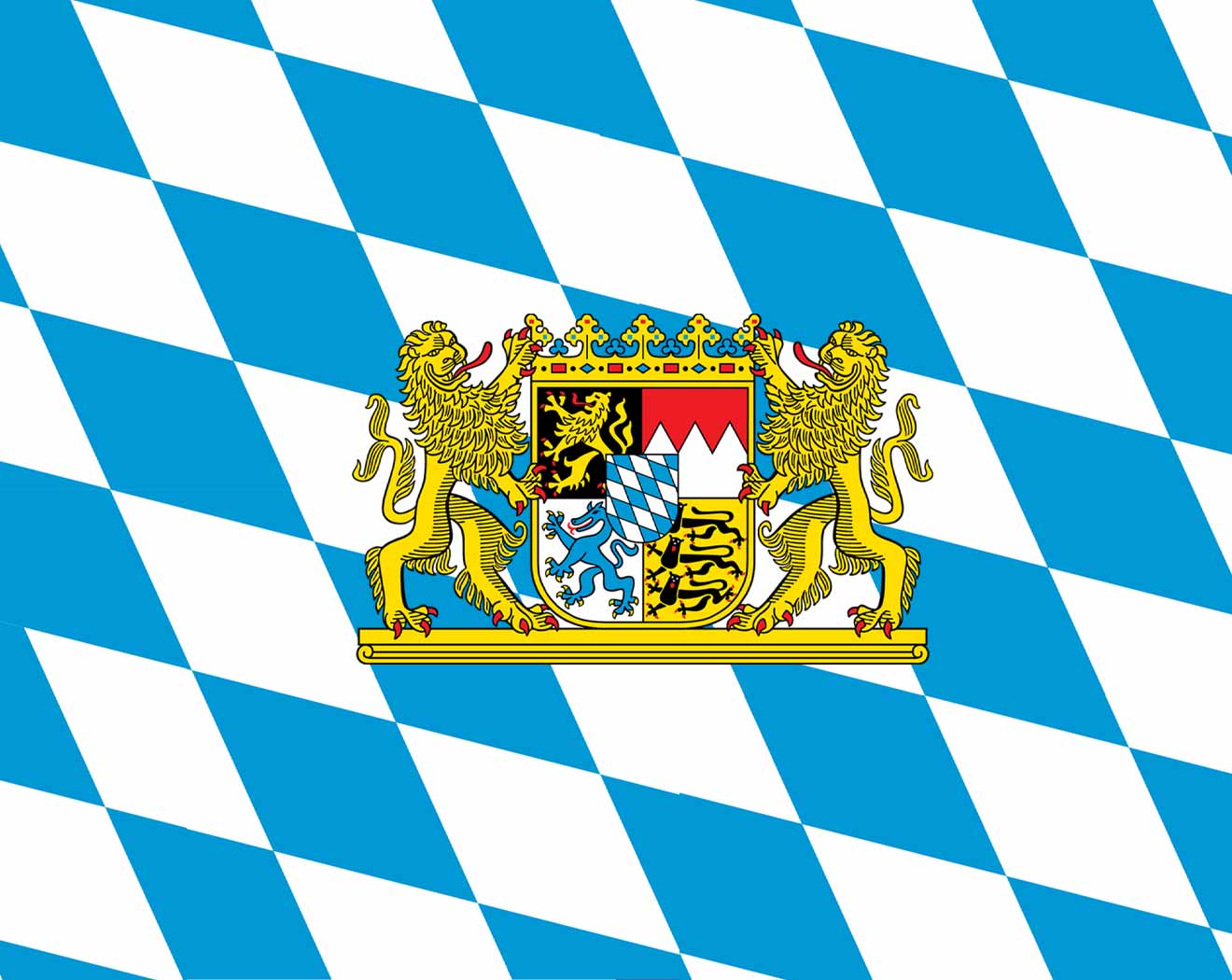 Bayern
Deutschland
Frankreich
Bayern
Deutschland
Frankreich
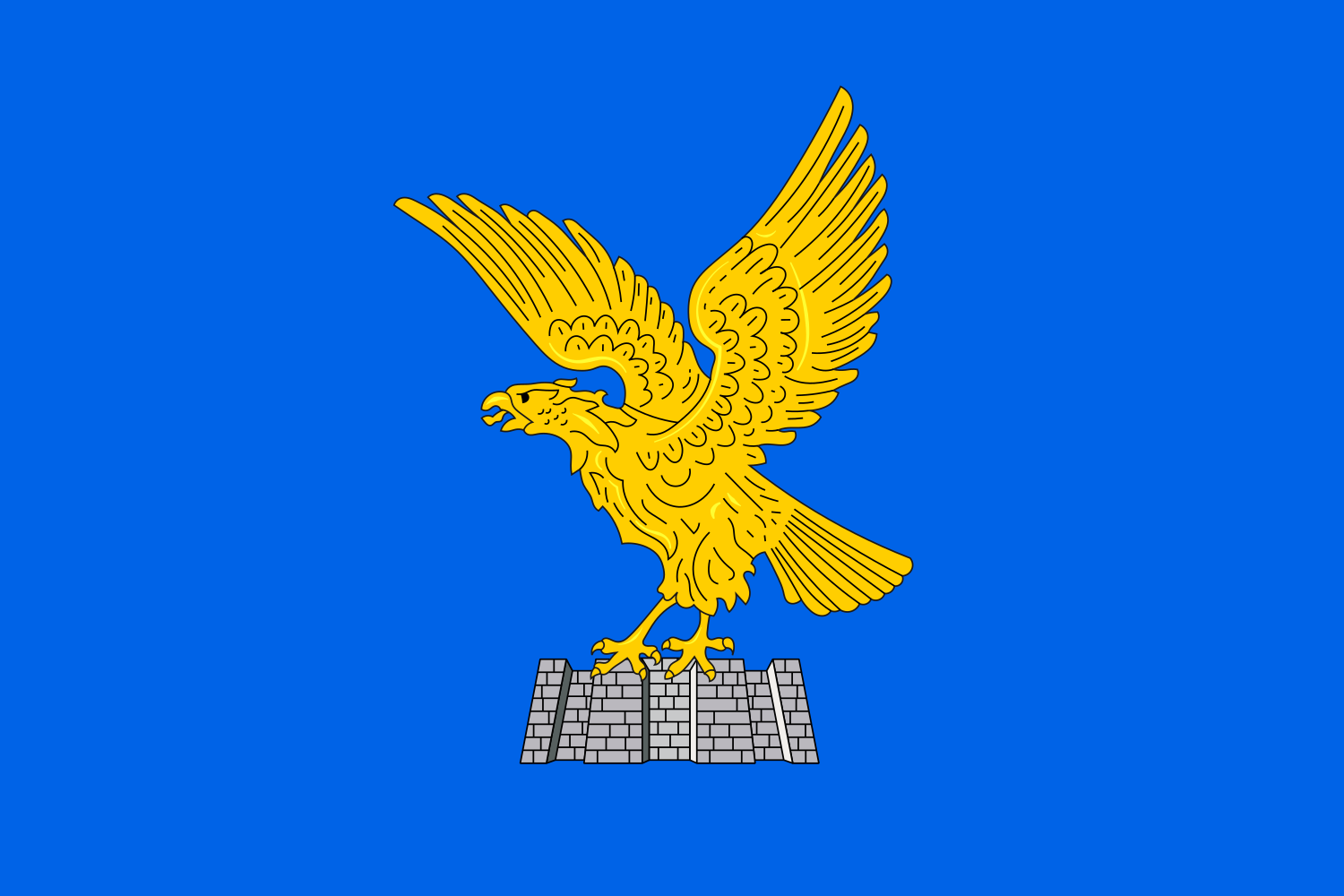 Friuli-Venezia Giulia
Italien
Liechtenstein
Lombardia
Monaco
Österreich
Friuli-Venezia Giulia
Italien
Liechtenstein
Lombardia
Monaco
Österreich
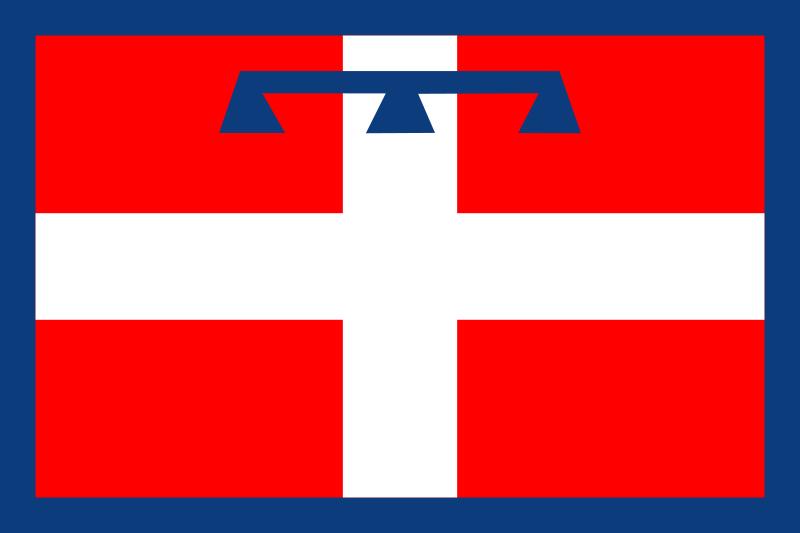 Piemonte
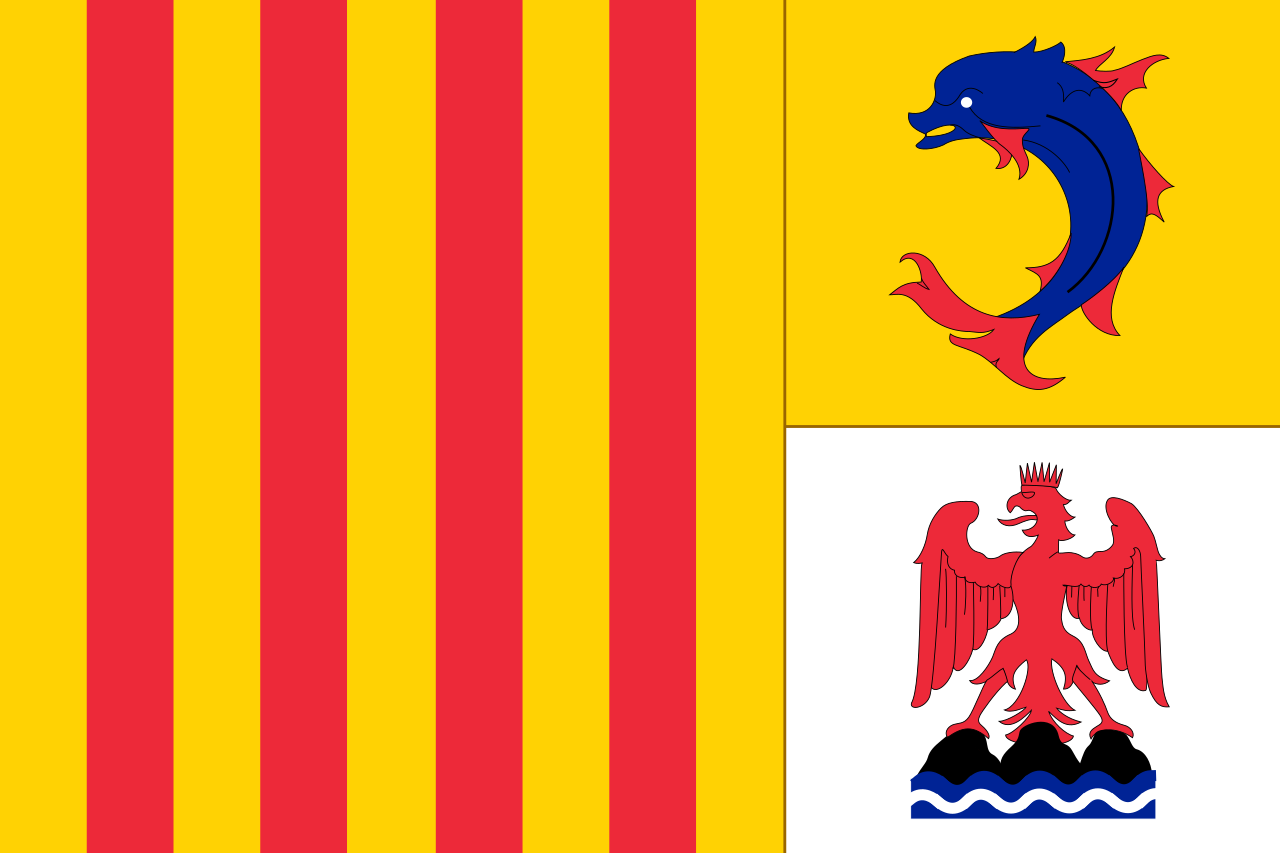 Provence-Alpes-Côte d´Azur
Schweiz
Slowenien
Provence-Alpes-Côte d´Azur
Schweiz
Slowenien
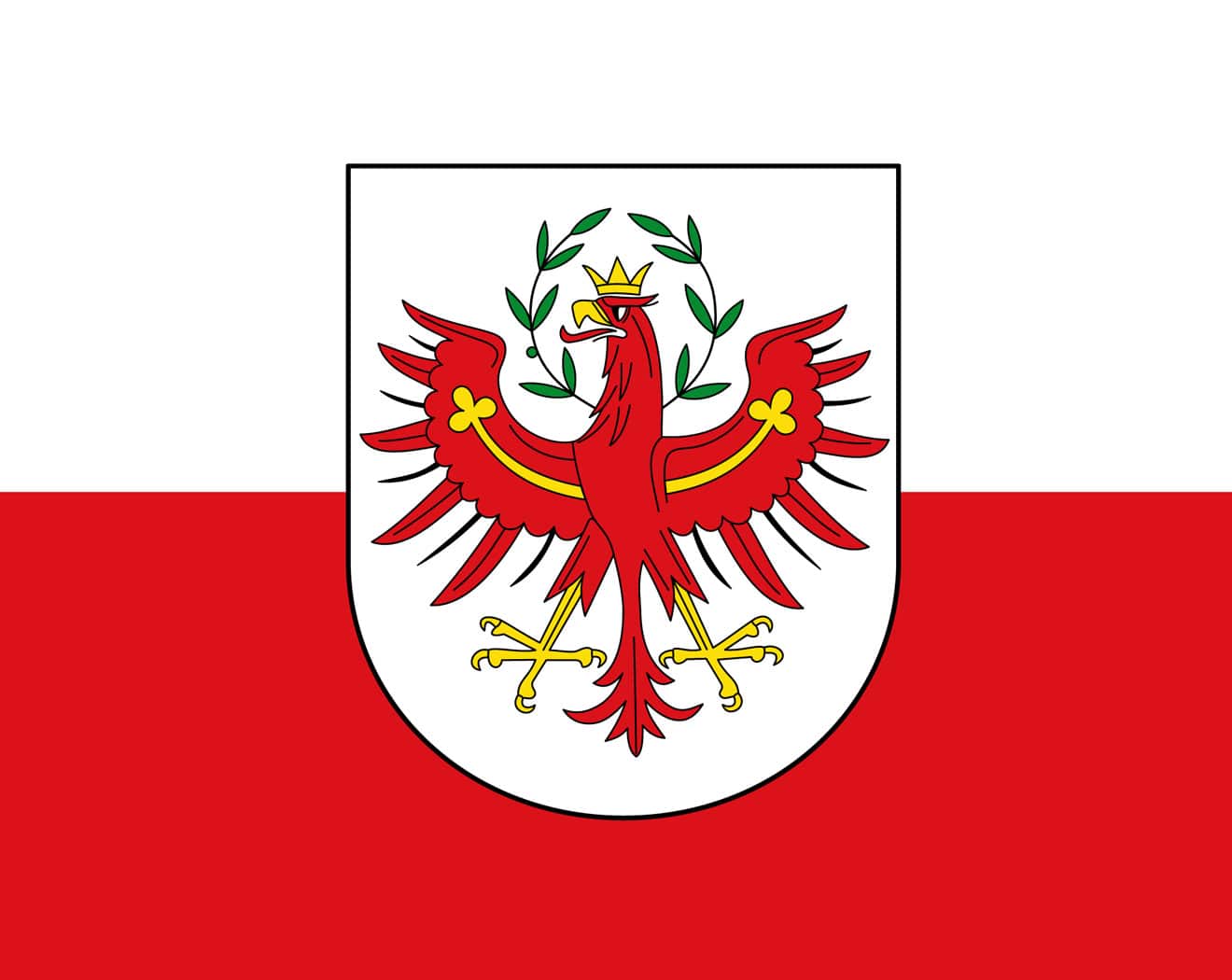 Tirol
Tirol
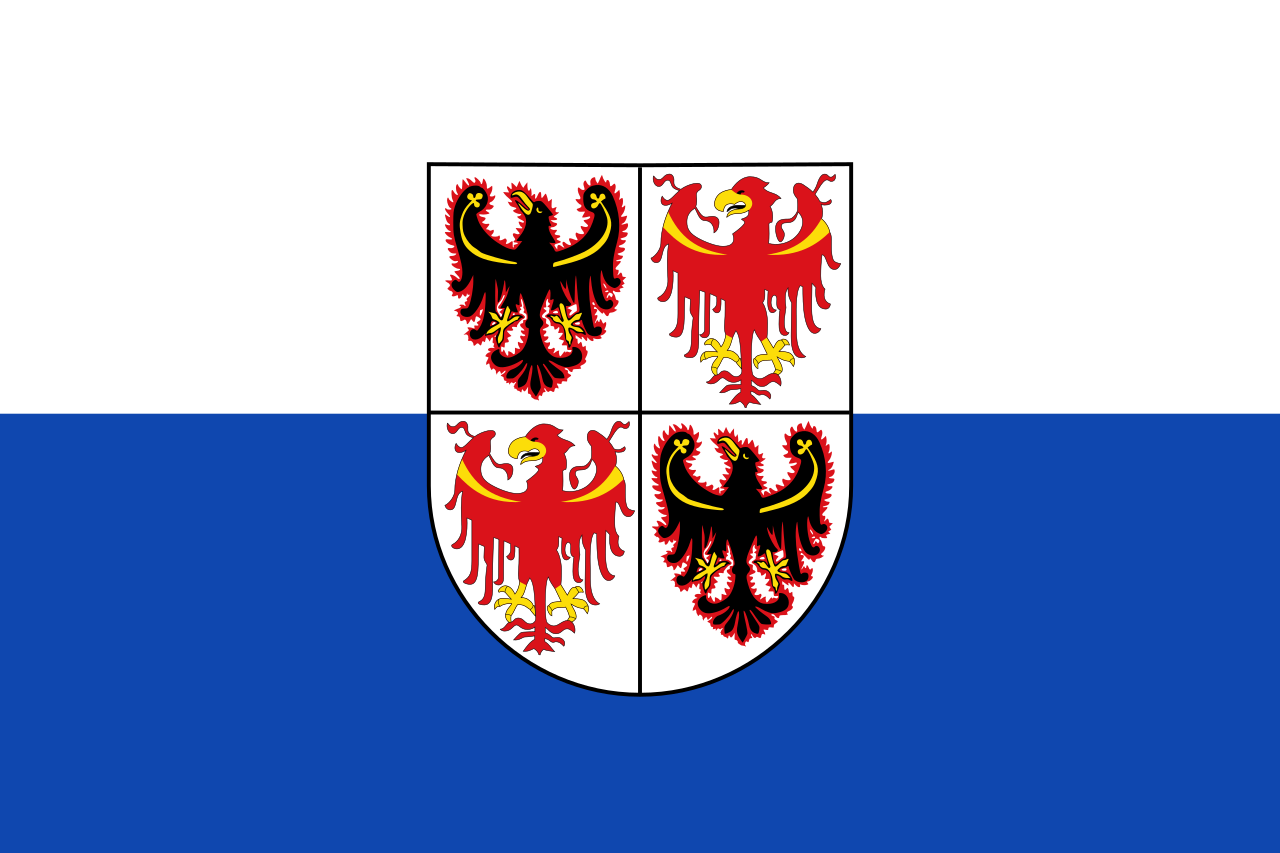 Trentino-Alto Adige
 Urlaub und Reisen
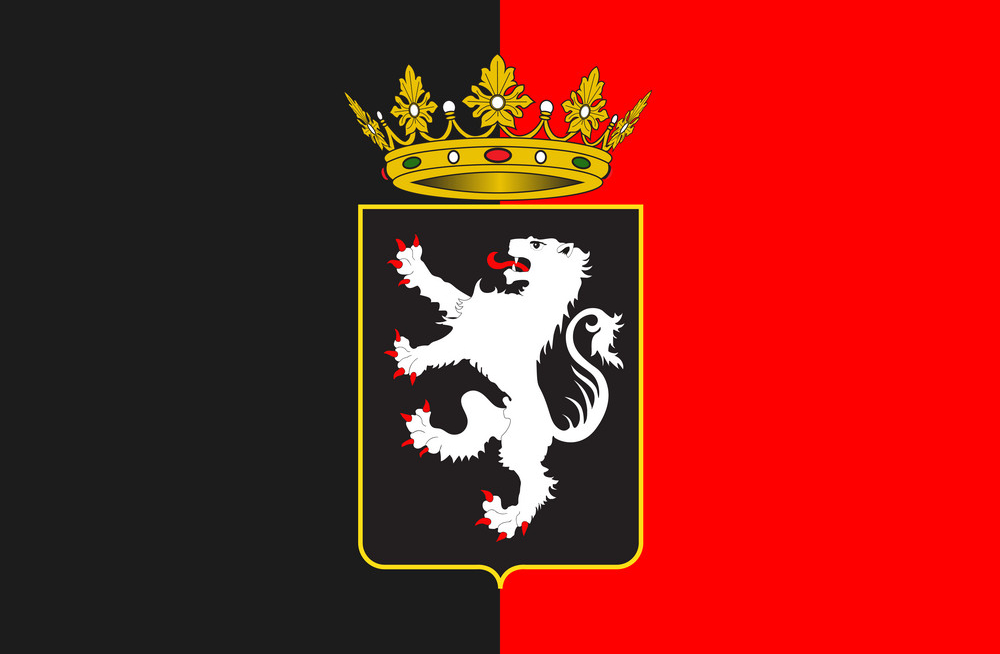 Valle d´Aosta
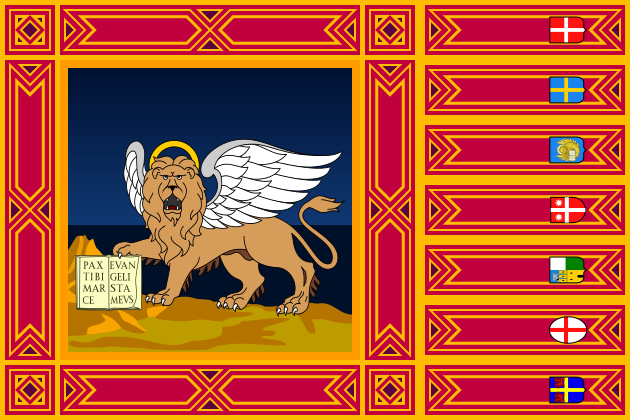 Veneto
 Vorarlberg
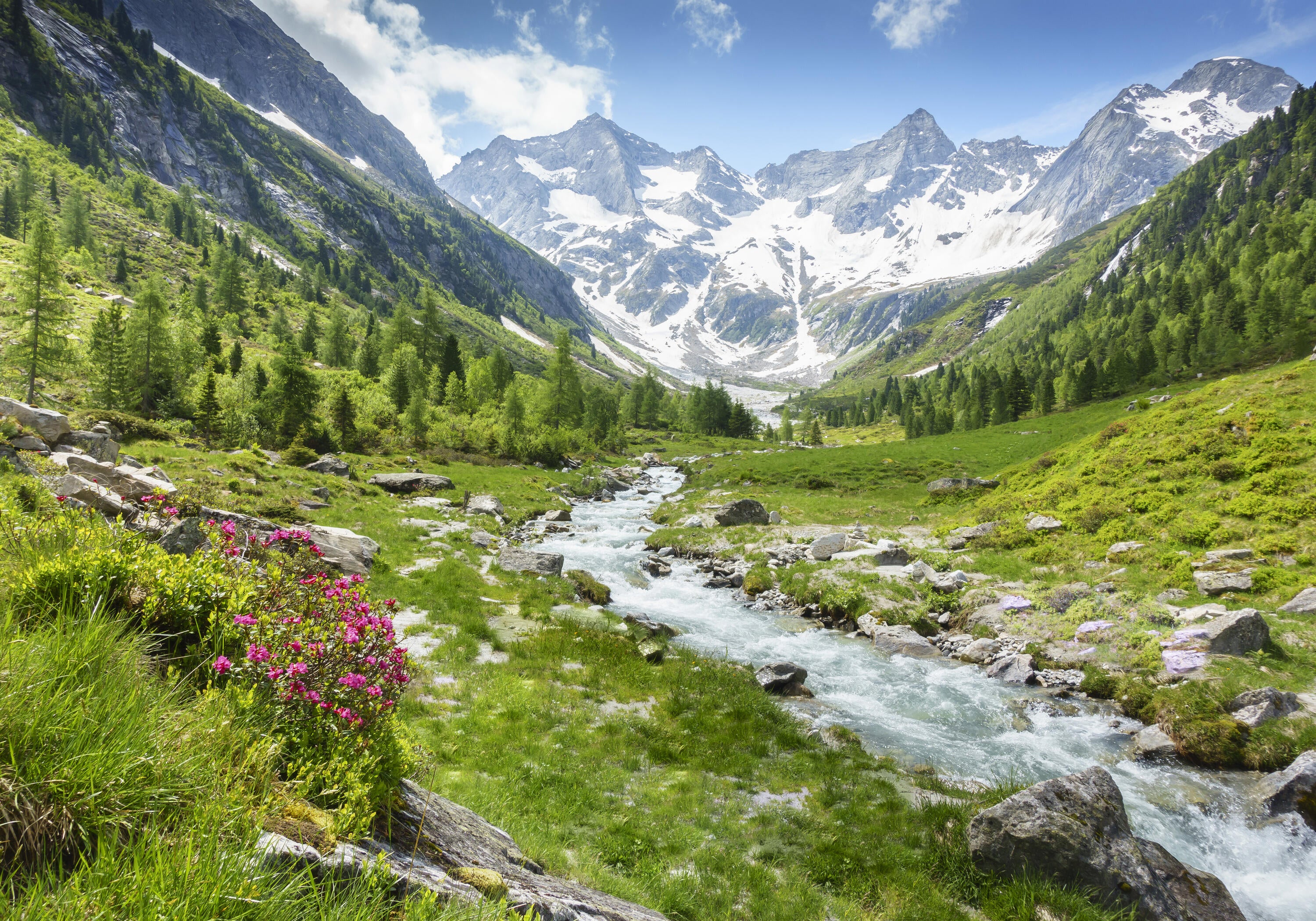
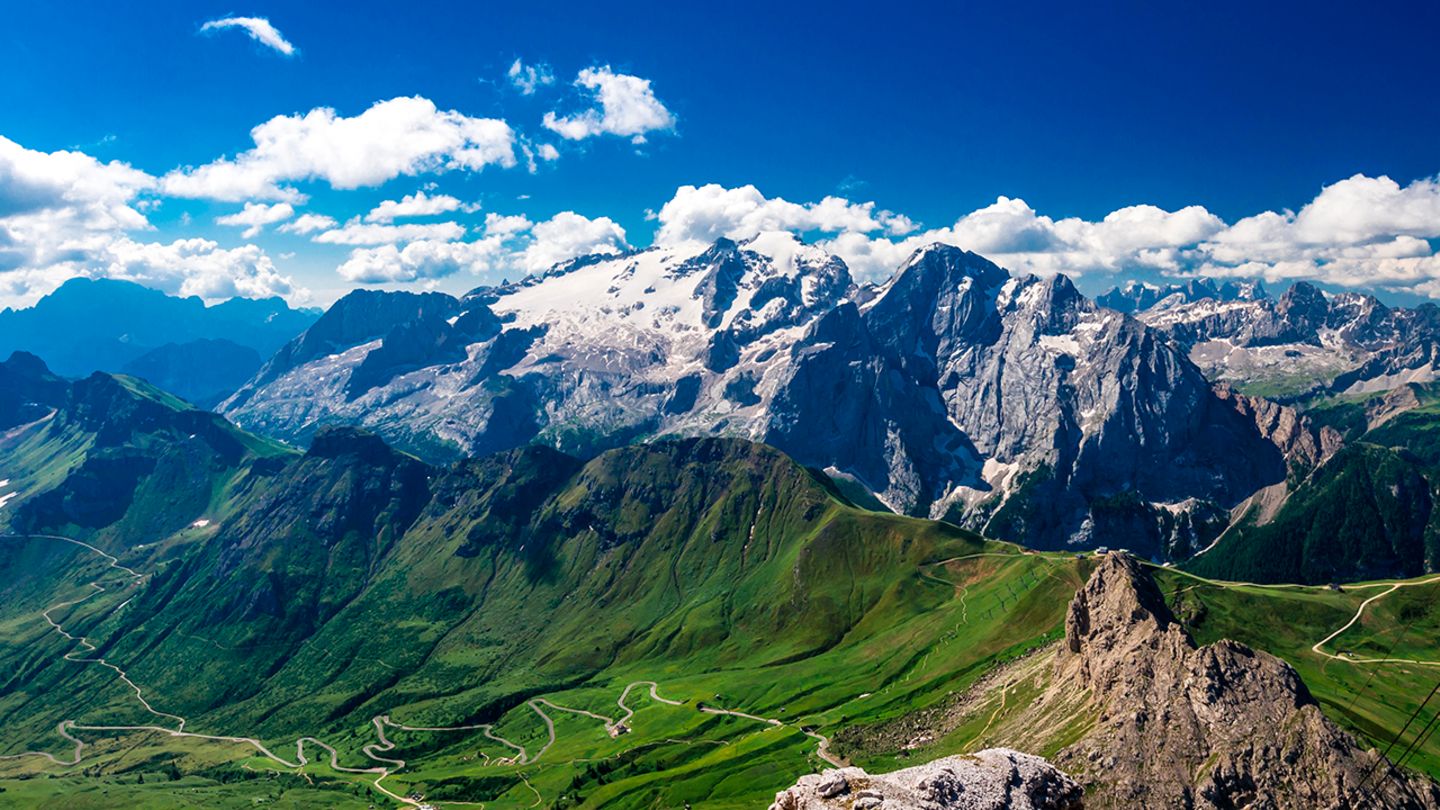
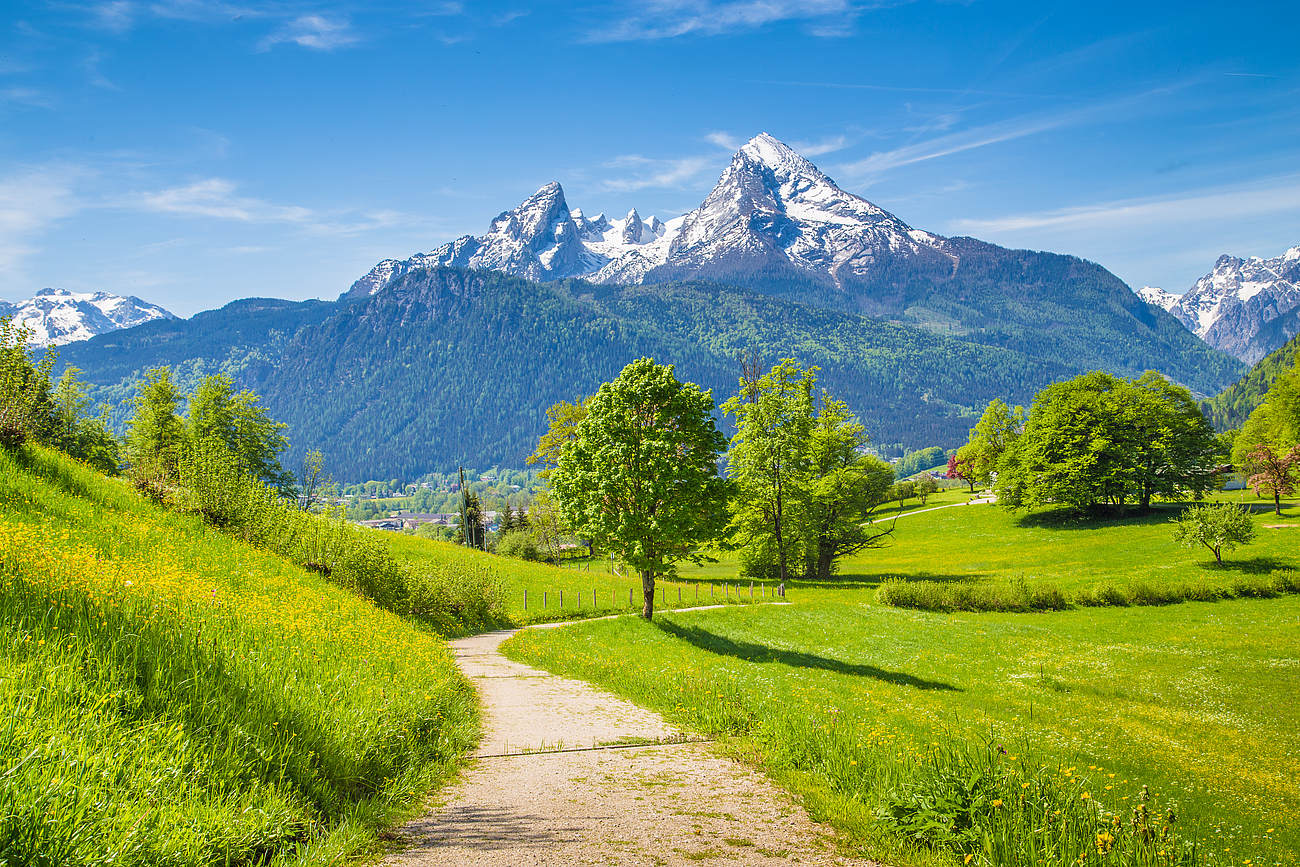
欧洲南部高大的山脉。西起法国尼斯附近地中海海岸,呈弧形向北、东延伸,经意大利北部、瑞士南部、列支敦士登、德国西南部,东止奥地利的维也纳盆地。总面积约22万平方千米。长约1200千米,宽130~260千米,东宽西窄。平均海拔3000米左右。 山脉主干向西南方向延伸为比利牛斯山脉,向南延伸为亚平宁山脉,向东南方向延伸为迪纳拉山脉,向东延伸为喀尔巴阡山脉。阿尔卑斯山脉可分为3段。西段西阿尔卑斯山从地中海岸,经法国东南部和意大利的西北部,到瑞士边境的大圣伯纳德山口附近,为山系最窄部分,也是高峰最集中的山段。勃朗峰(4810米)是整个山脉的最高点,位于法国和意大利边界。中段中阿尔卑斯山,介于大圣伯纳德山口和博登湖之间,宽度最大。有马特峰(4479米)和蒙特罗莎峰( 4634米)。东段东阿尔卑斯山在博登湖以东,海拔低于西、中两段阿尔卑斯山。
阿尔卑斯山(德语:Alpen;法语:Alpes;意大利语:Alpi;斯洛文尼亚语:Alpe)是一座位于欧洲中心的山脉,它覆盖了意大利北部边界、法国东南部、瑞士、列支敦士登、奥地利、德国南部及斯洛文尼亚。它可以被细分为三个部分,从地中海到勃朗峰的西阿尔卑斯山,从瓦莱达奥斯塔到布伦纳山口(奥地利和意大利交界处)的中阿尔卑斯山,从布伦纳山口到斯洛文尼亚的东阿尔卑斯山。欧洲许多大河都发源于此,水力资源丰富,为旅游、度假、疗养胜地。
阿尔卑斯山共有128座海拔超过4000米的山峰,其中最高峰勃朗峰海拔4810.45米[1],位于法国和意大利的交界处。山脉呈弧形,长1200千米,宽130~260千米,平均海拔约3000米,总面积约22万平方千米[2]。阿尔卑斯山北边是水汽较多的气候,而南边则较为干燥,雨量很少。
Die Alpen sind das höchste Gebirge im Inneren Europas. Es erstreckt sich in einem 1200 Kilometer langen und zwischen 150 und 250 Kilometer[1] breiten Bogen vom Ligurischen Meer bis zum Pannonischen Becken.
Die gesamte Alpenregion nimmt eine Fläche von etwa 200.000 Quadratkilometern ein.[2] Sie dehnt sich etwa 750 km von West nach Ost und ca. 400 km von Süd nach Nord aus und wird vom Rhonetal, dem Schweizer Mittelland, dem Oberlauf der Donau, der Kleinen Ungarischen Tiefebene, der Po-Ebene und dem Golf von Genua umgrenzt.
Der Alpenbogen schließt im Südwesten am Golf von Genua an den Apennin an, umfasst die Po-Ebene, verzweigt sich zum Französischen und Schweizer Jura und endet fächerförmig im Osten vor dem westpannonischen Berg- und Hügelland. Im Nordosten an der Donau bei Wien sind die Alpen durch das Wiener Becken von den geologisch verwandten Karpaten getrennt, im Südosten gehen sie in das stark verkarstete Dinarische Gebirge über. Im Norden fallen die Alpen allmählich zum österreichischen und deutschen Alpenvorland ab. Im Süden ist der Abfall zur Po-Ebene steiler. Der Gebirgszug, zu dem die Alpen gehören, erstreckt sich vom afrikanischen Atlas bis nach Südostasien.[3]
Die Gipfelhöhen in den westlichen Gebirgsstöcken liegen meist zwischen 3000 und 4300 Meter über dem Meeresspiegel, in den Ostalpen sind die Berge etwas niedriger. Der höchste Gipfel der Alpen ist der Mont Blanc mit 4810 Metern. 128 Berge der Alpen sind Viertausender, etliche Berge mehr oder weniger vergletschert. Die Alpen sind in zahlreiche Gebirgsgruppen und -ketten gegliedert.
Die Alpen bilden im „Herzen Europas“[4] eine wichtige Klima- und Wasserscheide. Sie trennen den zentralen Mittelmeerraum mit dem Etesienklima vom atlantisch beeinflussten nördlichen Mitteleuropa und stehen am Ostrand unter kontinentalem Einfluss. Auch die Entwässerung folgt diesen Großrichtungen zu Mittelmeer, Nordsee und Schwarzem Meer.
Der Alpenraum umfasst Gebiete der acht Alpenstaaten Frankreich, Monaco, Italien, Schweiz, Liechtenstein, Deutschland, Österreich und Slowenien. Er bildet den Lebensraum von 13 Millionen Menschen und genießt europäische Bedeutung als Erholungsraum.[4] Ungarn hat Anteile an Mittelgebirgen, die zu den Alpen gezählt werden, beispielsweise an Günser und Ödenburger Gebirge, wird in der Regel jedoch nicht zum Alpenraum gezählt. Seit der Frühgeschichte stellen Alpentäler und -pässe auch wichtige transeuropäische Verkehrsverbindungen dar.
アルプス山脈(アルプスさんみゃく、羅: Alpes アルペース、仏: Alpes、伊: Alpi、独: Alpen、英: Alps)は、アルプス・ヒマラヤ造山帯に属し、ヨーロッパ中央部を東西に横切る「山脈」である。オーストリア、スロベニアを東端とし、イタリア、ドイツ、リヒテンシュタイン、スイス各国にまたがり、フランスを南西端とする多国にまたがっている。アルプ(スイスの高山山腹の夏季放牧場;英語: alp,フランス語: alpe,ドイツ語: Alpe)がいっぱいであるからアルプスであると考える説と、ケルト語の alp「岩山」を語源とし、ラテン語を経由したと考える説がある。最高峰のモンブランは標高4,810.9m(2007年)で、フランスとイタリアの国境をなし、ヨーロッパの最高峰[1]でもある。
アルプス山脈はヨーロッパの多数の河川の水源地となっており、ここからドナウ川、ライン川、ローヌ川、ポー川、といった大河川が流れ出て、それぞれ黒海、北海、地中海、アドリア海へと注ぐ。
The Alps (/ælps/; French: Alpes [alp]; German: Alpen [ˈalpn̩]; Italian: Alpi [ˈalpi]; Romansh: Alps; Slovene: Alpe [ˈáːlpɛ]) are the highest and most extensive mountain range system that lies entirely in Europe,[2][note 1] stretching approximately 1,200 kilometres (750 mi) across eight Alpine countries (from west to east): France, Switzerland, Italy, Monaco, Liechtenstein, Austria, Germany, and Slovenia.[3] The mountains were formed over tens of millions of years as the African and Eurasian tectonic plates collided. Extreme shortening caused by the event resulted in marine sedimentary rocks rising by thrusting and folding into high mountain peaks such as Mont Blanc and the Matterhorn. Mont Blanc spans the French–Italian border, and at 4,810 m (15,781 ft) is the highest mountain in the Alps. The Alpine region area contains about a hundred peaks higher than 4,000 metres (13,000 ft).
The altitude and size of the range affects the climate in Europe; in the mountains precipitation levels vary greatly and climatic conditions consist of distinct zones. Wildlife such as ibex live in the higher peaks to elevations of 3,400 m (11,155 ft), and plants such as Edelweiss grow in rocky areas in lower elevations as well as in higher elevations. Evidence of human habitation in the Alps goes back to the Palaeolithic era. A mummified man, determined to be 5,000 years old, was discovered on a glacier at the Austrian–Italian border in 1991.
By the 6th century BC, the Celtic La Tène culture was well established. Hannibal famously crossed the Alps with a herd of elephants, and the Romans had settlements in the region. In 1800, Napoleon crossed one of the mountain passes with an army of 40,000. The 18th and 19th centuries saw an influx of naturalists, writers, and artists, in particular, the Romantics, followed by the golden age of alpinism as mountaineers began to ascend the peaks.
The Alpine region has a strong cultural identity. The traditional culture of farming, cheesemaking, and woodworking still exists in Alpine villages, although the tourist industry began to grow early in the 20th century and expanded greatly after World War II to become the dominant industry by the end of the century. The Winter Olympic Games have been hosted in the Swiss, French, Italian, Austrian and German Alps. At present, the region is home to 14 million people and has 120 million annual visitors.[4]
Les Alpes (prononcé [alp]) sont une chaîne de montagnes qui s'étend en Europe, recouvrant la frontière nord de l'Italie, le Sud-Est de la France, Monaco, la Suisse, le Liechtenstein, l'Autriche, le Sud de l'Allemagne et la Slovénie.
Les Alpes culminent à 4 809 mètres, au sommet du mont Blanc. On recense 82 sommets majeurs de plus de 4 000 m d'altitude (Suisse : 48, Italie : 38, France : 24). Les cols de montagne reliant les vallées ou les pays dépassent souvent les 2 000 m d'altitude. Les Alpes forment une barrière de 1 200 km entre la Méditerranée et le Danube.
Le Alpi sono la catena montuosa più importante d'Europa, situate nell'Europa centrale a cavallo dei confini di Italia, Francia, Svizzera, Liechtenstein, Germania, Austria, Slovenia e Ungheria, separando l'Europa settentrionale da quella meridionale con lo stivale italiano. Suddivise in varie sezioni e svariati sottogruppi racchiudono in sé le vette più alte del continente centrale europeo, rivestendo anche un'importanza storica, naturalistica, idrografica e turistico-economica per i rispettivi paesi.
Los Alpes son una importante cadena de montañas situada en la Europa Central. Su cumbre más alta es el Mont Blanc, con 4.810 metros de altitud. Alrededor de los Alpes, favorecidos por ríos importantes de caudal uniforme y ricas tierras de cultivo, se ubicaron desde la prehistoria diversos pueblos, principalmente celtas, como los borgoñones, leucos, lombardos, helvecios, y posteriormente germánicos en el noreste y pueblos itálicos después de la conquista de la Galia Cisalpina por Julio César. Actualmente viven unos 14 millones de personas en la región de los Alpes.
А́льпы (фр. Alpes, нем. Alpen, итал. Alpi, романш. Alps, словен. Alpe) — самый высокий и протяжённый горный хребет среди систем, целиком лежащих в Европе. При этом Кавказские горы выше, а Уральские — протяжённей, но они лежат также и на территории Азии (в зависимости от выбранного определения границы между Европой и Азией).
Альпы представляют собой сложную систему хребтов и массивов, протянувшуюся выпуклой к северо-западу дугой от Лигурийского моря до Среднедунайской низменности. Альпы располагаются на территории 8 стран: Франции, Монако, Италии, Швейцарии, Германии, Австрии, Лихтенштейна и Словении. Общая длина альпийской дуги составляет около 1200 км (по внутреннему краю дуги — около 750 км), ширина — до 260 км. Самой высокой вершиной Альп является гора Монблан высотой 4810 метров над уровнем моря, расположенная на границе Франции и Италии[1]. Всего в Альпах сосредоточено около 100 вершин-четырёхтысячников[2].
Альпы являются международным центром альпинизма, горнолыжного спорта и туризма. Туризм в Альпах начал активно развиваться в XX веке и получил большой толчок после окончания Второй мировой войны, став одним из главных направлений в конце столетия. Пять стран из восьми (Швейцария, Франция, Италия, Австрия и Германия) были хозяйками Зимних Олимпийских игр, которые проводились в альпийских объектах[3]. Несмотря на активное развитие туризма, в альпийском регионе по-прежнему существует самобытная традиционная культура, включая сельское хозяйство, деревообработку и сыроварение.
Благодаря расположению в центре Западной Европы, Альпы являются одной из наиболее изученных горных систем. Многие понятия названы по имени Альп, в частности, альпийский климатический пояс, период альпийской складчатости, альпийский тип рельефа, альпийские луга, альпинизм.
 Modewelt


 Formel-1-Weltmeisterschaft 2017
 Circuit
Formel-1-Weltmeisterschaft 2018
Formel-1-Weltmeisterschaft 2025
Italien
Lombardia
Sport
Circuit
Formel-1-Weltmeisterschaft 2018
Formel-1-Weltmeisterschaft 2025
Italien
Lombardia
Sport


 Finanz

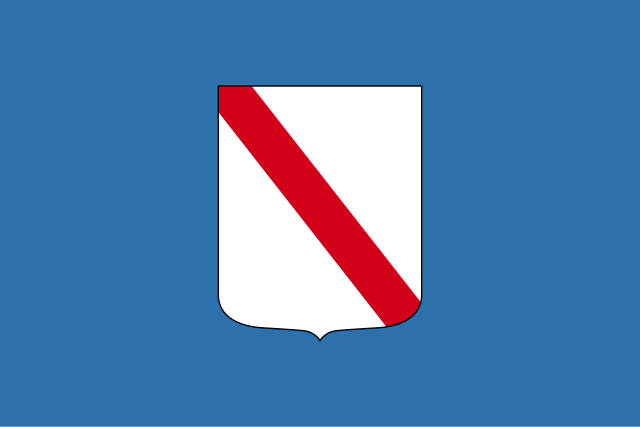 Campania
Emilia-Romagna
Italien
Campania
Emilia-Romagna
Italien
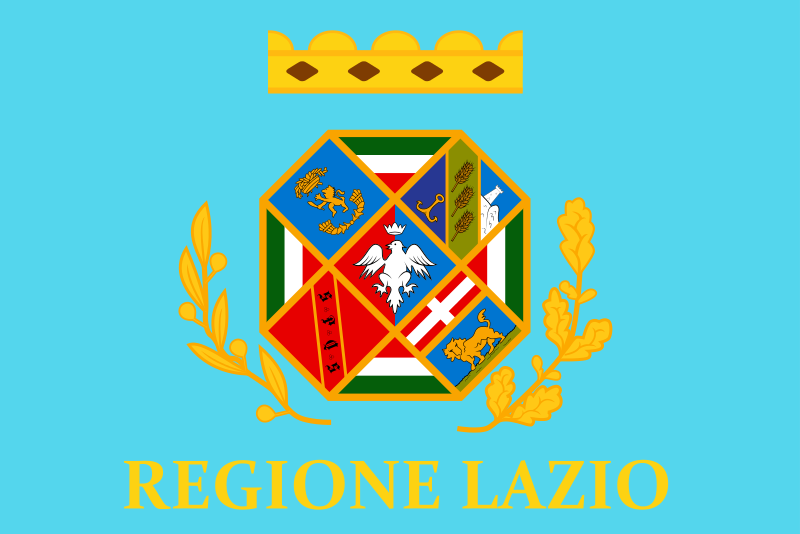 Lazio
Lombardia
Piemonte
Lazio
Lombardia
Piemonte
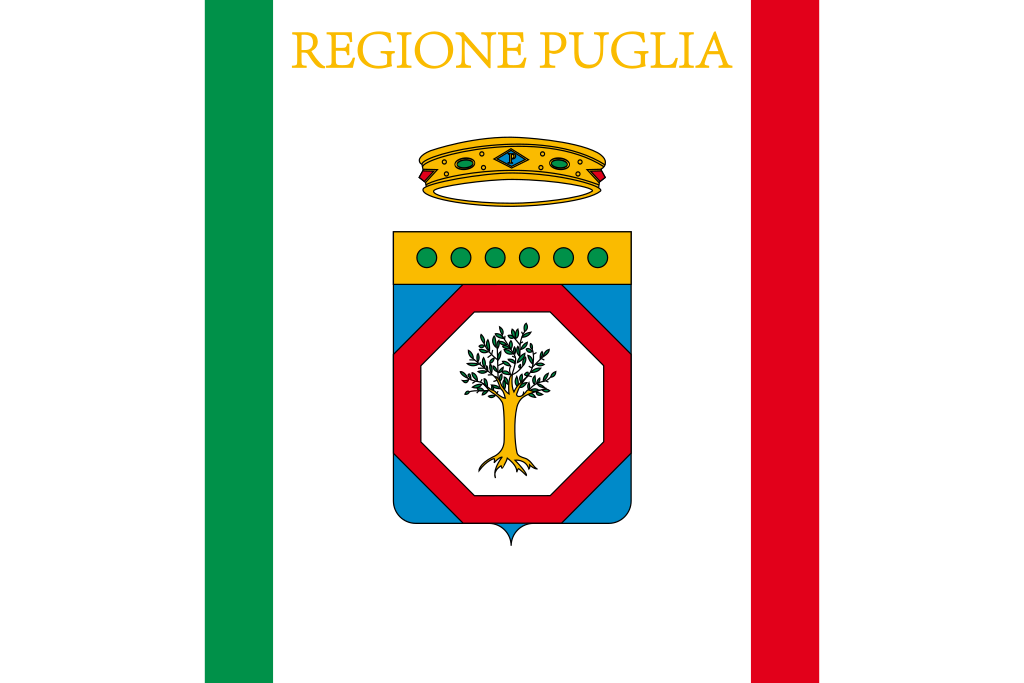 Puglia
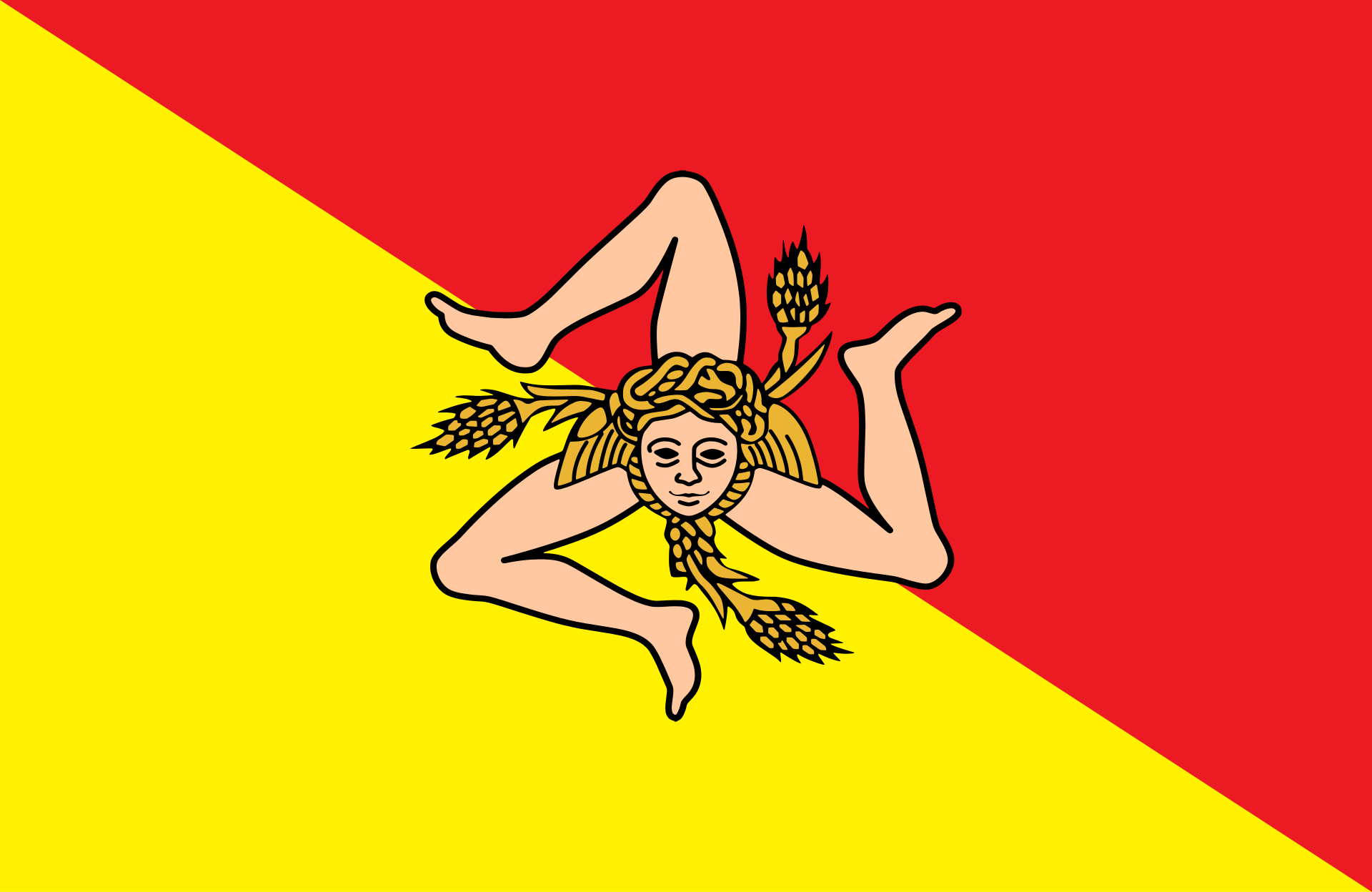 Sicilia
Technologie des Hochgeschwindigkeitszugs
Zentralantrieb
Technologie des Hochgeschwindigkeitszugs
Rad-Schiene-System
Sicilia
Technologie des Hochgeschwindigkeitszugs
Zentralantrieb
Technologie des Hochgeschwindigkeitszugs
Rad-Schiene-System
 Toscana
 Transport und Verkehr
Hochgeschwindigkeitsverkehr
Transport und Verkehr
Technologie des Hochgeschwindigkeitszugs
Veneto
Transport und Verkehr
Hochgeschwindigkeitsverkehr
Transport und Verkehr
Technologie des Hochgeschwindigkeitszugs
Veneto
 Essen und Trinken
*Mittelmeer
Italien
Essen und Trinken
*Mittelmeer
Italien
 Landwirtschaft, Forstwirtschaft, Viehzucht, Fischerei
Lombardia
Piemonte
Sicilia
Toscana
Landwirtschaft, Forstwirtschaft, Viehzucht, Fischerei
Lombardia
Piemonte
Sicilia
Toscana
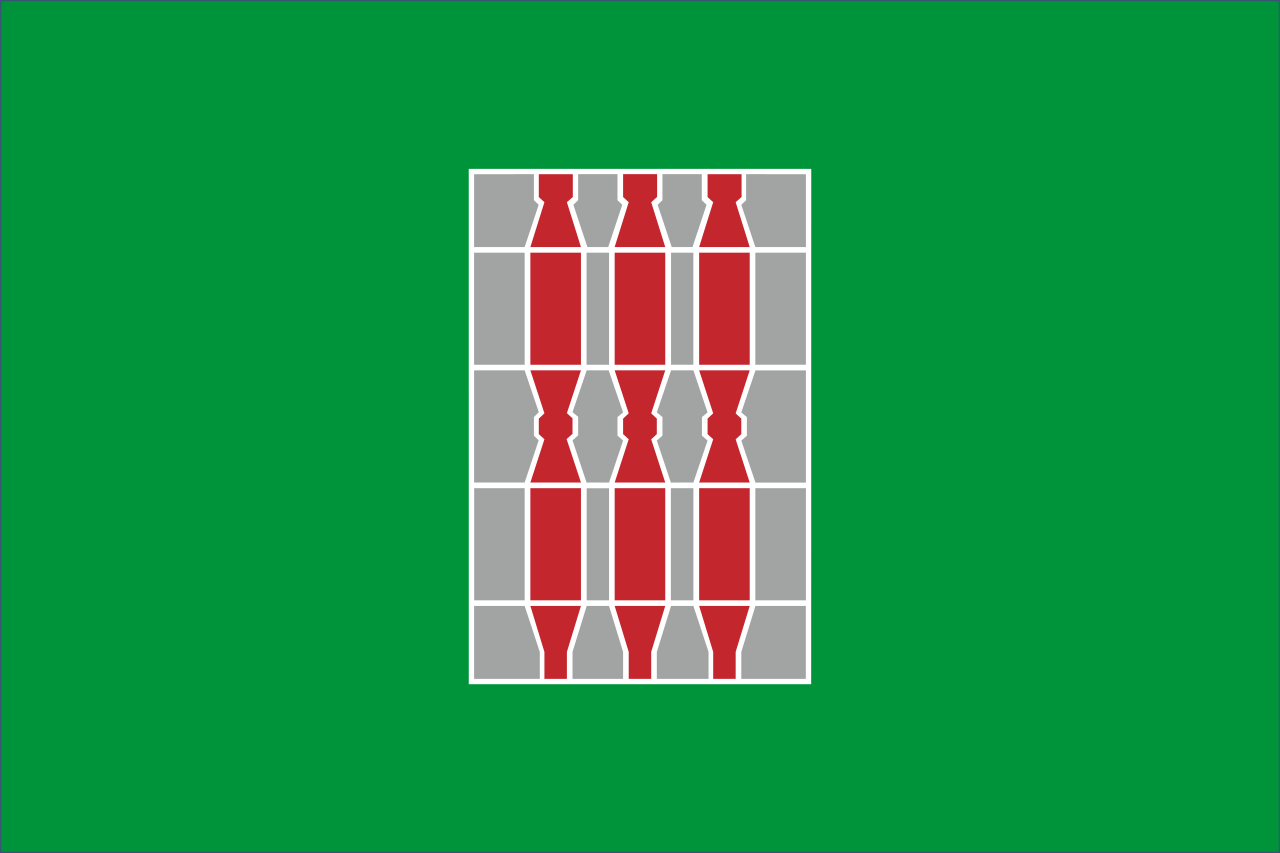 Umbria
Veneto
Umbria
Veneto
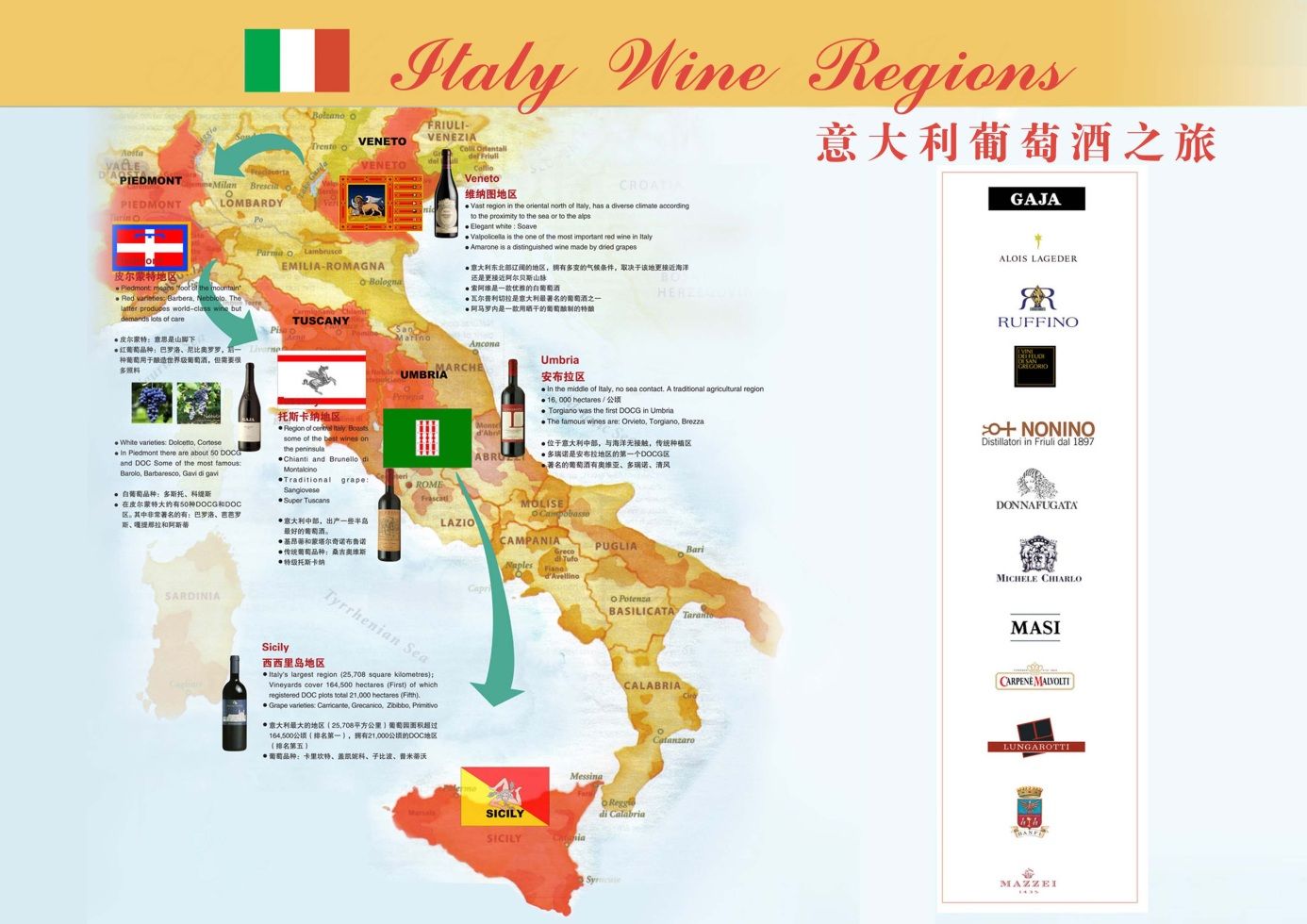
一概而论地评价意大利葡萄酒好于或差于其他国家的葡萄酒是不负责任的。因为,这个国家有着庞大的葡萄酒产量、惊人的风格多样性,当然也存在不同品质 的差异。在意大利很多地方依然保留着传统甚至显得过时的酿酒方法,可这并不妨碍他们酿造出最出色的酒。新式的酿酒方法也被广泛采用,而且对于普通情况来 说,这是提升意大利葡萄酒品质的重要手段。无论是传统亦或是创新,这些酿造技术被深谙酿酒之道的人采用都会获得经典佳酿。那些意大利传统的维护者和创新者 之间,或许有些小的争论,但是他们都最终获得国际市场的认可。
意大利和法国每年都在争夺世界上最大的葡萄酒生产国、出口国还有消费国的头衔。这两个国家每年大约生产6百万吨的葡萄酒,年出口量约占其总产量的四 分之一,意大利和法国的年人均消费葡萄酒量几乎一样,大约是50升(25年前为90升)。意大利酿酒葡萄种植面积约为922,000公顷,法国与其相当, 有917,000公顷(从这个数据上看,相比于西班牙的1,166,000公顷就略显失色)。很明显,从产量、出口量、消费量以及葡萄园面积来看,意大利 和法国几乎没有太大差别。
意大利的最大出口市场,按照出口额统计为美国。意大利出口的葡萄酒差不多有三分之二被大批散装地运到其他国家进行调配,尤其是德国(占总出口量的 38%)和法国(占总出口量的25%),许多葡萄酒被蒸馏成工业酒精中——大约占整体葡萄酒产量的15% ——相当于整个北美葡萄酒产量的一半。 所以尽管意大利的葡萄酒产量惊人,其中被装瓶且带有商标的酒款大约只占总产量的30-40%,这些远不及意大利被评为DOC级酒的一半数量,(详情请见关 于意大利葡萄酒法律部分),这也意味着等级分类的葡萄酒总量大约是整体产量的14%。(Quelle:http://www.italiawinealliance.com.cn)
 Internationale Städte
FIFA Fussball-Weltmeisterschaft 1990
Internationale Städte
FIFA Fussball-Weltmeisterschaft 1990
 Geschichte
Italien
Lombardia
Mailand
Olympische Winterspiele 2026
Geschichte
Italien
Lombardia
Mailand
Olympische Winterspiele 2026
 Weltkulturerbe

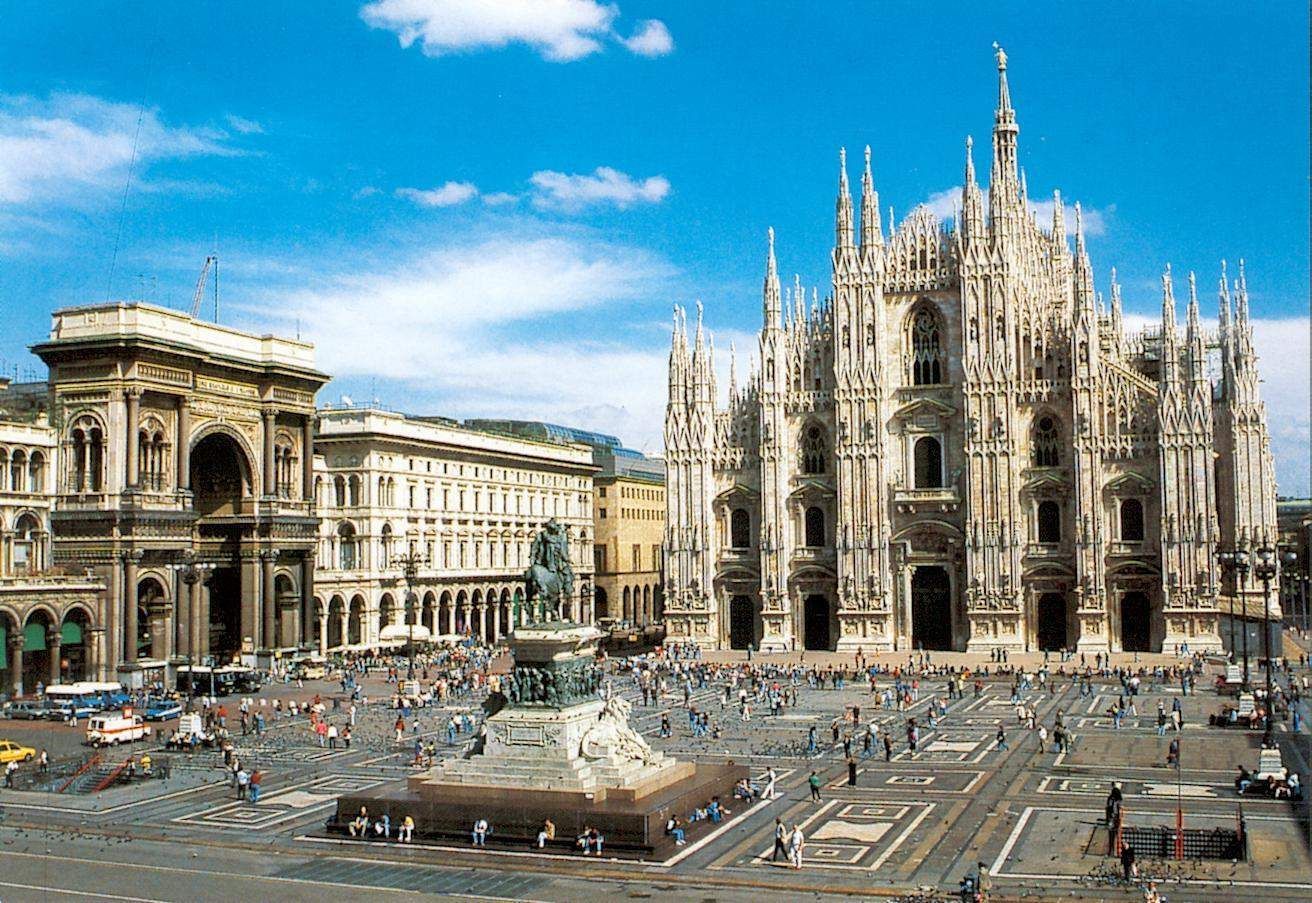
米兰(意大利语:Milano)是欧洲国家意大利的西北方大城,也是米兰省的省会和伦巴第大区的首府,位于意大利人口最密集和发展程度最高的伦巴第平原上。它是欧洲南方的重要交通要点,历史相当悠久,以观光、时尚与建筑景观闻名于世。米兰目前有132万居民,但如果将郊区的居住人口计算在内,则超过810万人,是欧洲三大都会区之一。总面积约有1,982平方公里 ,每平方公里超过2,000人居住[2] 。目前米兰市长为Giuliano Pisapia。
市区生产总值占意大利国内生产总值的4.8%,这个地区也被称为蓝香蕉(Blue Banana),是欧洲人口最密集与工业最发达的地区[3] 。
米兰最初被凯尔特人当中的因苏布雷人(Insubres)称为Medhlan[4]。后来罗马人在西元前222年征服该地后,称它为Mediolanum。米兰因此成为罗马帝国最繁荣的地区之一,并在286年至402年成为西罗马帝国的首都。米兰在中世纪时期则被称为Mailand,德语目前依然使用这个名字,它来自于凯尔特语的Mid-lan,意为“平原中心”。拿破仑于1796年占领米兰,并于1805年将米兰当作意大利王国的首都[5][6] 。米兰随后成为受到奥地利帝国所控制的伦巴第-威尼西亚王国首都,并于1859年成为萨丁尼亚王国的一部份,逐渐隶属于意大利王国。
米兰是一个国际性及国际化的城市,有15.2%的人口出生于国外[7]。这个城市依然是欧洲主要的运输和工业中心,米兰是欧洲联盟当中第10重要的商业和金融中心(2009年)[8],其经济购买力(参见米兰经济 )位居世界第26位[9]。在2008年,米兰都会区的国内生产总值位居欧洲第七位[10]。米兰省2007年的人均国内生产总值大约为€40,000(为欧盟27国平均水平的161%),是意大利人均国内生产总值最高的省份[11],城市工人平均所得位居意大利首位[11],在世界上则排名第26位[12]。此外对于外籍员工而言,米兰是世界第11昂贵的城市[13]。根据2010年一项经济学人信息社的研究显示,米兰是全球第12昂贵的居住城市[14]。据一些研究报告显示,它的经济环境位于世界第20位,也是欧洲的第10重要的商业和金融中心[15][16],拥有价值非常高的城市品牌[17]。
米兰是公认的世界时尚和设计之都,商业、工业、音乐、体育、文学、艺术及媒体皆具有全球重要影响力,也是一个主要的全球城市[18]。全市拥有丰富的文化古迹和遗产,拥有充满活力的夜生活[19][20],并具有独特的料理,例如意大利面包和意大利调味饭,耶诞节的点心巴内多内则是米兰另一个著名的特产。蒙特拿破仑大街上的时装商店举世闻名,埃马努埃莱二世长廊被认为是世界上最古老的购物中心。米兰的音乐剧特别著名,尤其是传统歌剧,也孕育出几位重要的作曲家(例如朱塞佩·威尔第),斯卡拉大剧院也相当知名。米兰也拥有一些重要的博物馆、大学、专科院校、宫殿、教堂和图书馆,例如布雷拉美术学院和斯福尔扎古堡。两支著名的足球队伍:AC米兰和国际米兰也以这座城市为根据地。米兰在最受欢迎的欧洲旅游城市中排名第52位,在2008年共有超过1,914,000名外国旅客造访[21]。这个城市曾经举办过1906年世界博览会并将于2015年再次举办世界博览会[22]。米兰2005年7月启用的RHO新展会会场占地250万平方米,展览面积46万平方米,是世界上最大的博览会场。米兰也以阿尔法·罗密欧汽车品牌和丝绸工业著称。
Mailand (italienisch Milano [miˈlaːno], lombardisch Milan [miˈlã(ŋ)],[2] lateinisch Mediolanum) ist mit 1,3 Millionen Einwohnern die zweitgrößte Stadt Italiens und Hauptstadt der Region Lombardei sowie der Metropolitanstadt Mailand. Die Metropolregion war 2006 mit 7,4 Millionen Einwohnern der größte italienische Ballungsraum.[3]
Einst eine Gründung keltischer Siedler, erlebte die Stadt im Römischen Reich einen raschen Aufschwung. Mailand unterstand in seiner Geschichte dem Einfluss deutscher, französischer und österreichischer Kaiser und wuchs nach der Einigung Italiens zur größten Industriestadt des Landes. Sie ist heute die führende Kultur-, Medien- und Modemetropole Italiens, eine Universitätsstadt und ein internationaler Finanzplatz als Sitz der Italienischen Börse. Sie beherbergt ein Weltkulturerbe, historisch bedeutsame Bauwerke und vielfältige Kunstschätze, die mehrere Millionen Touristen pro Jahr anziehen. Die Messestadt ist dank ihrer verkehrsgünstigen Lage in der oberitalienischen Po-Ebene ein Knotenpunkt des Schienen- und Autobahnnetzes und zweitgrößtes Luftfahrtdrehkreuz Italiens mit drei internationalen Flughäfen.
ミラノ(伊: Milano)は、イタリアで最大の都市圏人口を擁する都市で、ミラノ県の県都およびロンバルディア州の州都である。ヨーロッパ有数の世界都市。イタリア語のアクセントの関係でミラーノと記されることもある。英語ではミラン(英: Milan)、フランス語ではミラン(仏: Milan)、ドイツ語ではマイラント(独: Mailand)、スペイン語ではミラン(西: Milán)、ラテン語ではメディオラーヌム(羅: Mediolanum)と言う。
ミラノはイタリア全土では首都ローマに次ぎ第2位、北部イタリアにおいては最大の都市で商業、工業、金融の中心。観光地としても名高い。1982年に1,607,804人いた人口はその後ドーナツ化現象で長く減り続けたが、ここ数年はおよそ130万人前後で落ち着いている(2013年時点の人口は1,324,169人)。2015年の近郊を含む都市圏人口は約526万人であり、イタリアで最大、南ヨーロッパではスペインのマドリードに次ぐ都市圏を形成している。日本の稚内市とほぼ同緯度に位置するが、最寒月の平均気温がおよそ5℃程度と、比較的温暖。
ミラノ・コレクションなどで知られるように古くから服飾・繊維産業などファッション関連の産業が盛んな土地柄であるが、近年は航空産業や自動車産業、精密機器工業なども発達しておりイタリア最大級の経済地域を形成している。
日本の民間研究所が2016年に発表した「世界の都市総合力ランキング」では、世界31位と評価された[4]。また、アメリカのシンクタンクが2016年に発表した世界都市ランキングでは世界45位と評価された[5]。
Milan (/mɪˈlæn, mɪˈlɑːn/;[3] Italian: Milano [miˈlaːno] ( listen); Lombard: Milan [miˈlãː] (Milanese variant))[4][5] is a city in northern Italy, capital of Lombardy, and the second-most populous city in Italy after Rome, with the city proper having a population of 1,369,466 while its province-level municipality has a population of 3,238,665.[6] Its continuously built-up urban area (that stretches beyond the boundaries of the Metropolitan City of Milan) has a population estimated to be about 5,270,000 over 1,891 square kilometres (730 square miles).[7] The wider Milan metropolitan area, known as Greater Milan, is a polycentric metropolitan region that extends over central Lombardy and eastern Piedmont and which counts an estimated total population of 7.5 million, making it by far the largest metropolitan area in Italy.[8][9][10][11][12] Milan served as capital of the Western Roman Empire from 286 to 402 and the Duchy of Milan during the middle and early modern age.
Milan is considered a leading alpha global city,[13] with strengths in the field of the art, commerce, design, education, entertainment, fashion, finance, healthcare, media, services, research and tourism. Its business district hosts Italy's Stock Exchange and the headquarters of national and international banks and companies. In terms of GDP, it has the third-largest economy among European cities after Paris and London, but the fastest in growth among the three, and is the wealthiest among European non-capital cities.[14][15] Milan is considered part of the Blue Banana and one of the "Four Motors for Europe."
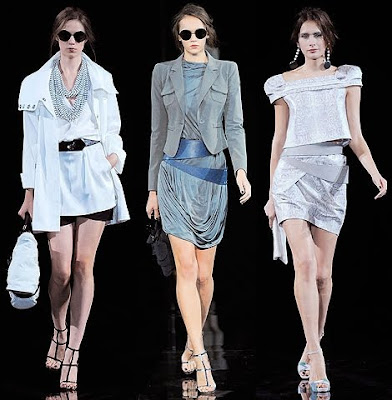
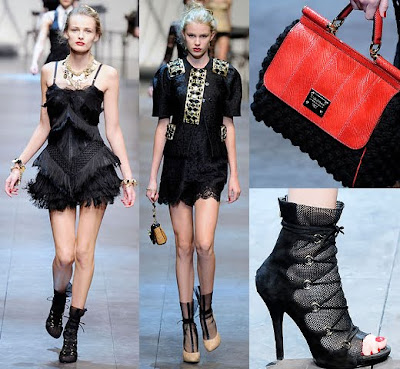
The city has been recognized as the world’s fashion capital and the world's design capital [16] thanks to several international events and fairs, including Milan Fashion Week and the Milan Furniture Fair, which are currently among the world's biggest in terms of revenue, visitors and growth.[17][18][19] It hosted the Universal Exposition in 1906 and 2015. The city hosts numerous cultural institutions, academies and universities, with 11% of the national total enrolled students.[20] Milan is the destination of 8 million overseas visitors every year, attracted by its museums and art galleries that boast some of the most important collections in the world, including major works by Leonardo da Vinci. The city is served by a large number of luxury hotels and is the fifth-most starred in the world by Michelin Guide.[21] The city is home to two of Europe's most successful football teams, A.C. Milan and F.C. Internazionale, and one of Italy's main basketball teams, Olimpia Milano.
Milan (en italien Milano, du latin Mediolanum ; en lombard Milàn) est une ville d'Italie située au nord du pays, à proximité des Alpes. Chef-lieu de la région Lombardie, située au milieu de la plaine du Pô, Milan compte approximativement 1 369 000 habitants en 2016, ce qui en fait la deuxième ville d'Italie en nombre d'habitants. En comprenant son agglomération, elle constitue toutefois la plus grande aire urbaine du pays ; avec ses 7 123 563 d'habitants en 2009, celle-ci est la quatrième aire urbaine d'Europe, après celles de Moscou, de Paris et de Londres. Région dynamique et densément peuplée, cœur industriel et poumon financier de l'Italie, elle représente la partie méridionale de la dorsale européenne1, aussi appelée « Banane bleue ».
Fondée durant l'Antiquité par des peuples celtes, les Insubres, Milan est conquise en -222 par les Romains et sera la capitale de l'Empire romain d'Occident pendant un siècle, de 286 à 402. Elle devient durant les siècles suivants un lieu majeur du christianisme, gouverné par des comtes puis par la famille Visconti, qui en font l'une des places financières les plus importantes du Moyen Âge. De 1395 à 1796, la ville forme le Duché de Milan, fief du Saint-Empire romain germanique successivement sous la domination de la France, des Habsbourg d'Espagne et de l'Autriche, avant de rejoindre en 1859 le Royaume d'Italie. Au début du XXe siècle, Milan devient la région la plus industrielle du pays et est à l'avant-garde du processus de consolidation de la jeune nation italienne. En grande partie dévastée durant la Seconde Guerre mondiale, en raison de l'occupation nazie, la ville devient le centre de la Résistance italienne. De l'après-guerre à aujourd'hui, Milan connaît une explosion démographique et économique, attirant de nombreux travailleurs du sud de l'Italie ainsi que des étrangers, faisant d'elle l'une des villes les plus cosmopolites du pays2.
Milan est considéré comme le cœur industriel, commercial, financier et universitaire de l'Italie. Siège de la Bourse italienne, elle représente un grand pôle d'attraction pour les sièges d'entreprises, notamment dans le secteur de la mode et du design, dont Milan est l'une des capitales mondiales - elle accueille notamment l'une des principales fashion weeks et le Salon international du meuble. Elle accueille par ailleurs 185 000 étudiants – soit 11 % des étudiants en Italie –, dans des établissements tels que la prestigieuse université Bocconi. Enfin, Milan est le lieu de résidence de deux grands clubs de football européens : le Milan AC et l'Inter de Milan.
Destination touristique de premier plan, avec près de deux millions de touristes chaque année3, elle abrite un patrimoine culturel important, composé de places (la Piazza del Duomo, la Piazza Mercanti), de palais construits à la Renaissance (Palais royal de Milan, Palazzo della Ragione, Casa Panigarola), de son célèbre opéra (La Scala) et de nombreux musées. Le Château des Sforza, à proximité du Parco Sempione, en accueille plusieurs. Ces bâtiments anciens en côtoient de plus récents, comme la Galleria Vittorio Emanuele II ou la tour Pirelli. Milan est la deuxième ville italienne - après Naples - étoilée au Guide Michelin4.
Milan accueille l'Exposition universelle de 2015.
Milano (/miˈlano/ ; Milàn in dialetto milanese[6], /miˈlãː/[7]) è un comune italiano di 1 369 466 abitanti[4], capoluogo della regione Lombardia, dell'omonima città metropolitana, e centro di una delle più popolose aree metropolitane d'Europa.
Fondata intorno al 590 a.C., forse con il nome di Medhelan, nei pressi di un santuario da una tribù celtica facente parte del gruppo degli Insubri e appartenente alla cultura di Golasecca, fu conquistata dagli antichi Romani nel 222 a.C. e in seguito da loro ridenominata Mediolanum. Con il passare dei secoli accrebbe la sua importanza sino a divenire capitale dell'Impero romano d'Occidente, nel cui periodo fu promulgato l'editto di Milano, che concesse a tutti i cittadini, quindi anche ai cristiani, la libertà di onorare le proprie divinità.
In prima linea nella lotta contro il Sacro Romano Impero in età comunale, divenne prima signoria per poi essere innalzata a dignità ducale alla fine del XIV secolo, rimanendo al centro della vita politica e culturale dell'Italia rinascimentale. All'inizio del XVI secolo perse l'indipendenza a favore dell'Impero spagnolo per poi passare, quasi due secoli dopo, sotto la corona austriaca: grazie alle politiche asburgiche, Milano divenne uno dei principali centri dell'illuminismo italiano. Capitale del Regno d'Italia napoleonico, dopo la Restaurazione fu tra i più attivi centri del Risorgimento fino al suo ingresso nel Regno d'Italia sabaudo.
Principale centro economico e finanziario della penisola italiana, Milano ne guidò lo sviluppo industriale, costituendo con Torino e Genova il "Triangolo industriale", in particolar modo durante gli anni del boom economico quando la crescita industriale e urbanistica coinvolse anche le città limitrofe, creando la vasta area metropolitana milanese. In ambito culturale, Milano è il principale centro italiano dell'editoria ed è ai vertici del circuito musicale mondiale grazie alla stagione lirica del Teatro alla Scala e alla sua lunga tradizione operistica. È inoltre tra i principali poli fieristici europei e del disegno industriale, ed è considerata una delle capitali mondiali della moda.
Milán (en italiano: Milano, y en dialecto milanés: Milàn)2 es la mayor Área Metropolitana de Italia y el segundo municipio de Italia por población, capital de la Ciudad metropolitana de Milán y de la región de Lombardía. Se encuentra ubicada en la llanura padana, una de las regiones más desarrolladas de Italia. En 2008, el PIB de Lombardía, fue estimado por el INSEE en 366 mil millones de euros, el segundo de Europa después de la región de Isla de Francia.[cita requerida]
Milán, como capital económica e industrial de Italia, tiene el aspecto y las características de una metrópolis moderna: rascacielos (célebre el rascacielos Pirelli, construido en 1959), edificios de cristal y metal y grandes almacenes. Su inconmensurable patrimonio artístico es uno de los mayores de Italia y de Europa, contando con cientos de iglesias monumentales antiguas y museos tan fundamentales para la historia del arte como la Pinacoteca de Brera, uno de los mayores museos de Europa, fundada en 1809 por Napoleón Bonaparte como hermano italiano del Louvre. Destaca también la obra maestra de Leonardo da Vinci, la pintura mural "La Última Cena" y los muchos monumentos románicos (sobre todo iglesias y basílicas) que hacen de Milán la capital del primer románico, llamado también Románico lombardo.
Мила́н (итал. Milano [miˈlaːno], ломб. Milan [miˈlãː], лат. Mediolanum — в центре равнины) — главный город северной части Италии. Административный центр области Ломбардия[3], самого крупного региона Италии, и провинции Милан. Второй по величине город Италии. Имеет репутацию финансово-экономической столицы страны и одной из мировых столиц моды. Относится к глобальным городам.
Alberto Zaccheroni
FIFA-Klub-Weltmeisterschaft 2025
FIFA-Klub-Weltmeisterschaft 2025
Gruppe E
Giovanni Trapattoni
Italien
José Mourinho
La Serie A
La Serie A 2015/16
La Serie A 2016/17
La Serie A 2017/18
La Serie A 2018/19
Lombardia
Marcello Lippi
Rafael Benítez
Sport
(F)UEFA Champions League
UEFA Champions League 2018/19
Gruppe B
UEFA Champions League 2019/20
Gruppe F
UEFA Champions League 2025/26

国际米兰足球俱乐部(意大利语:Football Club Internazionale(發音:[ˌinternattsjoˈnaːle]) Milano)简称国米,是一家位于意大利米兰市的足球俱乐部,意大利足球甲级联赛参赛球队之一。
国际米兰成立于1908年3月9日,俱乐部的44位创始人是当时反对“米兰板球与足球俱乐部”(即现时的AC米兰)国际球员禁令政策而出走分裂的成员。因为俱乐部成立之初即向全世界的球员敞开大门,而不仅限于意大利球员,所以称之为“国际”俱乐部。俱乐部的创始人之一,也是队徽最初的设计者乔治·穆贾尼选择了蓝色和黑色作为球队的代表色。[4]
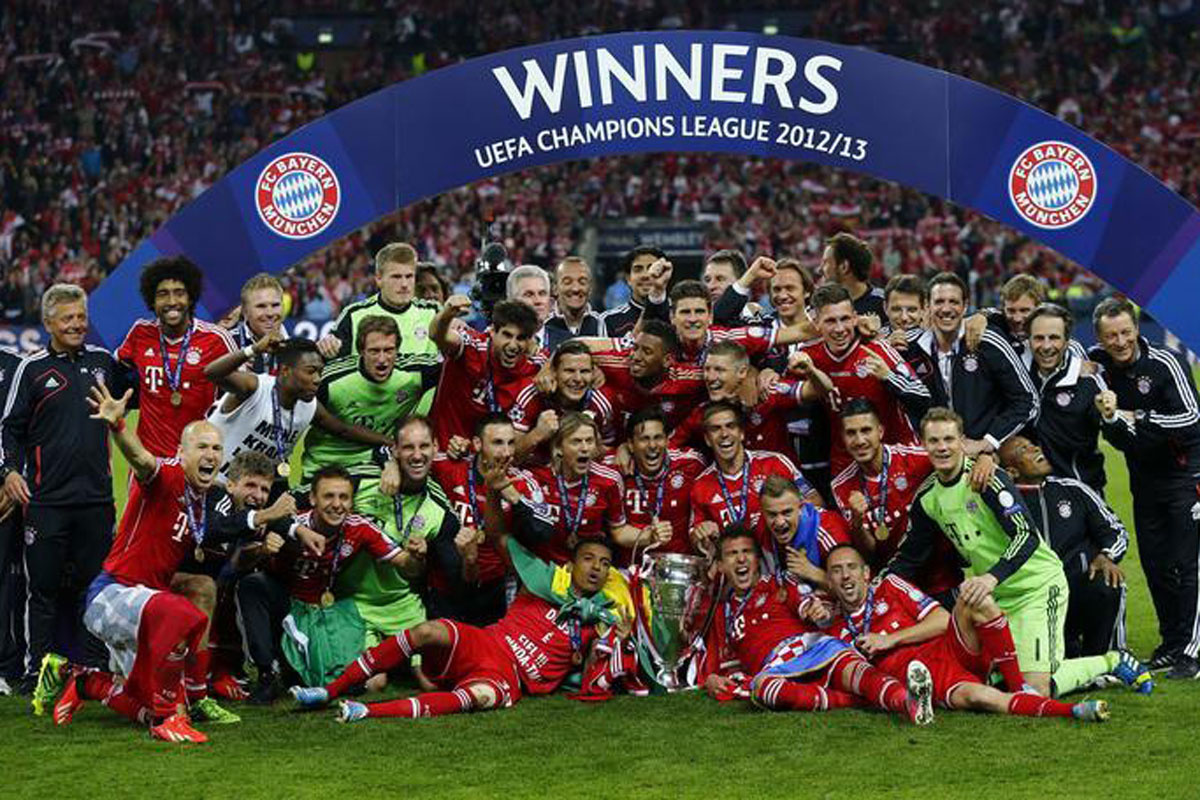
国际米兰历史上共获20次顶级联赛冠军、9次意大利杯冠军、7次意大利超级杯冠军和3次欧洲冠军联赛冠军。在2010年,国际米兰连获意甲联赛、意大利杯和欧洲冠军联赛三项冠军,成为意大利足球史上第一支也是唯一一支“三冠王”球队。此外,国际米兰也曾获得欧洲联盟杯、洲际杯、世俱杯等国际赛事冠军。
国际米兰曾为“意甲七姐妹”[5]之一,也与AC米兰和尤文图斯两支球队并称“北方三强”。国际米兰和AC米兰这两支同样来自米兰的俱乐部之间的碰撞被称为“米兰德比”,和来自都灵的尤文图斯之间的对决则是“意大利德比”。国际米兰曾是G-14成员之一。
国际米兰自1908年成立以来从未降至次级联赛,并且是唯一一支参与了意大利足球甲级联赛1929年赛制改革(由单循环赛制改为双循环赛制)后所有赛季的球队。
Der Football Club Internazionale Milano, kurz Internazionale oder Inter, im deutschsprachigen Raum bekannt als Inter Mailand, ist ein 1908 gegründetes italienisches Fußballunternehmen aus der lombardischen Hauptstadt Mailand.
Weitere Bezeichnungen sind I Nerazzurri („Die Schwarz-Blauen“), La Beneamata und Il Biscione.
Mit 20 nationalen Meistertiteln, neun nationalen Pokalsiegen, dem dreimaligen Gewinn des Europapokals der Landesmeister bzw. der UEFA Champions League, dem zweimaligen Gewinn des Weltpokals, einmal der FIFA-Klub-Weltmeisterschaft und drei Finalsiegen im UEFA-Pokal bzw. der UEFA Europa League zählt Inter zu den erfolgreichsten Fußballvereinen der Welt. Der Verein ist außerdem einer von acht Klubs, welche in einer Saison das große Triple errangen.
Inter ist der einzige Klub in Italien, der seit Gründung der Serie A durchgehend in der höchsten Spielklasse teilnimmt.
Heimspielstätte ist das auch unter dem ehemaligen Namen San Siro bekannte Giuseppe-Meazza-Stadion. Dieses teilt sich der Klub mit dem Stadtrivalen AC Mailand.
Alberto Zaccheroni
Audi Cup
Carlo Ancelotti
Fabio Capello
Giovanni Trapattoni
Italien
La Serie A
La Serie A 2015/16
La Serie A 2016/17
La Serie A 2017/18
La Serie A 2018/19
Lombardia
Sport
(F)UEFA Europa League
UEFA Europa League 2017/18
Gruppe D
UEFA Europa League 2018/19
Gruppe F
 Energieressource
 Abruzzo
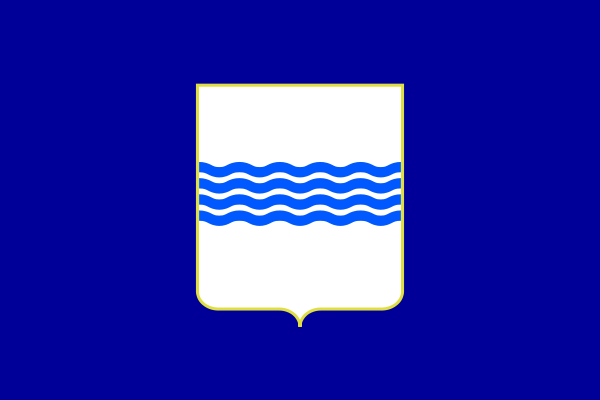 Basilicata
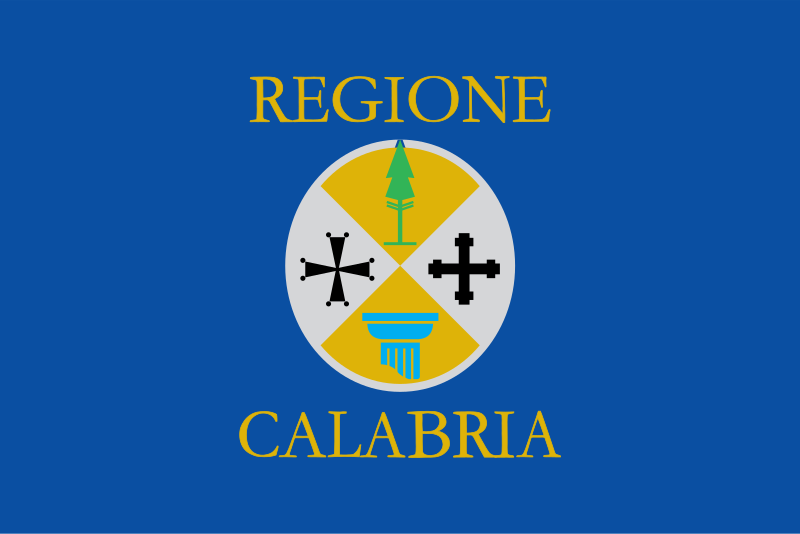 Calabria
Campania
Emilia-Romagna
Friuli-Venezia Giulia
Italien
Lazio
Calabria
Campania
Emilia-Romagna
Friuli-Venezia Giulia
Italien
Lazio
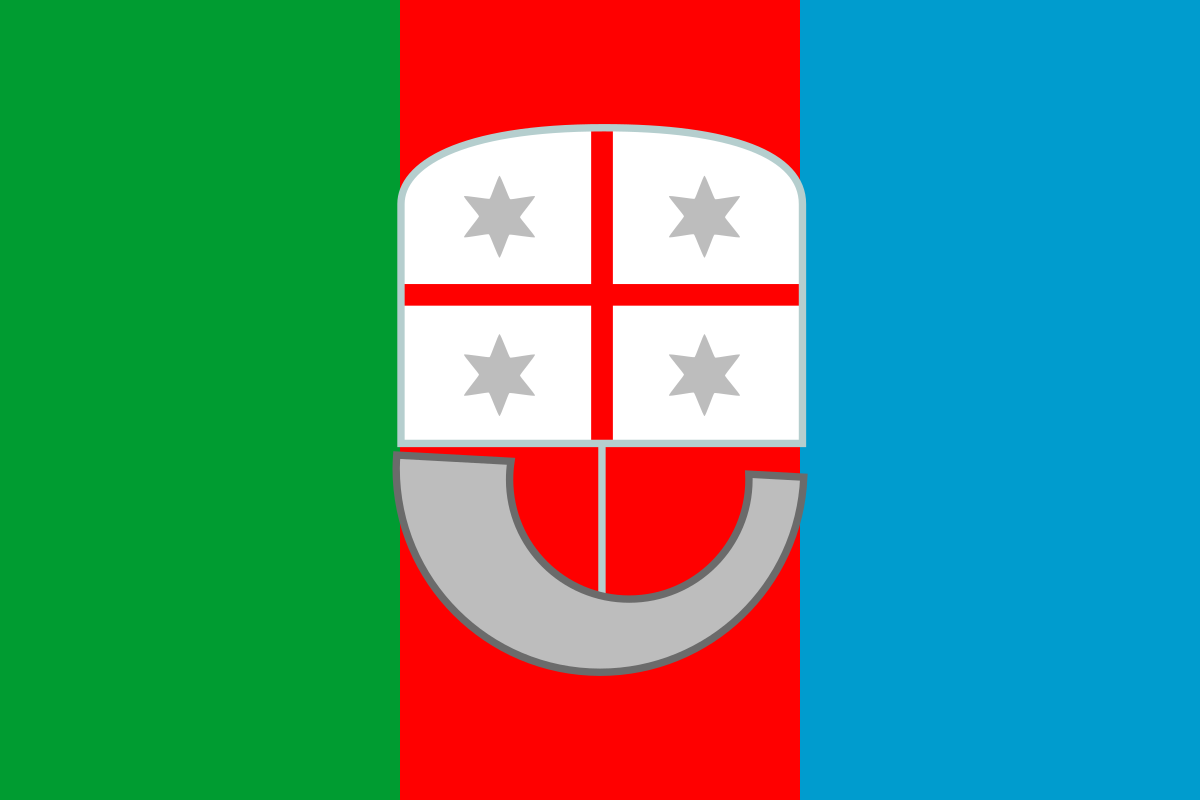 Liguria
Lombardia
Liguria
Lombardia
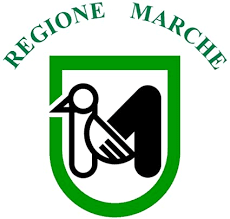 Marche
 Molise
Piemonte
Puglia
Molise
Piemonte
Puglia
 Sardegna
Sicilia
Toscana
Trentino-Alto Adige
Umbria
Sardegna
Sicilia
Toscana
Trentino-Alto Adige
Umbria
 Unternehmen
*Größte Stromunternehmen
Valle d´Aosta
Veneto
Unternehmen
*Größte Stromunternehmen
Valle d´Aosta
Veneto
 Wirtschaft und Handel