Deutsch-Chinesische Enzyklopädie, 德汉百科
 Yunnan Sheng-YN
 Traditional medicine
 Architecture

 Religion
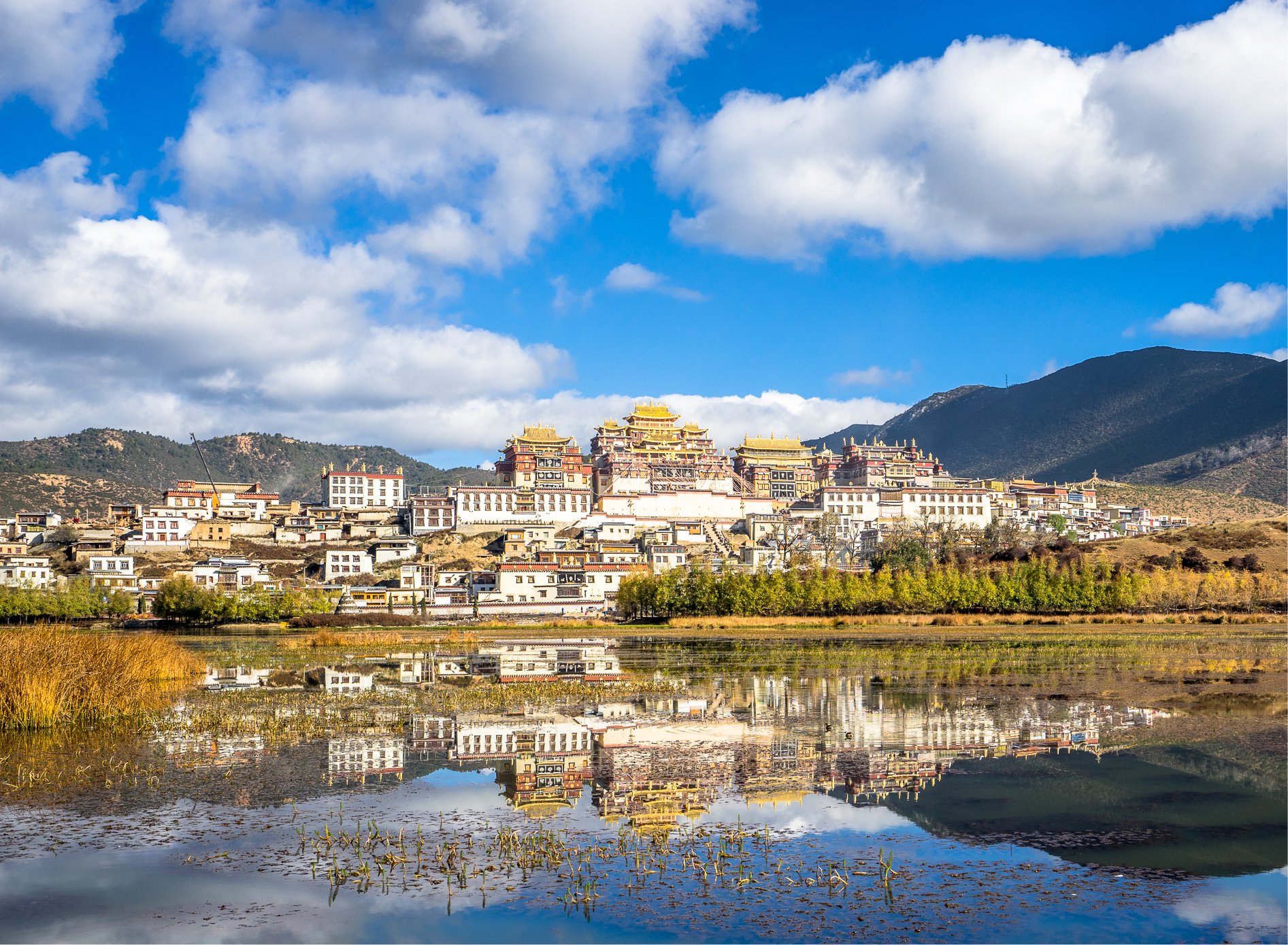
Das Kloster Ganden Songtsenling (Tibetisch: དགའ་ལྡན་སུམ་རྩེན་གླིང་, Wylie: dga' ldan sum rtsen gling; chinesisch 噶丹松赞林寺, Pinyin Gádān Sōngzànlín Sì, englisch Songzanlin Lamasery) ist ein Kloster des tibetischen Buddhismus in Shangri-La, dem früheren Zhongdian (中甸县), im Autonomen Bezirk Dêqên[1] der Tibeter im Nordwesten der chinesischen Provinz Yunnan. Es ist das größte Kloster der Gelug-Schule des tibetischen Buddhismus in Yunnan. (Vorsicht: Es existieren viele Alternativnamen, s.u.)
1679 hatte der fünfte Dalai Lama – Ngawang Lobsang Gyatso – den chinesischen Kaiser Kangxi um die Genehmigung gebeten, hatte selbst den Ort ausgewählt, den Tempel aufgebaut und ihm seinen Namen gegeben. Qing-Kaiser Yongzheng gab ihm den chinesischen Namen Guihua-Kloster[2]. Der Tempel war die Aufenthaltsstätte bekannter tibetischer buddhistischer Mönche.
Es liegt auf dem Reiseweg vieler Touristen nach Tibet. Auch die Grenze zur Provinz Sichuan liegt in seiner Nähe.

 Literature
Gansu Sheng-GS
Literature
Gansu Sheng-GS
 History
Qinghai Sheng-QH
Sichuan Sheng-SC
Xinjiang Uygur Zizhiqu-XJ
Xizang Zizhiqu-XZ
Yunnan Sheng-YN
History
Qinghai Sheng-QH
Sichuan Sheng-SC
Xinjiang Uygur Zizhiqu-XJ
Xizang Zizhiqu-XZ
Yunnan Sheng-YN

格萨尔王传(藏语:གེ་སར་རྒྱལ་པོ་,威利:Ge-sar rgal-po,蒙古语:ᠭᠡᠰᠡᠷ
ᠬᠠᠭᠠᠨ),流行在西藏和中亚地区的著名史诗,目前在西藏、蒙古和土族中间尚有140位演唱艺人在说唱这部史诗。
格萨尔王传已经存在有一千多年,长达60万诗行,相当于印度史诗《摩诃婆罗多》3部长,《罗摩衍那》15部,是世界最长的史诗。讲述传说中的岭国国王格萨尔的故事,对藏传佛教影响很大。
格萨尔王传在目前有多达五十多种不同的版本,但仅中国大陆发行的藏文版本就已达到120册,分29章。而第一个印刷发行的版本是1716年,在北京发布的蒙古文版。
Gesar[1] ist ein epischer tibetischer König, dessen Heldentaten in von Barden vorgetragenen Gesängen, in ihrer Gesamtheit Gesar-Epos genannt, beschrieben werden. Dieses Epos gilt als der größte zentralasiatische Epenzyklus.
Dieses Korpus von Erzählungen enthält das Grundmotiv vom Kampf des guten tibetischen Herrschers Gesar, der als Mensch geboren wird, jedoch viele göttliche Fähigkeiten hat, gegen das Böse in der Welt. Gesars kriegerische und listenreiche Taten werden in ganz Zentralasien von Ladakh bis in die Mongolei, besonders aber in Osttibet, in Form von Gesängen tradiert, daher wird es meist Gesar-Epos genannt. Es existiert unter anderem in tibetischer, mongolischer (ᠭᠡᠰᠡᠷ
ᠬᠠᠭᠠᠨ ᠤ
ᠲᠤᠭᠤᠵᠢ, Гэсэрийн тууж) und türkischer Sprache. Die Vortragenden waren und sind z. T. noch spezielle Gesar-Barden, die teilweise Texte im Umfang dicker Bücher memorieren können.
Das Epos ist sehr umfangreich und nimmt seinen Anfang mit der Entstehung der Welt. Es wurde wahrscheinlich für eine Aufführung über mehrere Tage hinweg konzipiert.
The Epic of King Gesar[a] (/ˈɡɛzər, ˈɡɛs-/), also spelled Geser (especially in Mongolian contexts) or Kesar (/ˈkɛzər, ˈkɛs-/), is an epic cycle, of Tibet and greater Central Asia, believed to date from the 12th century, that relates the heroic deeds of the culture hero Gesar,[1] the fearless lord of the legendary kingdom of Ling (Wylie: gling). It is recorded variously in poetry and prose, through oral poetry performance, [2] it is sung widely throughout Central Asia and North East of South Asia. Its classic version is to be found in central Tibet.[3] Some 100 bards of this epic (Wylie: sgrung, "tale")[4] are still active today in the Gesar belt of China.[5] Tibetan, Mongolian, Buryat, Balti, Ladakhi and Monguor singers maintain the oral tradition and the epic has attracted intense scholarly curiosity as one of the few oral epic traditions to survive as a performing art. Besides stories conserved by such Chinese minorities as the Bai, Naxi, the Pumi, Lisu, Yugur[6] and Salar,[7] versions of the epic are also recorded among the Balti of Baltistan, the Burusho people of Hunza and Gilgit[6] and the Kalmyk and Ladakhi peoples,[8][9] in Sikkim, Bhutan, Nepal, and among various Tibeto-Burmese, Turkic, and Tungus tribes.[10] The first printed version was a Mongolian text published in Beijing in 1716.[11]
The epic is composed of a very large body of versions, each with many variants, and is reputed by some to be the longest in the world.[4] Although there is no one definitive text, the Chinese compilation so far of just its Tibetan versions has filled some 120 volumes, more than one million verses,[4] divided into 29 "chapters".[12] Western calculations speak of more than 50 different books edited so far in China, India and Tibet.[4]
L'épopée du roi Guésar — dit aussi Gesar Khan ou Gesar de Ling — est le poème épique le plus célèbre des populations tibétaines1, et mongoles.
Elle comporterait plusieurs millions de vers, ce qui en ferait l'œuvre littéraire la plus longue actuellement connue dans le monde. Composée il y a plus de huit siècles à partir de récits beaucoup plus anciens, elle est encore interprétée de nos jours par plusieurs dizaines de bardes dans les régions de populations tibétaines et mongoles.
L'épopée est inscrite au Patrimoine culturel immatériel de l'humanité depuis 2009 par l'UNESCO2.
L’Epica di Re Gesar, anche scritto Geser (particolarmente in contesti mongoli) o Gesser o Kesar, è un ciclo epico, ritenuto risalire al XII secolo, che racconta le gesta dell'eroe culturale Gesar [1], impavido signore del leggendario regno di Ling. Composto in varie forme di poesia e prosa aventi come stile tipico di rappresentazione lo shuochang cinese[2] e cantato in molte zone dell'Asia centrale e del nord est dell'Asia meridionale, la sua versione classica è rintracciabile nel Tibet centrale.[3] Un centinaio di bardi di questa narrazione epica[4] sono tuttora attivi nella cosiddetta "cintura Gesar" della Cina[5]. La tradizione è mantenuta viva da centinaia di cantastorie tibetani, mongoli, buriati, balti, ladakhi e tu ovvero mongour, e l'epica ha suscitato viva curiosità da parte degli studiosi come una delle poche tradizioni orali epiche sopravvissute in forma di arte performativa. Oltre agli intrecci conservati da minoranze cinesi come i bai, i naxi, i pumi, i lisu, gli iuguri[6] e i salar[7], ulteriori versioni dell'epica si riscontrano anche in Pakistan — tra i balti del Baltistan e i burúšo di Hunza e Gilgit [8], oltre che presso calmucchi e ladakhi[9][10], in Sikkim, Bhutan, Nepal, tra svariate etnie tibeto-birmane, popolazioni di lingue turche e tribù tunguse[11]. La sua prima versione stampata è stato un testo mongolo pubblicato a Pechino nel 1716.[12]
L'epica si compone di un amplissimo corpus di versioni, ciascuna delle quali a sua volta con molte varianti, e secondo alcuni sarebbe la più lunga del mondo.[13] Sebbene non esista un testo definitivo, l'attuale compilazione cinese soltanto delle versioni tibetane ha riempito 120 volumi, più di un milione di versi[14] divisi in 29 "capitoli".[15] Secondo conteggi occidentali, più di 50 libri sarebbero a questo punto pubblicati in Cina, India e Tibet.[13]
El rey Guesar es una epopeya tibetana. Es el escrito más largo del mundo, y actualmente el texto épico más antiguo que conserva vitalidad, y que se sigue recitando y ampliando oralmente hasta hoy en día.
Der Taihe Gong Jindian (chinesisch 太和宫金殿, Pinyin Tàihé Gōng Jīndiàn), auch Taihegong-Bronzehalle oder Tongwa-Tempel (铜瓦寺, Tóngwǎ sì – „Bronzeziegel-Tempel“), befindet sich auf dem Berg Mingfeng Shan (鸣凤山) im Straßenviertel Qingyun des Stadtbezirks Panlong der Stadt Kunming in der Provinz Yunnan der Volksrepublik China.
Der daoistische Tempel wurde ursprünglich 1602 während der Ming-Dynastie unter dem Provinz-Gouverneur Chen Yongbin (陈用宾) erbaut.
Der gegenwärtige „Goldene Tempel“ (Jindian) wurde von Wu Sangui 吴三桂 im Jahr 1671 der Qing-Dynastie erbaut. Er ist 6,2 Meter breit und 6,7 m hoch[1] und stellt die größte Bronzehalle Chinas dar. Er wurde aus ca. 200 Tonnen[2] Bronze gefertigt.
Die Halle erstrahlt wie Gold im Sonnenlicht, was dem Tempel zu seinem Namen verhalf. Außer den aus Marmor gefertigten Treppen und Balustraden sind sowohl Wände, Säulen, Dachziegel, Altäre, Buddha-Statuen, Wanddekorationen als auch die Banner in der Nähe des Torturmes aus Bronze gefertigt.
太和宫金殿,又名铜瓦寺,位于云南省昆明市盘龙区穿金路771号,明万历三十年(1602年)开始修建,明崇祯十年(1637年)被移至鸡足山,后在清康熙十年(1671年)重铸。 太和宫金殿坐东朝西,面阔三间,通面阔615厘米(柱网轴线间距,下同);进深七檩,通进深612厘米,平面形状接近正方形。每面四根檐柱,柱径20厘米;殿内共四根金柱,柱径21.5厘米。昆明鸣凤山太和宫作为全国少有的建有紫金城和金殿的古老的道教真武宫观,成为中国明、清时期道教发展、政治变幻、金属产业发展等史实的重要见证,饱含了多方面的珍贵价值。
 Geography