Deutsch-Chinesische Enzyklopädie, 德汉百科
 Chūbu
Chūbu

 International cities
 History
 Important port
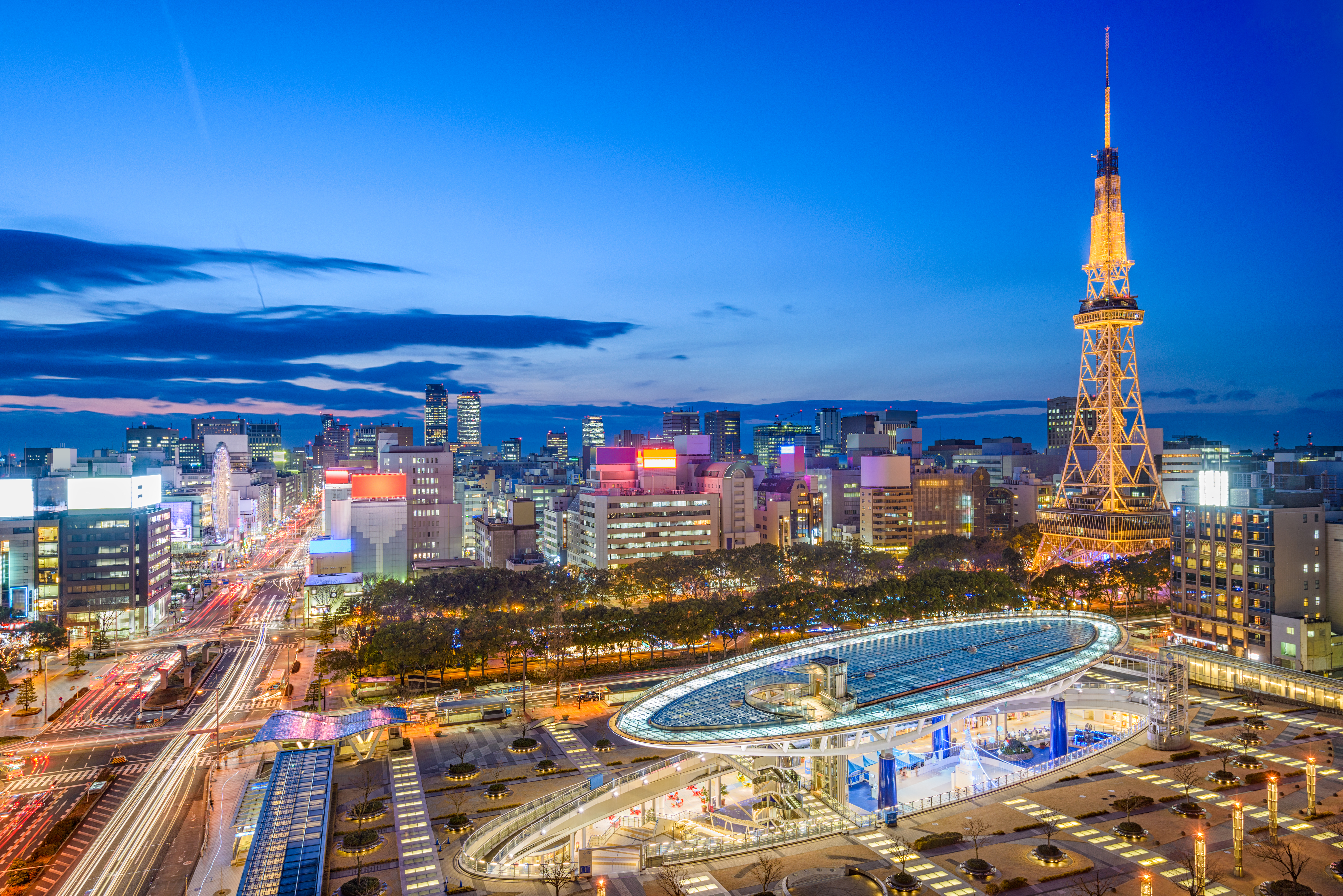
名古屋为爱知县首府,是仅次于东京、大阪和横滨的第四大城市。位于本州中南部浓尾平原,濒临伊势湾,为中部日本的政治、工业、经济、文化和交通中心。早在12世纪就见于史书记载,古称那古野、那古屋、名 护屋,1889年设市。二次世界大战期间,城区大部分被炸毁,战后按原来式样重建,形成一个半径达40公里的“大名古屋”。
名古屋面积为376平方公里,人口215万。是一个充满了活力的城市,它有众多的娱乐中心、购物中心、博物馆,也是著名的会展中心。
全市划分为14个行政区。中区、热田区及其毗邻地带是市中心,有宽100米的大街贯穿其间。市中心的名古屋城建于庆长15年(公元1610年),1959年重建,为名古屋市象征。其他古迹有:热 田刘宫、大须观音寺(即真福寺)。(Quelle: http://trip.sotrip.com/tour/newsotrip/sotrip_dest/destination_home/japan/riben/mingguwu/index.html )
名古屋市(日语:名古屋市/なごやし Nagoya shi */?)是位于日本爱知县西部(尾张地方)的都市,为爱知县首府,同时是中部地方与东海地方的中枢都市、以及爱知县唯一的政令指定都市,人口约230万,在日本各都市中排名第四,仅次于东京、横滨及大阪,也是日本三大都市圈之一中京圈的核心城市。由于位于东京与京都之间,因此又被称为“中京”[1]。全市划分为16个区。
名古屋是东海地方在政治、经济、文化、交通等领域的中枢,市中心的名驿(名古屋站商圈)、荣、锦三、大须、金山是全市主要的商业区,其中前两地拥有大规模的地下街廓。2008年,名古屋市和神户市一起被联合国教科文组织认可为“创意都市”[2]。2017年,名古屋的城区人口约有1,007万人,在世界排名第37位[3]。此外,在美国智库AT Kearney颁布的全球城市排名中,名古屋市被评为世界第69位的都市[4]。
名古屋的市徽由圆形中置一“八”字而成,取自江户时代在此当家的尾张德川家的印记“丸八印”[5]。
Nagoya ist mit 2,1 Mio Einwohnern nach Tokio, Yokohama und Osaka viertgrößtes japanisches Industriezentrum und sportlich hauptsächlich durch den Baseballverein Chūnichi Dragons und den Fußballverein Nagoya Grampus Eight bekannt. In der Agglomeration von Nagoya befindet sich der Hauptsitz des Automobilkonzerns Toyota.
Die Stadt war schon im Mittelalter als Handelszentrum und Hauptort der Provinz Owari bekannt. Oda Nobunaga wurde 1534 in der Burg Nagono, Vorgängerin der Burg Nagoya, geboren. 1555 zog er in die Burg von Kiyosu um und verlagerte damit das Machtzentrum in Zentraljapan nach Kiyosu. 1610 wurde die Burg von Nagoya von Tokugawa Ieyasu wieder aufgebaut. Anschließend wurde Nagoya wieder zum eindeutigen Zentrum Owaris. Nachdem die Familie Tokugawa ihre Macht als Shōgun gesichert hatte, gab der erste Shōgun Tokugawa Ieyasu die Stadt Nagoya an seinen Sohn weiter. Von den historischen Bauten überstanden nur wenige den Krieg. Die meisten wurden im Zweiten Weltkrieg am 14./17. Mai 1945 völlig zerstört. Die Burg wurde 1959 wieder aufgebaut. Der Kulturschatz der Tokugawa-Familie wird heute im Tokugawa-Museum ausgestellt.(Quelle: http://www.mexpedia-japan.de/Staedte.php)
Nagoya (jap. 名古屋市, -shi) ist eine Großstadt, Hafenstadt und Verwaltungssitz der japanischen Präfektur Aichi auf Honshū am Pazifik (Japan).
Nagoya ist mit 2,3 Mio. Einwohnern nach Tokio, Yokohama und Osaka viertgrößtes japanisches Industriezentrum und sportlich hauptsächlich durch den Baseballverein Chūnichi Dragons und den Fußballverein Nagoya Grampus Eight bekannt.
東京特別区部を除くと横浜市・大阪市に次ぐ全国第3位の人口を有する市[3]。中部地方における行政・経済・文化の中枢で、東日本と西日本を結ぶ交通の要所となっている。
古くは三種の神器のひとつである草薙剣(くさなぎのつるぎ)を祀る[4]熱田神宮がある鳥居前町であり、江戸時代は尾張徳川家の治める城下町として繁栄した歴史を持つ。また、タイ王国から寄贈された真舎利(釈迦の遺骨・お骨)を安置するために創建された日本唯一の寺[5]である覚王山日泰寺がある。
名古屋市を中心として中京圏を形成し、愛知県内や岐阜県南部、三重県北部に多くの衛星都市を持ち、日本の三大都市圏の1つに数えられる。2019年の都市的地域の人口は約1,024万人と推計される[6]。中京圏の域内総生産は約3,637億ドルであり、これは国内で3番目、世界で第22番目の規模である[7]。
アメリカ合衆国のシンクタンクが2019年に発表した総合的な世界都市ランキングにおいて、世界70位の都市であると評価された[8]。ユネスコの創造都市に認定されている[9]。市章は、尾張徳川家の合印に由来する「㊇」である[10]。
Nagoya (名古屋市, Nagoya-shi) is the largest city in the Chūbu region of Japan. It is Japan's fourth-largest incorporated city and the third most populous urban area. Located on the Pacific coast on central Honshu, it is the capital of Aichi Prefecture and is one of Japan's major ports along with those of Tokyo, Osaka, Kobe, Yokohama, and Chiba. It is also the center of Japan's third-largest metropolitan region, known as the Chūkyō metropolitan area. As of 1 October 2019, 2,327,557 people lived in the city, part of Chūkyō metropolitan Area's 10.11 million people,[4] making it one of the 50 largest urban areas in the world.
In 1610, the warlord Tokugawa Ieyasu, a retainer of Oda Nobunaga, moved the capital of Owari Province from Kiyosu to Nagoya. This period saw the renovation of Nagoya Castle. Nagoya was proclaimed a city in 1889, during the Meiji Restoration; it became a major industrial hub for Japan. The traditional manufactures of timepieces, bicycles, and sewing machines were followed by the production of special steels, chemicals, oil, and petrochemicals, as the area’s automobile, aviation, and shipbuilding industries flourished.[5] Nagoya was impacted by bombing from US air raids during World War II.
After the war, Nagoya developed into a major port and transport center. The Shinkansen high-speed line connecting Tokyo and Osaka converges on Nagoya. Nagoya is served by two airports: Chubu Centrair International Airport in nearby Tokoname, and Nagoya Airfield, home to Mitsubishi Aircraft Corporation. Nagoya remains an important center for the automotive, aviation, and ceramic industries, hosting the headquarters of Brother Industries, Ibanez, Lexus, and Toyota Tsusho, among others.
Nagoya is home to Nagoya University, the Nagoya Institute of Technology, and Nagoya City University. It is also the location of numerous cultural institutions, including the Tokugawa Art Museum, Atsuta Shrine, Higashiyama Zoo and Botanical Gardens, Aichi Arts Center, and Misono-za. Nagoya TV Tower is the oldest TV tower in Japan.
Nagoya (名古屋市, Nagoya-shi?) est la troisième ville du Japon par sa superficie et la quatrième par la population, derrière Tokyo, Yokohama et Osaka. Située sur la côte Pacifique, au bord de la baie d'Ise dans la région du Chūbu, au centre de Honshū, c'est la capitale de la préfecture d'Aichi. Le pachinko, né à Nagoya, y a son musée.
L'agglomération de Nagoya, qui compte environ neuf millions d'habitants, est la troisième du pays.
Nagoya è una città della regione di Chūbu nell'isola di Honshū in Giappone, con un porto sull'oceano Pacifico. È il capoluogo della prefettura di Aichi, la quarta maggiore città del Giappone e la terza città sul piano economico. Dispone di due aeroporti, tra cui il nuovo Aeroporto Internazionale di Chūbu-Centrair, aperto il 17 febbraio 2005.
Nagoya (名古屋市 Nagoya-shi?) es la cuarta ciudad más grande de Japón. Localizada en la costa del Pacífico en la región de Chūbu, en el centro de la isla de Honshū, es la capital de la prefectura de Aichi.
Наго́я (яп. 名古屋市 Нагоя-си, букв. «именной (фамильный) старый дом»[1]) — город, определённый указом правительства, четвёртый по количеству населения город в Японии. Один из крупнейших портов Японии и административный центр префектуры Айти. Ядро экономического района Токай
 Automobile
 *Engine
Automobile
***Technology
Automobile
*Commercial vehicles
Automobile
Lexus
Automobile
Automobile
Daihatsu
Automobile
Hino
Automobile
ISUZU
Automobile
Subaru
Automobile
GAC
Automobile
*Self-driving car
Automobile
*Hydrogen propulsion
Chūbu
*Engine
Automobile
***Technology
Automobile
*Commercial vehicles
Automobile
Lexus
Automobile
Automobile
Daihatsu
Automobile
Hino
Automobile
ISUZU
Automobile
Subaru
Automobile
GAC
Automobile
*Self-driving car
Automobile
*Hydrogen propulsion
Chūbu
 Energy resource
*****Energy storage
Manufacturing and Innovation
Japan
Partner of the Paris 2024 organizing committee
Energy resource
Energy resource
*****Energy storage
Manufacturing and Innovation
Japan
Partner of the Paris 2024 organizing committee
 Companies
*Big automaker
Companies
*Big automaker
 Science and technology
Global Innovators
Science and technology
Global Innovators

Die Toyota Motor Corporation (japanisch トヨタ自動車株式会社, Toyota Jidōsha Kabushiki-gaisha) ist ein multinationales Unternehmen und einer der größten Automobilhersteller der Welt.
丰田汽车公司(日语:トヨタ自動車株式会社/トヨタじどうしゃ Toyota Jidōsha */?,英语:Toyota Motor Corporation),简称丰田(トヨタ,TOYOTA)是日本的跨国汽车公司,丰田亦是雷克萨斯(LEXUS)、大发(Daihatsu)及日野(HINO)品牌的母公司,并以20%股份成为斯巴鲁的最大股东,拥有马自达5.1%的股份。2020年起,丰田成为全球最大的汽车制造商。
Automobile
§YAMAHA
Chūbu

 IT-Times
Japan
IT-Times
Japan
 Music
Music
 Musical instrument
Companies
Companies
*Centuries-old companies in the world
Science and technology
Global Innovators
Musical instrument
Musical instrument
Companies
Companies
*Centuries-old companies in the world
Science and technology
Global Innovators

Chūbu
Chūgoku
Hokkaidō
Japan
Kantō
Kinki
Kyūshū
Shikoku
Shinkansen
500
Shinkansen
700
Shinkansen
700T
Shinkansen
800
Shinkansen
CRH2
Shinkansen
E2
Shinkansen
E3
Shinkansen
E4
Shinkansen
E5
Shinkansen
E6
Shinkansen
E7
Shinkansen
N700
High speed train technology
Rad-Schiene-System
High speed train technology
Distributed Drive
Tōhoku
 Transport and traffic
High speed traffic
Transport and traffic
High speed train technology
Transport and traffic
High speed traffic
Transport and traffic
High speed train technology
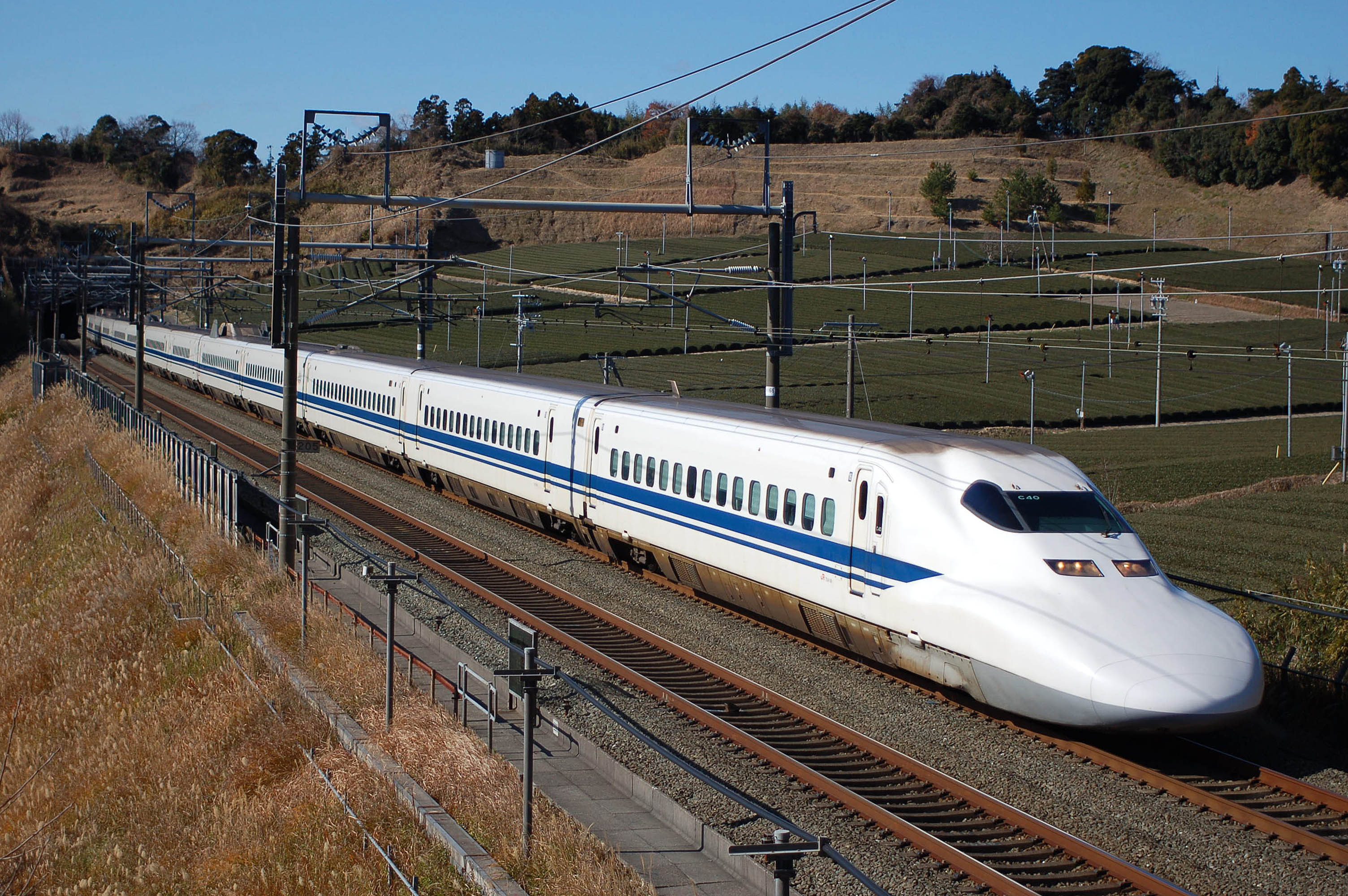
新干线(日语:新幹線/しんかんせん Shinkansen */?)是日本的高速铁路系统,也是全世界第一个投入商业营运的采用标准轨(1435mm)的纯客运高速铁路系统。第一条路线是连结东京与大阪之间的东海道新干线,于东京奥运开幕前的1964年10月1日通车营运。经过多年扩展,目前有10条路线,其中包含2条路线较短的“迷你新干线”,将日本大多数的重要都市连结起来。最初由日本国有铁道研发与营运,国铁分割民营化后由JR集团接续,目前由JR北海道、JR东日本、JR东海、JR西日本、JR九州等5家JR公司提供服务。
新干线是以同时适合快速及大量运输而设计,因而其建造与营运技术均有别于传统铁路,例如全面采用动力分散式列车、轨道全面采用立体交叉[1]、首创列车自动控制系统[2]等。最短可以3分钟的班距运行。除了迷你新干线之外,列车运行最高车速依路线可达到每小时240至320公里,但在进行速度测试时,曾创下每小时443公里的最高纪录(由“300X”实验列车在1996年所创下)。身为日本铁路技术居于世界顶尖的重要象征,新干线的技术也向海外输出,如台湾高铁及施工中的印度高速铁路;做为系统基础而采用新干线系统部分技术的有英国、中国大陆、美国德州等地的高速铁路。
Shinkansen (jap. 新幹線, [ɕĩŋkaãsẽɴ], dt. „neue Stammstrecke“) ist sowohl der Name des Streckennetzes japanischer Hochgeschwindigkeitszüge der verschiedenen JR-Gesellschaften als auch der Züge selbst.
Im ursprünglichen Sinn ist Shinkansen der Name des ab 1964 eingeführten regelspurigen Schnellfahrstreckennetzes und nicht der Züge selbst. Er wird gebildet aus den Schriftzeichen shin (新) für „neue“, kan (幹) für „Stamm/Haupt-“, sen (線) für „Strecke, Linie“ und bezeichnet damit die Rückgratfunktion für das übrige Eisenbahnnetz, über das die japanischen Großstädte mit einer Höchstgeschwindigkeit von bis zu 320 km/h verbunden werden. Tatsächlich wird der Begriff aber auch synonym für die Züge verwendet und subsumiert dabei unterschiedliche Baureihen und die in Japan üblichen Namen für die angebotenen Expresszugverbindungen.
 Animal world
 Geography

 Performing Arts


 Automobile
*Automotive supplier
Automobile
***Technology
Automobile
*Self-driving car
Chūbu
IT-Times
Driver assistance systems
Japan
Science and technology
Global Innovators
Automobile
*Automotive supplier
Automobile
***Technology
Automobile
*Self-driving car
Chūbu
IT-Times
Driver assistance systems
Japan
Science and technology
Global Innovators

 Sport
Chūbu
FIFA Fussball-Weltmeisterschaft 2002
Hokkaidō
Japan
Kantō
Kinki
Kyūshū
Republic of Korea
Tōhoku
Sport
Chūbu
FIFA Fussball-Weltmeisterschaft 2002
Hokkaidō
Japan
Kantō
Kinki
Kyūshū
Republic of Korea
Tōhoku
 Exhibition
 Architecture
 Chūbu
Energy resource
Energy resource
*Electrical power
Energy resource
Nuclear power plants
Japan
Chūbu
Energy resource
Energy resource
*Electrical power
Energy resource
Nuclear power plants
Japan
 Economy and trade