
Deutsch-Chinesische Enzyklopädie, 德汉百科

EEPROM,或写作E2PROM,全称电可擦除可编程只读存储器 (英语:Electrically-Erasable Programmable Read-Only Memory),是一种可以通过电子方式多次复写的半导体存储设备。相比EPROM,EEPROM不需要用紫外线照射,也不需取下,就可以用特定的电压,来抹除芯片上的信息,以便写入新的数据。
EEPROM有四种工作模式:读取模式、写入模式、擦除模式、校验模式。读取时,芯片只需要Vcc低电压(一般+5V)供电。编程写入时, 芯片通过Vpp(一般+25V, 较新者可能使用 12V 或 5V)获得编程电压,并通过PGM编程脉冲(一般50ms)写入数据。擦除时,只需使用Vpp高电压,不需要紫外线,便可以擦除指定地址的内容。为保证写 入正确,在每写入一块数据后,都需要进行类似于读取的校验步骤,若错误就重新写入。现今的 EEPROM 通常已不再需要使用额外的 Vpp 电压,且写入时间也已有缩短。
由于EEPROM的优秀性能,以及在线上操作的便利,它被广泛用于需要经常擦除的BIOS芯片以及闪存芯片,并逐步替代部分有断电保留需要的RAM芯片,甚至取代部分的硬盘功能(见固态硬盘)。它与高速RAM成为当前(21世纪00年代)最常用且发展最快的两种存储技术。
Ein EEPROM (engl. Abk. für electrically erasable programmable read-only memory, wörtlich: elektrisch löschbarer programmierbarer Nur-Lese-Speicher, auch E2PROM) ist ein nichtflüchtiger, elektronischer Speicherbaustein, dessen gespeicherte Information elektrisch gelöscht werden kann. Er ist verwandt mit anderen löschbaren Speichern, wie dem durch UV-Licht löschbaren EPROMs und dem ebenfalls elektrisch löschbaren Flash-Speicher. Er wird verwendet zur Speicherung kleinerer Datenmengen in elektrischen Geräten, bei denen die Information auch ohne anliegende Versorgungsspannung erhalten bleiben muss oder bei denen einzelne Speicherelemente bzw. Datenworte einfach zu ändern sein müssen. Ein typisches Beispiel ist der Rufnummernspeicher eines Telefons. Zur Speicherung größerer Datenmengen wie z. B. dem BIOS in PC-Systemen sind meist Flash-Speicher ökonomischer.
EEPROM (also E2PROM) stands for Electrically Erasable Programmable Read-Only Memory and is a type of non-volatile memory used in computers, integrated in microcontrollers for smart cards and remote keyless system, and other electronic devices to store relatively small amounts of data but allowing individual bytes to be erased and reprogrammed.
EEPROMs are organized as arrays of floating-gate transistors. EEPROMs can be programmed and erased in-circuit, by applying special programming signals. Originally, EEPROMs were limited to single byte operations which made them slower, but modern EEPROMs allow multi-byte page operations. It also has a limited life for erasing and reprogramming, now reaching a million operations in modern EEPROMs. In an EEPROM that is frequently reprogrammed while the computer is in use, the life of the EEPROM is an important design consideration.
Flash memory is a type of EEPROM designed for high speed and high density, at the expense of large erase blocks (typically 512 bytes or larger) and limited number of write cycles (often 10,000). There is no clear boundary dividing the two, but the term "EEPROM" is generally used to describe non-volatile memory with small erase blocks (as small as one byte) and a long lifetime (typically 1,000,000 cycles). Many microcontrollers include both: flash memory for the firmware, and a small EEPROM for parameters and history.
La mémoire EEPROM (Electrically-Erasable Programmable Read-Only Memory ou mémoire morte effaçable électriquement et programmable) (aussi appelée E2PROM ou E²PROM) est un type de mémoire morte. Une mémoire morte est une mémoire utilisée pour enregistrer des informations qui ne doivent pas être perdues lorsque l'appareil qui les contient n'est plus alimenté en électricité.
EEPROM (anche scritto E2PROM), acronimo di Electrically Erasable Programmable Read-Only Memory, è un tipo di memoria non volatile, usata nei computer e altri dispositivi elettronici per memorizzare piccole quantità di dati che devono essere mantenuti quando viene tolta l'alimentazione elettrica (per esempio la configurazione del dispositivo). Le operazioni di scrittura, cancellazione e riscrittura hanno luogo elettricamente.
Ciascuna cella di memoria capace di memorizzare un singolo bit è costituita da due transistori MOS, uno "di memoria" e uno "di accesso".
EEPROM o E²PROM son las siglas de Electrically Erasable Programmable Read-Only Memory (ROM programable y borrable eléctricamente). Es un tipo de memoria ROM que puede ser programada, borrada y reprogramada eléctricamente, a diferencia de la EPROM que ha de borrarse mediante un aparato que emite rayos ultravioleta. Son memorias no volátiles.
Las celdas de memoria de una EEPROM están constituidas por un transistor MOS, que tiene una compuerta flotante (estructura SAMOS), su estado normal está cortado y la salida proporciona un 1 lógico.
Aunque una EEPROM puede ser leída un número ilimitado de veces, sólo puede ser borrada y reprogramada entre 100.000 y un millón de veces.
Estos dispositivos suelen comunicarse mediante protocolos como I²C, SPI y Microwire. En otras ocasiones, se integra dentro de chips como microcontroladores y DSPs para lograr una mayor rapidez.
La memoria flash es una forma avanzada de EEPROM creada por el Dr. Fujio Masuoka mientras trabajaba para Toshiba en 1984 y fue presentada en la Reunión de Aparatos Electrónicos de el IEEE de 1984. Intel vio el potencial de la invención y en 1988 lanzó el primer chip comercial de tipo NOR.

Ein EPROM (engl. Abk. für erasable programmable read-only memory, wörtlich: löschbarer programmierbarer Nur-Lese-Speicher) ist ein nichtflüchtiger elektronischer Speicherbaustein, der bis etwa in die Mitte der 1990er-Jahre vor allem in der Computertechnik eingesetzt wurde, inzwischen aber weitgehend durch EEPROMs abgelöst ist.
Dieser Bausteintyp ist mit Hilfe spezieller Programmiergeräte (genannt „EPROM-Brenner“) programmierbar. Er lässt sich mittels UV-Licht löschen und danach neu programmieren. Nach etwa 100 bis 200 Löschvorgängen hat das EPROM das Ende seiner Lebensdauer erreicht. Das zur Löschung nötige Quarzglas-Fenster (normales Glas ist nicht UV-durchlässig) macht das Gehäuse relativ teuer. Daher gibt es auch Bauformen ohne Fenster, die nominal nur einmal beschreibbar sind (One Time Programmable, OTP), sich durch Röntgenstrahlung aber ebenfalls löschen lassen.
Das EPROM wurde 1970 bei Intel von Dov Frohman entwickelt.
可擦除可编程只读存储器(英语:Erasable Programmable Read Only Memory),由以色列工程师Dov Frohman发明,是一种断电后仍能保留数据的计算机存储芯片——即非易失性的(非易失性)。它是一组浮栅晶体管,被一个提供比电子电路中常用电压更高电压的电子器件分别编程。一旦编程完成后,EPROM只能用强紫外线照射来擦除。通过封装顶部能看见硅片的透明窗口,很容易识别EPROM,这个窗口同时用来进行紫外线擦除。
一片编程后的EPROM,可以保持其数据大约10~20年,并能无限次读取。擦除窗口必须保持覆盖,以防偶然被阳光擦除。老式计算机的BIOS芯片,一般是EPROM,擦除窗口往往被印有BIOS发行商名称、版本和版权声明的标签所覆盖。
一些在闪存出现前生产的微控制器,具有使用EPROM来存储程序的版本,以利于程序开发;因为,如使用一次性可编程器件,在调试时将造成严重浪费。
An EPROM (rarely EROM), or erasable programmable read-only memory, is a type of memory chip that retains its data when its power supply is switched off. Computer memory that can retrieve stored data after a power supply has been turned off and back on is called non-volatile. It is an array of floating-gate transistors individually programmed by an electronic device that supplies higher voltages than those normally used in digital circuits. Once programmed, an EPROM can be erased by exposing it to strong ultraviolet light source (such as from a mercury-vapor light). EPROMs are easily recognizable by the transparent fused quartz window in the top of the package, through which the silicon chip is visible, and which permits exposure to ultraviolet light during erasing.
La mémoire EPROM (Erasable Programmable Read-Only Memory) est un type de mémoire morte reprogrammable. La mémoire EPROM peut être lue par l'électronique de l'équipement sur lequel elle est utilisée. Par contre, elle ne peut pas être facilement ré-écrite. L'écriture est un processus relativement lent qui dépendra du modèle (exemples : 1 minute pour 2 Mbit pour un modèle moderne - M27C160 - mais jusqu'à 3 minutes pour un modèle plus ancien de seulement 32 Kbit - F2732 -) et nécessitant l'application de tensions électriques plus élevées et rarement gérées directement par la carte mémoire. Il est possible d'écrire la totalité de l'EPROM ou indépendamment certaines adresses mémoires mais il faut pour cela retirer l'EPROM de son support et la placer dans un appareil dédié à cet effet.
In elettronica digitale, la EPROM, acronimo di Erasable Programmable Read Only Memory, ovvero memoria di sola lettura programmabile e cancellabile, è una memoria informatica di sola lettura cancellabile tramite raggi ultravioletti. Si tratta di un'evoluzione della PROM che, una volta programmata, non può più essere in generale modificata. La EPROM invece può essere totalmente cancellata, per un numero limitato ma consistente di volte, e riprogrammata a piacimento.
L'invenzione della EPROM, avvenuta nel 1971, è dovuta ad un ingegnere israeliano, Dov Frohman, fuoriuscito dalla Fairchild Semiconductor per unirsi a Moore, Noyce e Grove, fondatori della società Intel, che a loro volta erano usciti dalla Fairchild l'anno prima.
Le memorie EPROM si basano sul transistor ad effetto di campo FAMOS (Floating-gate Avalanche Injection MOS), un tipo di Floating Gate MOSFET a canale p programmabile mediante breakdown a valanga.
EPROM son las siglas de Erasable Programmable Read-Only Memory (ROM programable borrable). Es un tipo de chip de memoria ROM no volátil inventado por el ingeniero Dov Frohman de Intel.1 Está formada por celdas de FAMOS (Floating Gate Avalanche-Injection Metal-Oxide Semiconductor) o "transistores de puerta flotante",2 cada uno de los cuales viene de fábrica sin carga, por lo que son leídos como 1 (por eso, una EPROM sin grabar se lee como FF en todas sus celdas).
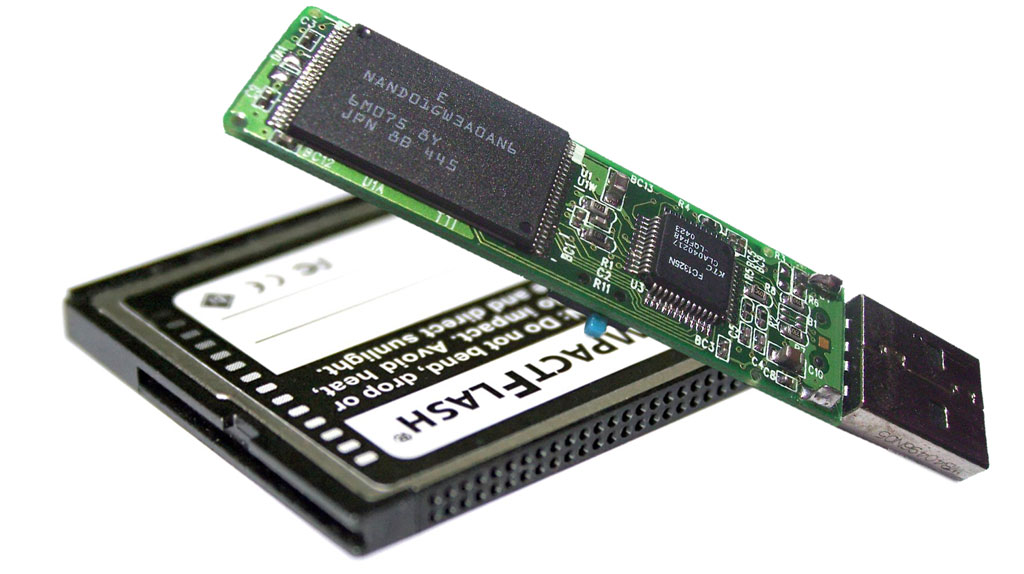
快闪存储器(英语:flash memory),是一种电子式可清除程序化只读存储器的形式,允许在操作中被多次擦或写的存储器。这种科技主要用于一般性数据存储,以及在计算机与其他数字产品间交换传输数据,如储存卡与U盘。闪存是一种特殊的、以宏块抹写的EEPROM。早期的闪存进行一次抹除,就会清除掉整颗芯片上的数据。
Flash-Speicher sind digitale Speicherbausteine; die genaue Bezeichnung lautet Flash-EEPROM. Sie gewährleisten eine nichtflüchtige Speicherung bei gleichzeitig niedrigem Energieverbrauch. Flash-Speicher sind portabel und miniaturisiert, es lassen sich jedoch bei Flash-EEPROM, im Gegensatz zu gewöhnlichem EEPROM-Speicher, Bytes, die kleinsten adressierbaren Speichereinheiten, nicht einzeln löschen oder überschreiben. Flash-Speicher sind auch langsamer als Festwertspeicher (ROM).
Flash memory is an electronic (solid-state) non-volatile computer storage medium that can be electrically erased and reprogrammed.
Toshiba developed flash memory from EEPROM (electrically erasable programmable read-only memory) in the early 1980s and introduced it to the market in 1984.[citation needed] The two main types of flash memory are named after the NAND and NOR logic gates. The individual flash memory cells exhibit internal characteristics similar to those of the corresponding gates.
While EPROMs had to be completely erased before being rewritten, NAND-type flash memory may be written and read in blocks (or pages) which are generally much smaller than the entire device. NOR-type flash allows a single machine word (byte) to be written – to an erased location – or read independently.
The NAND type operates primarily in memory cards, USB flash drives, solid-state drives (those produced in 2009 or later), and similar products, for general storage and transfer of data. NAND or NOR flash memory is also often used to store configuration data in numerous digital products, a task previously made possible by EEPROM or battery-powered static RAM. One key disadvantage of flash memory is that it can only endure a relatively small number of write cycles in a specific block.[1]
Example applications of both types of flash memory include personal computers, PDAs, digital audio players, digital cameras, mobile phones, synthesizers, video games, scientific instrumentation, industrial robotics, and medical electronics. In addition to being non-volatile, flash memory offers fast read access times, although not as fast as static RAM or ROM.[2] Its mechanical shock resistance helps explain its popularity over hard disks in portable devices, as does its high durability, ability to withstand high pressure, temperature and immersion in water, etc.[3]
Although flash memory is technically a type of EEPROM, the term "EEPROM" is generally used to refer specifically to non-flash EEPROM which is erasable in small blocks, typically bytes.[citation needed] Because erase cycles are slow, the large block sizes used in flash memory erasing give it a significant speed advantage over non-flash EEPROM when writing large amounts of data. As of 2013, flash memory costs much less than byte-programmable EEPROM and had become the dominant memory type wherever a system required a significant amount of non-volatile solid-state storage.
La mémoire flash est une mémoire de masse à semi-conducteurs ré-inscriptible, c'est-à-dire une mémoire possédant les caractéristiques d'une mémoire vive mais dont les données ne disparaissent pas lors d'une mise hors tension. Ainsi, la mémoire flash stocke les bits de données dans des cellules de mémoire, mais les données sont conservées en mémoire lorsque l'alimentation électrique est coupée.
Sa vitesse élevée, sa durée de vie et sa faible consommation (qui est même nulle au repos) la rendent très utile pour de nombreuses applications : appareils photo numériques, téléphones cellulaires, imprimantes, assistants personnels (PDA), ordinateurs portables ou dispositifs de lecture et d'enregistrement sonore comme les baladeurs numériques, clés USB. De plus, ce type de mémoire ne possède pas d'éléments mécaniques, ce qui lui confère une grande résistance aux chocs.
La memoria flash, anche chiamata flash memory, è una tipologia di memoria a stato solido, di tipo non volatile, che per le sue prestazioni può anche essere usata come memoria a lettura-scrittura. Quando viene utilizzata come ROM viene anche chiamata flash ROM.
In una memoria flash le informazioni vengono registrate in un vettore di floating gate MOSFET, una tipologia di transistor ad effetto di campo in grado di mantenere carica elettrica per un tempo lungo. Ogni transistor costituisce una "cella di memoria" che conserva il valore di un bit. Le nuove flash utilizzano delle celle multilivello che permettono di registrare il valore di più bit attraverso un solo transistor.
Diversamente dalle tecnologie precedenti, la tecnologia Flash ha reso possibile il salvataggio o la cancellazione di dati in un unico passo, introducendo quindi un incredibile guadagno in velocità, e grazie alla non-volatilità è usata frequentemente nelle fotocamere digitali, nei lettori di musica portatili, nei cellulari, nelle pendrive (chiavette), nei palmari, nei moderni computer portatili e in molti altri dispositivi che richiedono un'elevata portabilità e una buona capacità di memoria per il salvataggio dei dati.
Esistono principalmente due tipologie di memorie flash, dette NOR flash e NAND flash, che differiscono per l'architettura ed il procedimento di programmazione. Vi è anche una tipologia ibrida, la AND flash, che sfrutta le caratteristiche di entrambe, NOR e NAND.
La memoria flash derivada de las siglas EEPROM permite la lectura y escritura de múltiples posiciones de memoria en la misma operación. Gracias a ello, la tecnología flash, mediante impulsos eléctricos, permite velocidades de funcionamiento muy superiores frente a la tecnología EEPROM primigenia, que sólo permitía actuar sobre una única celda de memoria en cada operación de programación. Se trata de la tecnología empleada en los dispositivos denominados memoria USB.


 IT-Times
 IC
IT-Times
Verarbeitungseinheiten - CPU, GPU, NPU, APU, TPU, VPU, FPGA, QPU, IPU, PIC

现场可编程逻辑门阵列(英语:Field Programmable Gate Array,缩写为FPGA),它以PAL、GAL、CPLD等可编程逻辑器件为技术基础发展而成。作为特殊应用集成电路中的一种半定制电路,它既弥补全定制电路不足,又克服原有可编程逻辑控制器逻辑门数有限的缺点。
Ein FPGA (Akronym für Field Programmable Gate Array) ist ein integrierter Schaltkreis (IC) der Digitaltechnik, in welchen eine logische Schaltung geladen werden kann. Die Bezeichnung kann übersetzt werden als im Feld (also vor Ort, beim Kunden) programmierbare (Logik-)Gatter-Anordnung.
Anders als bei der Programmierung von Computern, Mikrocontrollern oder Steuerungen bezieht sich hier der Begriff Programmierung nicht nur auf die Vorgabe zeitlicher Abläufe, sondern vor allem auch auf die Definition der gewünschten Schaltungsstruktur. Diese wird mittels einer Hardwarebeschreibungssprache formuliert und von einer Erzeugersoftware in eine Konfigurationsdatei übersetzt, welche vorgibt, wie die physischen Elemente im FPGA verschaltet werden sollen. Man spricht daher auch von der Konfiguration des FPGA. Ohne diese hat der Baustein keine Funktion.
FPGAs stellen eine Weiterentwicklung der PLDs dar und kommen in vielen Gebieten der digitalen Elektronik zum Einsatz.
IT-Times
HPC
IT-Times
Mainframe
IT-Times
Verarbeitungseinheiten - CPU, GPU, NPU, APU, TPU, VPU, FPGA, QPU, IPU, PIC
IT-Times
Internet of Things
IT-Times
Halbleitertechnologie
IT-Times
IC
Japan
 Wissenschaft und Technik
Global Innovators

 California-CA
IT-Times
IC
IT-Times
Halbleitertechnologie
Vereinigte Staaten
Wissenschaft und Technik
Global Innovators


图形处理器(英语:graphics processing unit,缩写:GPU),又称显示核心、视觉处理器、显示芯片或绘图芯片,是一种专门在个人计算机、工作站、游戏机和一些移动设备(如平板电脑、智能手机等)上运行绘图运算工作的微处理器。
图形处理器是英伟达公司(NVIDIA)在1999年8月发表精视 256(GeForce 256)绘图处理芯片时首先提出的概念,在此之前,计算机中处理视频输出的显示芯片,通常很少被视为是一个独立的运算单元。而对手冶天科技(ATi)亦提出视觉处理器(Visual Processing Unit)概念。图形处理器使显卡减少对中央处理器(CPU)的依赖,并分担部分原本是由中央处理器所担当的工作,尤其是在进行三维绘图运算时,功效更加明显。图形处理器所采用的核心技术有硬件座标转换与光源、立体环境材质贴图和顶点混合、纹理压缩和凹凸映射贴图、双重纹理四像素256位渲染引擎等。
图形处理器可单独与专用电路板以及附属组件组成显卡,或单独一片芯片直接内嵌入到主板上,或者内置于主板的北桥芯片中,现在也有内置于CPU上组成SoC的。个人计算机领域中,在2007年,90%以上的新型台式机和笔记本电脑拥有嵌入式绘图芯片,但是在性能上往往低于不少独立显卡。[1]但2009年以后,AMD和英特尔都各自大力发展内置于中央处理器内的高性能集成式图形处理核心,它们的性能在2012年时已经胜于那些低级独立显卡,[2]这使得不少低级的独立显卡逐渐失去市场需求,两大个人计算机图形处理器研发巨头中,AMD以AMD APU产品线取代旗下大部分的低级独立显示核心产品线。[3]而在手持设备领域上,随着一些如平板电脑等设备对图形处理能力的需求越来越高,不少厂商像是高通(Qualcomm)、PowerVR、ARM、NVIDIA等,也在这个领域里纷纷“大展拳脚”。
GPU不同于传统的CPU,如Intel i5或i7处理器,其内核数量较少,专为通用计算而设计。相反,GPU是一种特殊类型的处理器,具有数百或数千个内核,经过优化,可并行运行大量计算。虽然GPU在游戏中以3D渲染而闻名,但它们对运行分析、深度学习和机器学习算法尤其有用。GPU允许某些计算比传统CPU上运行相同的计算速度快10倍至100倍。
Ein Grafikprozessor (englisch graphics processing unit – GPU, seltener engl. visual processing unit – VPU[1]) ist ein auf die Berechnung von Grafiken spezialisierter und optimierter Prozessor für Computer, Spielkonsolen und Smartphones. Zusätzlich gibt er die berechneten Grafiken an ein oder mehrere Displays aus. Früher hatten Grafikkarten gar keine eigenen Rechenfähigkeiten und waren reine Ausgabekarten. Ab Mitte der 1990er Jahre wurden zuerst 2D-Fähigkeiten und später rudimentäre 3D-Fähigkeiten integriert, der Grafikprozessor war festverdrahtet oder seine Programmierbarkeit war beschränkt auf seine Firmware. Seit Mitte der 2000er Jahre kann die CPU „Programme“ auf die Grafikkarte/in die GPU laden, die so in beschränktem Rahmen flexibel programmierbar ist.
Grafikprozessoren findet man auf dem Die von CPUs mit integrierter Grafikeinheit (manchmal APU genannt), auf der Hauptplatine (Onboard, als Integrierter Grafikprozessor) wie auch auf Erweiterungskarten (Steckkarte). Im letzteren Fall sind mehrere GPUs auf einer Grafikkarte, bzw. auch mehrere Grafikkarten pro PC möglich. Für Notebooks gibt es externe Erweiterungsboxen, in die eine Grafikkarte gesteckt werden kann; in Dockingstationen kann eine eigene Grafikeinheit verbaut sein. Fast alle heute produzierten Grafikprozessoren für Personal Computer stammen von AMD, Intel oder Nvidia. Die Integration auf Steckkarten liegt dagegen bis auf Sonder- und Referenzmodelle seit einiger Zeit bei anderen Herstellern.
Un processeur graphique, ou GPU (de l'anglais Graphics Processing Unit), est un circuit intégré la plupart du temps présent sur une carte graphique (mais pouvant aussi être intégrée sur une carte-mère ou dans un CPU) et assurant les fonctions de calcul de l'affichage. Un processeur graphique a généralement une structure hautement parallèle (voir accélération matérielle) qui le rend efficace pour une large palette de tâches graphiques comme le rendu 3D, en Direct3D, en OpenGL, la gestion de la mémoire vidéo, le traitement du signal vidéo, la décompression Mpeg, etc.
Leur parallélisme massif les rend aussi intéressants comme processeurs de calcul matriciel, ou pour des cassages de code en force brute1 d'archives chiffrées. Enfin, leur rapport performance/prix les avantage pour le calcul2.
Peu d’entreprises conçoivent de tels processeurs : les plus connues sont NVIDIA, AMD (anciennement ATI) et Intel. Il y a aussi d'autres fabricants désormais moins importants ou moins connus du grand public, comme que Qualcomm, S3 Graphics, Matrox, 3DLabs (en), et XGI (en). Ces entreprises sont dites « Fabless », c'est-à-dire qu'elles conçoivent les circuits graphiques, mais ne les fabriquent pas en série. D'autres entreprises (Asus, MSI, PNY…) se chargent ensuite de proposer des cartes graphiques intégrant ces processeurs. Ce sont les entreprises constructrices. Celles-ci prennent en général une certaine liberté de modification des fréquences de fonctionnement des GPU par rapport aux fréquences de base préconisées par les concepteurs. C'est le principe de l'overclocking. Bien entendu, ces modifications nécessitent un choix rigoureux dans le système de refroidissement, car bien souvent, les fréquences en hausse provoquent également en contrepartie une hausse de température, à l'image des CPU. Ces fréquences varient entre les constructeurs et selon les modèles et les systèmes de refroidissement proposés par ces entreprises. L'écart de performance entre les modèles de référence (fournis par les concepteurs) et les constructeurs varie et certains GPU personnalisés peuvent même présenter un gain non négligeable par rapport au GPU de référence.
L'unità di elaborazione grafica (più nota come GPU, dalla lingua inglese graphics processing unit) o unità di elaborazione visiva (VPU, in inglese visual processing unit) o processore grafico o processore visivo è una tipologia particolare di coprocessore che si contraddistingue per essere specializzata nel rendering di immagini grafiche. Il suo tipico utilizzo è come coprocessore della CPU e da alcuni anni viene anche utilizzata in generiche elaborazioni dati (GPGPU).
La GPU è tipicamente implementata come microprocessore monolitico e, da alcuni anni, viene anche implementata assieme alla CPU nel medesimo circuito integrato.[1] Da alcuni anni vengono anche prodotti processori multicore formati da più core di GPU.
processori multicore | informatica | microprocessore monolitico rendering | coprocessore | elaborazioni dati | CPU grafiche.
Unidad de procesamiento gráfico o GPU (Graphics Processing Unit) es un coprocesador dedicado al procesamiento de gráficos u operaciones de coma flotante, para aligerar la carga de trabajo del procesador central en aplicaciones como los videojuegos o aplicaciones 3D interactivas. De esta forma, mientras gran parte de lo relacionado con los gráficos se procesa en la GPU, la unidad central de procesamiento (CPU) puede dedicarse a otro tipo de cálculos (como la inteligencia artificial o los cálculos mecánicos en el caso de los videojuegos).
La GPU implementa ciertas operaciones gráficas llamadas primitivas optimizadas para el procesamiento gráfico. Una de las primitivas más comunes para el procesamiento gráfico en 3D es el antialiasing, que suaviza los bordes de las figuras para darles un aspecto más realista. Adicionalmente existen primitivas para dibujar rectángulos, triángulos, círculos y arcos. Las GPU actualmente disponen de gran cantidad de primitivas, buscando mayor realismo en los efectos.
Las GPU están presentes en las tarjetas gráficas.
 Guangdong Sheng-GD
IT-Times
IC
IT-Times
Mobile Networks
IT-Times
Verarbeitungseinheiten - CPU, GPU, NPU, APU, TPU, VPU, FPGA, QPU, IPU, PIC
 IT-Times
Mainframe
IT-Times
PLC/DCS/FCS/SCADA/MES
IT-Times
Präzisionsinstrument/Medizinische Ausrüstung/Forschungsausrüstung
IT-Times
Präzisionsinstrument/Medizinische Ausrüstung/Forschungsausrüstung
IT-Times
Internet of Things
IT-Times
Halbleitertechnologie
IT-Times
IC
Japan
Kantō
 Transport und Verkehr
Hochgeschwindigkeitsverkehr
Transport und Verkehr
Technologie des Hochgeschwindigkeitszugs
 Unternehmen
*Größte Hersteller von Hochgeschwindigkeitszügen
Unternehmen
*Jahrhundertealte Unternehmen der Welt
Wissenschaft und Technik
Global Innovators

Die K.K. Hitachi Seisakusho (japanisch 株式会社日立製作所, Kabushiki-gaisha Hitachi Seisakusho, englisch Hitachi Ltd. Corporation) ist ein im Nikkei 225 gelisteter weltweit agierender Mischkonzern mit über 360.000 Mitarbeitern. Der Firmensitz ist in der japanischen Hauptstadt Tokio.
日立制作所(日语:日立製作所/ひたちせいさくしょ,罗马化:Hitachi seisakusho,东证1部:6501),简称日立(HITACHI),是源自日本的跨国电机及电子公司,亦为日本规模最大的综合电机制造商,总部位于东京丸之内。
IBM
IT-Times
IC
IT-Times
IT-Times
Verarbeitungseinheiten - CPU, GPU, NPU, APU, TPU, VPU, FPGA, QPU, IPU, PIC
