漢德百科全書 | 汉德百科全书
 Bavaria



The Walhalla is a hall of fame that honors laudable and distinguished people in German history – "politicians, sovereigns, scientists and artists of the German tongue";[1] thus the celebrities honored are drawn from Greater Germany, a wider area than today's Germany, and even as far away as Britain in the case of several Anglo-Saxons who are honored. The hall is a neo-classical building above the Danube River, east of Regensburg in Bavaria.
The Walhalla is named for the Valhalla of Norse Paganism. It was conceived in 1807 by Crown Prince Ludwig in order to support the gathering momentum for the unification of the many German states. Following his accession to the throne of Bavaria, construction took place between 1830 and 1842 under the supervision of the architect Leo von Klenze. The memorial displays some 65 plaques and 130 busts covering 2,000 years of history, beginning with Arminius, victor at the Battle of the Teutoburg Forest in 9 AD.
Le Walhalla est un temple néo-dorique en marbre situé à Donaustauf au bord du Danube, à 10 km en aval de Ratisbonne, en Bavière, Allemagne.
Ce monument imposant fut édifié dans la vallée du Danube entre le 18 octobre 1830 et le 18 octobre 1842 dans un site imposant, par l'architecte Leo von Klenze pour le compte du roi Louis Ier de Bavière. Ce dernier voulait en faire le mémorial (le Walhalla constitue le séjour des héros dans la mythologie nordique) des hommes et des femmes qui illustrèrent la civilisation allemande.
Le mémorial se visite et on peut y voir à l'intérieur 129 bustes de personnalités allemandes ou d'autres nationalités de langue germanique. Du péristyle on a une vue sur la courbe du Danube, les ruines du château de Donaustauf et les flèches de la cathédrale Saint-Pierre de Ratisbonne.
Il Walhalla è un tempio neoclassico ubicato nei pressi di Ratisbona, su una collina posta lungo le sponde del Danubio.
Il vasto complesso fu voluto dal re Ludovico I di Baviera, che volle incarnare in un'architettura la tradizione nordica del Valhalla, ovvero del luogo in cui si riunivano le anime degli eroi deceduti in guerra.
L'edificio, che doveva servire per ospitare busti e tavole commemorative di personaggi importanti della storia e della cultura della Germania, fu progettato da Leo von Klenze sulla base di un concorso indetto nel 1814. I primi progetti furono rielaborati tra il 1819 ed il 1821, mentre i lavori furono portati a termine tra il 1830 ed il 1842.
Tra le tavole commemorative ed i busti collocati al suo interno si ricordano ad esempio quelli di uomini di stato, come Otto von Bismarck, scienziati, come Albert Einstein e Carl Friedrich Gauss, musicisti, come Johann Sebastian Bach, Wolfgang Amadeus Mozart, Richard Strauss, Ludwig van Beethoven e Richard Wagner, poeti, come Johann Wolfgang von Goethe, artisti, come Hans Holbein, Peter Vischer il Vecchio, nonché di altre personalità, come Martin Lutero, Sophie Scholl, Immanuel Kant, Josef Radetzky ed altri.
Dal punto di vista architettonico, il monumento è costituito da un tempio periptero in stile dorico, ispirato al Partenone e posto su un possente basamento al quale si accede mediante ampie scalinate. La costruzione richiama in maniera straordinaria al monumento ideato da Friedrich Gilly per Federico il Grande, ma von Klenze conferisce all'opera un'impronta più romantica per la presenza al suo interno dei suddetti busti e di un bassorilievo che illustra la storia della Germania.
El Walhalla toma su nombre de la mitología nórdica y es un imponente templo neoclásico cuyo propósito es servir de monumento y salón de la fama para "alemanes laureados y distinguidos" (en realidad, germánicos, porque hay austríacos, suizos, neerlandeses, bohemios, etc.) levantado a orillas del Danubio a 6 kilómetros al este de Ratisbona, en Baviera, Alemania.
Fue concebido por el Rey Luis I de Baviera (el abuelo de Luis II) y construido entre 1830 y 1842 bajo diseños de Leo von Klenze, que también fue responsable del Befreiungshalle, también cerca de Ratisbona sobre el Danubio. El Walhalla debe su nombre al salón de los dioses de la mitología germánica (y nórdica) siendo el equivalente al Olimpo griego. Es una copia perfecta del Partenón de Atenas, sostenido por 52 columnas dóricas1 En su interior alberga bustos de 130 personas ilustres cubriendo 2000 años de historia. El más antiguo es Arminio, victorioso en la Batalla del bosque de Teutoburgo en el año 9 D.C.
Вальха́лла (нем. Walhalla) — зал славы выдающихся исторических личностей, принадлежащих к германской культуре, расположенный на левом берегу Дуная в 10 км к востоку от города Регенсбурга (Бавария, Германия). Согласно скандинавской и немецкой мифологиям Вальхалла — место посмертного обитания павших в битве героев, доставляемых туда воинственными девами — Валькириями. Здание в стиле неоклассицизма, представляющее собой копию древнегреческого храма, было построено архитектором Лео фон Кленце, известным в России возведением здания Нового Эрмитажа в Петербурге. Размеры Вальхаллы почти совпадают с размерами Парфенона афинского Акрополя, длина составляет 48,5 м, ширина — 14 м и высота — 15,5 м.[1]


 Christmas Market
 Baden-Wuerttemberg
Bavaria
Baden-Wuerttemberg
Bavaria
 Berlin
 Bremen
 Hamburg
 Hessen
 Mecklenburg-Vorpommern
 Lower Saxony
 North Rhine-Westphalia
 Rhineland-Palatinate
Rhineland-Palatinate
Rhineland-Palatinate
 Saarland
 Saxony
 Saxony-Anhalt
 Schleswig-Holstein
 Thuringia
 Architecture
Architecture
Architecture
 Baroque / Rococo architecture
Bavaria
Baroque / Rococo architecture
Bavaria
 History
L 1000 - 1500 AD
History
History
L 1000 - 1500 AD
 Religion
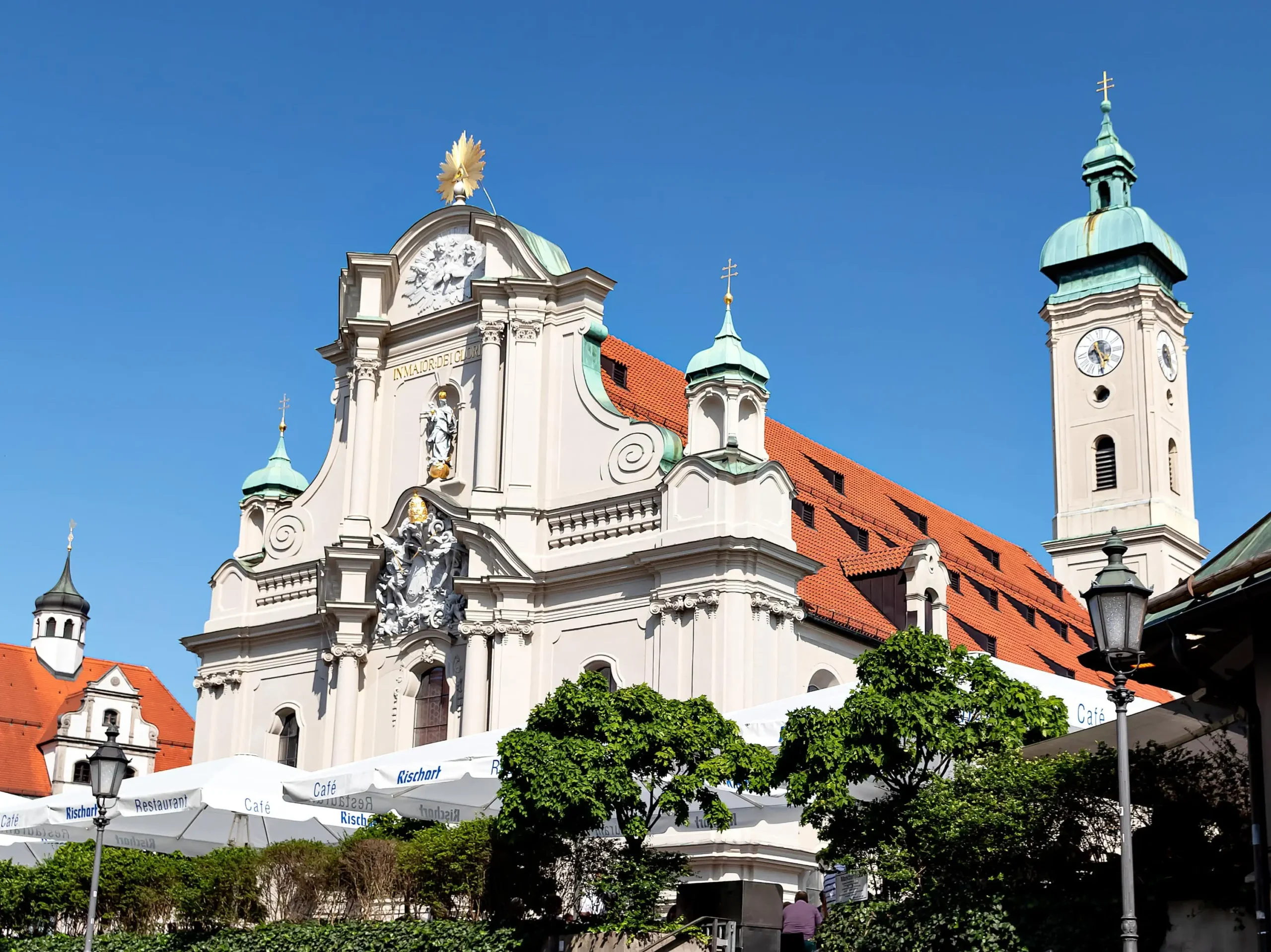
Die Pfarrkirche Heilig Geist ist eine römisch-katholische Kirche am Viktualienmarkt in München und gehört zu den ältesten erhaltenen Kirchengebäuden der Stadt.
Auf dem Grundstück der 1327 im Stadtbrand von München zerstörten ersten Pfarrei zum Heiligen Geist entstand bis 1392 der heutige Nachfolgebau als gotische dreischiffige Hallenkirche. Im 18. Jahrhundert wurde das Kircheninnere und die Ausstattung barockisiert und 1731 wiedereingeweiht. Bei weiteren Umbaumaßnahmen im späten 19. Jahrhundert wurde das Langhaus um drei Joche nach Westen erweitert und die Schaufassade erhielt ihre heutige Gestalt. Im Zweiten Weltkrieg bis auf die Außenmauern zerstört, wurde der Innenraum zunächst vereinfacht wiederhergestellt und die barocke Ausmalung später originalgetreu rekonstruiert.
圣神教堂(Heilig-Geist-Kirche)是一座天主教本堂区圣堂,也是慕尼黑现存最古老的教堂之一。可能1208年由路德维希一世建立圣神救济院,内有罗曼式的圣女加大利纳礼拜堂,紧邻 Thalburgtor,即今天老市政厅钟楼。
1327年的火灾摧毁了凯瑟琳的礼拜堂,随后新建了带有唱经楼的哥特式教堂,在1392年完成。
1724年至1730年,圣灵教堂由Ettenhofer和阿桑兄弟改建为巴洛克式。
巴伐利亚世俗化以后,1806年它从医院分出,以让出地方兴建谷物市场。1944年至45年,其外墙被空袭摧毁,重建始于1946年,仍然没有完成。祭台祝圣于1955年。自1973年以来,阿桑壁画,祭坛和整个内部,都进行修复。

St. Ulrich und Afra ist eine römisch-katholische Stadtpfarrkirche[1] und seit 1937 Päpstliche Basilika in Augsburg. Sie zählt zu den letzten großen spätgotischen Kirchenbauten in Schwaben. Die Kirche erfüllte und erfüllt verschiedene Funktionen: Wallfahrtskirche für die Augsburger Bistumsheiligen Ulrich, Afra und Simpert, Abteikirche für ein Benediktinerkloster, Münster eines bedeutenden Reichsstiftes, Garnisonkirche für das 4. Bayerische Chevaulegers-Regiment, Glaubensdenkmal für das Augsburger Großbürgertum. Der zwiebelförmige Turmhelm wurde zum Vorbild für barocke Kirchen in Bayern. Es handelt sich um ein Denkmal von nationaler Bedeutung,[2][3] in dem im 17. Jahrhundert zweimal die Wahl des römisch-deutschen Königs stattfand.